

-
Alaska Justice Forum ; Vol. 14, No. 1 (Spring 1997)
Bureau of Justice Statistics
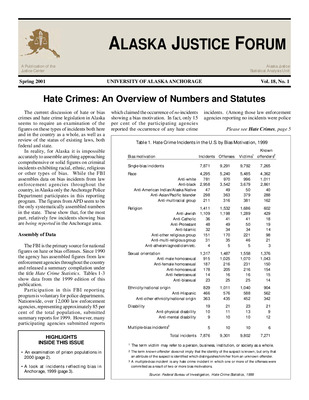
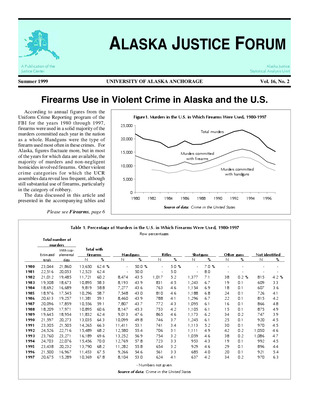
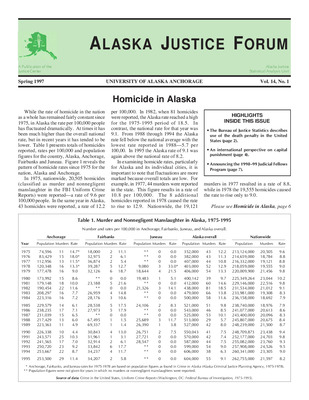
The Spring 1997 issue of the Alaska Justice Forum presents from 1975 to 1995 on murder and nonnegligent manslaughter in Anchorage, Fairbanks, Juneau, and Alaska overall; compares Alaska rates with homicide rates nationwide; discusses weapons used and the relationship between victim and offender in Alaska homicides; and compares the murder rate with the rate of other causes of death in Alaska. The Bureau of Justice Statistics reports that sixteen states executed 56 prisoners during 1995, the largest number of prisoners executed in a year in the U.S. since 1960; and the use of capital punishment by nations worldwide is examined.
-
Alaska Justice Forum ; Vol. 13, No. 4 (Winter 1997)
Claus N/A and N/A Bureau of Justice Statistics
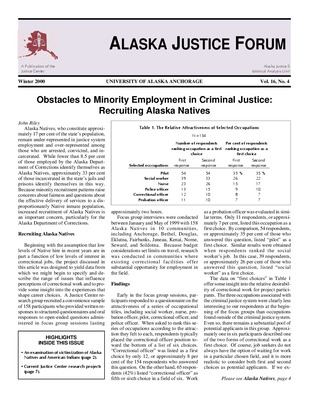
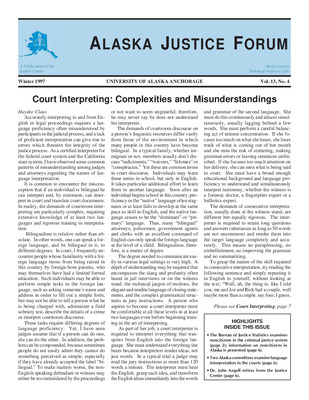
In the Winter 1997 issue of the Alaska Justice Forum, a certified interpreter for the federal and California court systems corrects misunderstandings about the nature of language interpretation in legal proceedings, observing that accurately interpreting to and from English in proceedings requires a language proficiency often misunderstood by participants in the court proceedings, and that lack of proficient interpretation can give rise to errors which threaten the integrity of the justice process. An accompanying sidebar describes the legal interpretation practice in Alaska courts and other Alaska justice agencies. A related article highlights two committees working on the problems presented by language interpretation and court proceedings in state and federal courts in Alaska. The Bureau of Justice Statistics reports on noncitizens in U.S. federal courts and prisons; sidebar stories describe background figures and information on noncitizens in Alaska and efforts of the Immigration and Naturalization Service to identify, apprehend, and deport criminal aliens. Dr. John E. Angell retires from his position as Director of the UAA Justice Center after over twenty years of service at the University of Alaska Anchorage.
-
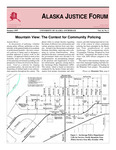
Alaska Justice Forum ; Vol. 14, No. 2 (Summer 1997)
Moras N/A and John Riley
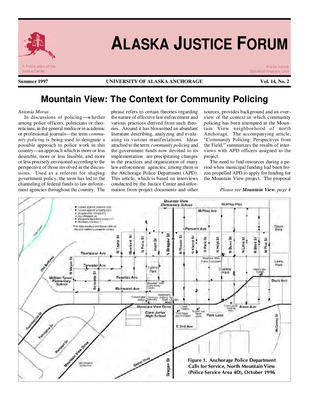
The Summer 1997 issue of the Alaska Justice Forum examines community policing — an approach that relies on officer-initiated efforts to reduce crime and public disorder — and the Anchorage Police Department’s attempt to implement community policing in the Mountain View neighborhood of north Anchorage. Dr. Robert H. Langworthy has accepted the position of Director of the Justice Center at University of Alaska Anchorage.
-
Alaska Justice Forum ; Vol. 14, No. 3 (Fall 1997)
Schafer E. N/A and Richard Curtis
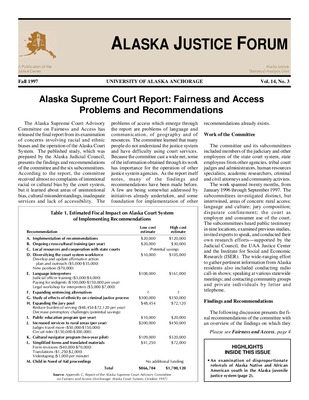
The Fall 1997 issue of the Alaska Justice Forum summarizes major findings of the final report of the Alaska Supreme Court Advisory Committee on Fairness and Access, reporting that the committee received few complaints of intentional racial or cultural bias by the court system, but learned about areas of unintentional bias, cultural misunderstandings, inadequate services, and lack of accessibility. Many of the committee's findings have relevance to justice system agencies beyond the court system. A Justice Center study of 28,618 referrals to the Alaska juvenile justice system found considerable disparity between white and minority youth in the rate at which they were referred, the frequency of their referrals, and the types of offenses which brought them to the attention of juvenile justice personnel.
-
Alaska Justice Forum ; Vol. 13, No. 2 (Summer 1996)
Bureau of Justice Statistics and Lisa Rieger
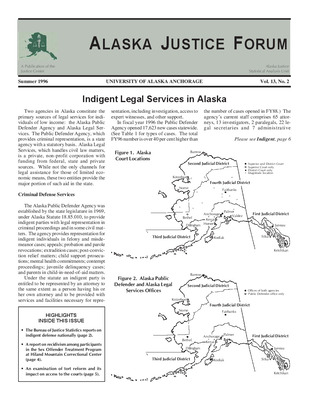
The Summer 1996 issue of the Alaska Justice Forum presents several articles on legal resources, both criminal and civil, available to Alaskans with low incomes, describing services provided by the Alaska Public Defender's office and Alaska Legal Services Corporation; criteria for determining indigency when assigning public counsel in Alaska; a 1996 amendment to Alaska's Public Defender Act; criminal defense services for low income people throughout the United States; and tort reform efforts in Alaska and nationwide which may result in decreased access to the courts for individuals with low incomes. An additional article describes results of a recidivism study of participants in the Sex Offender Treatment Program at Hiland Mountain Correctional Center from January 1987 to August 1995.
-
Alaska Justice Forum ; Vol. 12, No. 4 (Winter 1996)
Bureau of Justice Statistics, N. E. Schafer, and Melissa S. Green
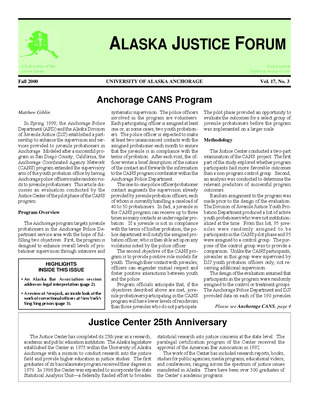
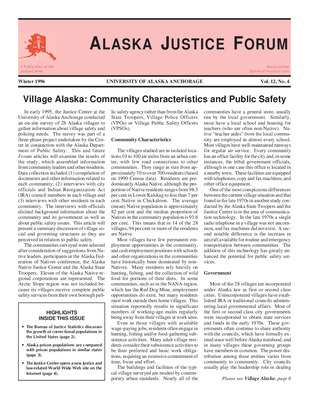
The Winter 1996 issue of the Alaska Justice Forum presents the first of two articles examining results of the village component of a statewide public safety project conducted by the Justice Center for the Alaska Department of Public Safety, in which researchers interviewed residents and officials of 28 Alaska villages on characteristics, government, and social control in predominately Alaska Native villages. The Bureau of Justice Statistics reports on the growing U.S. prison population, which increased 8.8 percent between mid-1994 and mid-1995; a sidebar story compares Alaska with states of similar population in an effort to understand the disparity in its rankings, with racial disparities in Alaska's prison population a possible factor. The Justice Center establishes a website.
-
Alaska Justice Forum ; Vol. 13, No. 3 (Fall 1996)
Erlich N/A, N/A Bureau of Justice Statistics, and Pamela Cravez
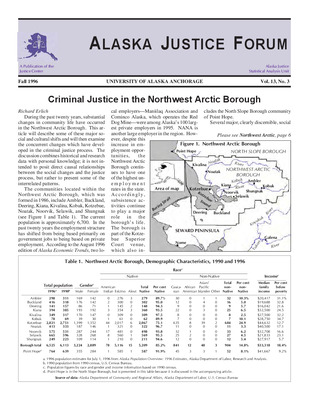
The Fall 1996 issue of the Alaska Justice Forum leads with a discussion of the particularities of justice system issues in the Northwest Arctic Borough based on historical evidence, research and personal observations made from Judge Richard Erlich’s experience as a long-term resident and Superior Court judge in Kotzebue. The Bureau of Justice Statistics reports on criminal victimization in the United States in 1994. The Joint State-Federal Courts Gender Equality Task Force reports on its three-year investigation into gender bias in Alaska state and federal courts, finding that sex-related bias affects not only litigants, witnesses, lawyers, employees, and judges with regard to process, but also with regard to the substantial outcome of cases.
-
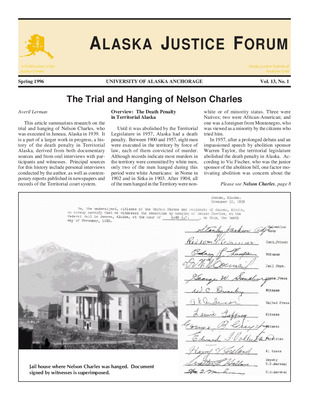
Alaska Justice Forum ; Vol. 13, No. 1 (Spring 1996)
Lerman N/A, N/A Bureau of Justice Statistics, N/A National Institute of Justice, and N/A UAA Justice Center
The Spring 1996 issue of the Alaska Justice Forum presents an account based on historical research of the trial and execution for murder of a Native fisherman, Nelson Charles, in Juneau in 1939 — one of the last executions in Alaska, which abolished the death penalty in 1957. The Bureau of Justice Statistics reports on capital punishment in the U.S. in 1994, during which 13 states executed 31 prisoners. The second of two articles on the village component of a statewide public safety project conducted in 1994 by the Justice Center for the Alaska Department of Public Safety focuses on the information derived from on-site interviews conducted in twenty-eight rural communities with predominately Alaska Native populations; specific, localized arrangements for public safety are described. Research in Germany on the effect of alternative sanctions on juvenile offenders indicates that youthful offenders sent to prison have higher rates of recidivism than those given alternative sanctions.
-
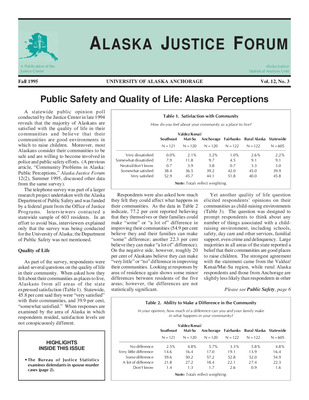
Alaska Justice Forum ; Vol. 12, No. 3 (Fall 1995)
Bureau of Justice Statistics
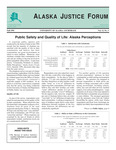
The Fall 1995 issue of the Alaska Justice Forum presents the second of two articles reporting results of a statewide public opinion survey on community and public safety problems in Alaska; responses about quality of life, community satisfaction, fear of crime, crime trends, and willingness to help with public safety activities are presented by area (Southeast Alaska, Valdez/Kenai/Mat-Su, Anchorage, Fairbanks, rural Alaska, and total statewide). A Bureau of Justice Statistics reports that, of an estimated 9,600 murder defendants in the nation's 75 most populous counties in 1988, six percent (an estimated 540 defendants) were persons charged with murdering their spouses.
-
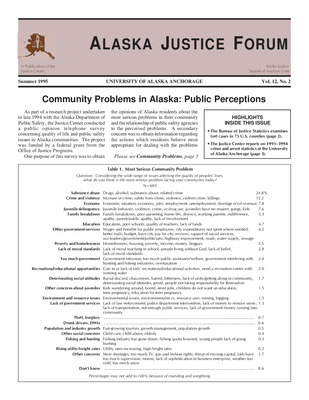
Alaska Justice Forum ; Vol. 12, No. 2 (Summer 1995)
Bureau of Justice Statistics, Roger C. Miller, and Cassie Atwell
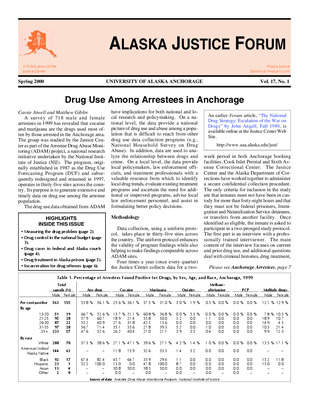
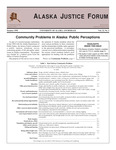
The Summer 1995 issue of the Alaska Justice Forum presents the first of two articles of a 1994 statewide public opinion survey on community and public safety problems (and proposed solutions) in Alaska. The Bureau of Justice Statistics reports results from a study of tort cases in state courts, finding that during a one-year period ending in 1992, state courts of general jurisdiction in the nation's 75 largest counties disposed of an estimated 378,000 tort cases involving 1.4 million plaintiffs and defendants. According to 1991–1994 offense and arrest statistics compiled by the Justice Center under the Crime Awareness and Campus Security Act (CACSA) of 1990, University of Alaska Anchorage educational and research sites are relatively free from serious crimes.
-
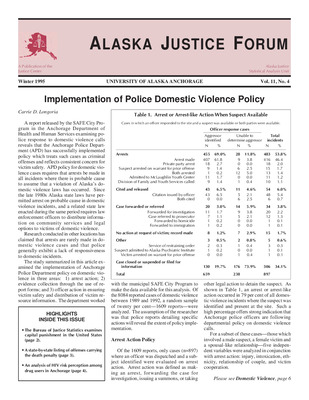
Alaska Justice Forum ; Vol. 11, No. 4 (Winter 1995)
Carrie D. Longoria, N/A Bureau of Justice Statistics, Andrea M. Fenaughty, Holly A. Massey, and Dennis G. Fisher
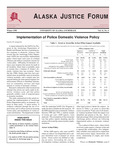
The Winter 1995 issue of the Alaska Justice Forum examines the implementation of Anchorage Police Department’s domestic violence policy, which treats domestic violence cases as criminal offenses and reflects consistent concern for victim safety. During 1993, according to the Bureau of Justice Statistics, 38 men were executed in the U.S.; at year’s end, 34 states and the federal prison system held 2,716 prisoners under sentence of death, 5.3 percent more than at yearend 1992. As part of an national five-year study of drug users, AIDS, and HIV, researchers at the University of Alaska Anchorage have assembled data measuring the risk perceptions of individuals in Anchorage who are at some actual risk for contracting HIV — data which may have some implications for correctional systems.
-
Alaska Justice Forum ; Vol. 12, No. 1 (Spring 1995)
N. E. Schafer, Richard Curtis, and N/A UAA Justice Center
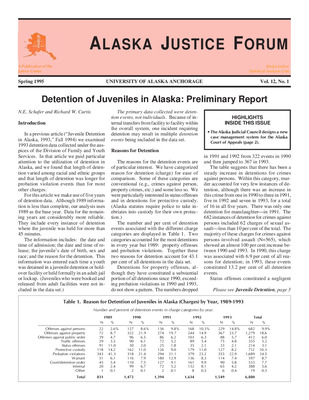
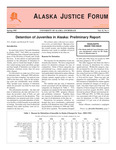
The Spring 1995 issue of the Alaska Justice Forum examines detention data collected during Juvenile Justice and Delinquency Prevention Act compliance monitoring to describe juvenile detentions in Alaska for the five years from 1989 to 1993, with particular attention given to repeat offenders, defined as individuals detained six or more times during the five-year period. The Alaska Judicial Council and Alaska Court of Appeals have further expanded the computerized case management system designed by the Alaska Judicial Council.
-
Alaska Justice Forum ; Vol. 11, No. 1 (Spring 1994)
Teresa W. Carns, N/A Bureau of Justice Statistics, and N/A UAA Justice Center
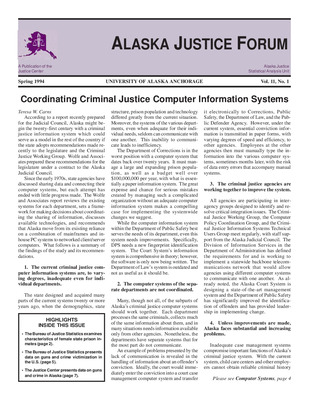
The Spring 1994 issue of the Alaska Justice Forum summarizes a report prepared for the Alaska Judicial Council which describes existing state criminal justice computer information systems in Alaska and makes recommendations for improved connectivity and coordination between them. According to the Bureau of Justice Statistics, the number of women in state prisons grew 75 percent from 1986 to 1991, with women comprising 5.2 percent of all prisoners (up from 4.7 percent in 1986). Figures on guns and crime nationally and in Alaska are presented based on data from the Bureau of Justice Statistics and the FBI’s Uniform Crime Reporting system.
-
Alaska Justice Forum ; Vol. 11, No. 3 (Fall 1994)
Richard Curtis, N. E. Schafer, N/A Bureau of Justice Statistics, Teresa W. Carns, and Sarah Josephson
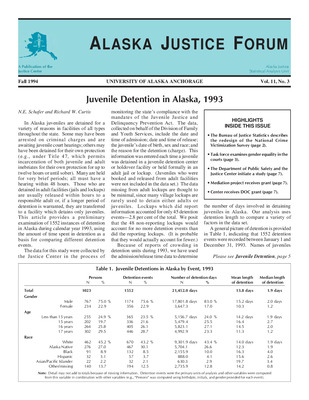
The Fall 1994 issue of the Alaska Justice Forum analyzes the 1,552 juvenile detention events in Alaska in 1993, which involve 1,023 youths who spent a total of 21,452 days in detention. The National Crime Victimization Survey (NCVS), one of two Justice Department measures of crime in the United States (the other being the FBI’s Uniform Crime Reports) has been redesigned. Surveys recently conducted by the Joint State-Federal Courts Gender Equality Task Force present an overall picture of gender equality issues in Alaska state courts.
-
Alaska Justice Forum ; Vol. 11, No. 2 (Summer 1994)
Lawrence C. Trostle, Patrick Cunningham, and N/A Bureau of Justice Statistics
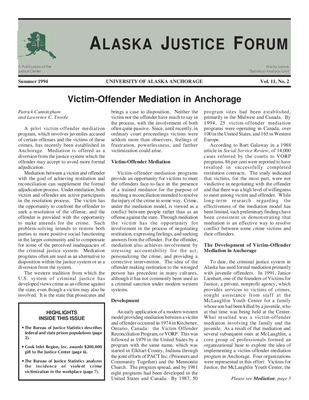
The Summer 1994 issue of the Alaska Justice Forum describes a pilot victim-offender mediation program in Anchorage which involves juveniles accused of certain offenses and the victims of those crimes. The number of prisoners under the jurisdiction of federal or state correctional authorities at the end of 1993 reached a record high of 948,881, according to the Bureau of Justice Statistics (BJS), with Alaska’s system increased by 7.1 per cent in 1993, less than the percentage increase for the nation as a whole. A second BJS report finds that nearly one million individuals each year become victims of violent crime while working or on duty, accounting for 15% of the over 6.5 million acts of violence experienced by Americans age 12 or older. A gift of $200,000 from Cook Inlet Region, Inc. (CIRI) to University of Alaska is intended to address justice issues and problems affecting Alaska Natives.
Printing is not supported at the primary Gallery Thumbnail page. Please first navigate to a specific Image before printing.