

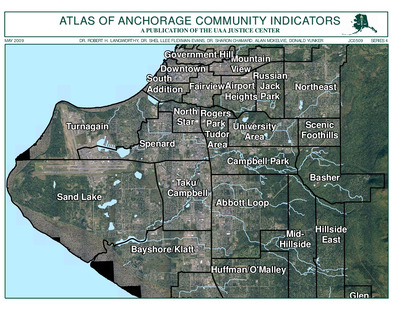
Anchorage Community Indicators Series 4: Atlas of Anchorage Community Indicators presents Anchorage community indicators at the census block group level derived from data captured in the 2000 U.S. Census and the 2005 Anchorage Community Survey.
-
Atlas of Anchorage Community Indicators
Robert H. Langworthy, Shel L. Flexman-Evans, Sharon Chamard, Alan R. McKelvie, and Donald Yunker
The Anchorage Community Indicators (ACI) project is designed to make information (extracted from data) accessible so that conversations about the health and well-being of Anchorage may become more completely informed. Policy makers, social commentators, service delivery systems, and scholars often stake out positions based on anecdotal evidence or hunches when, in many instances, solid, empirical evidence could be compiled to support or challenge these opinions.The Atlas of Anchorage Community Indicators makes empirical information about neighborhoods widely accessible to many different audiences. The initial selection of indicators for presentation in the Atlas was inspired by Peter Blau and his interest in measures of heterogeneity (diversity) and inequality and by the work of the Project on Human Development in Chicago Neighborhoods. In both cases the measures they developed were well-conceptualized and validated. The Atlas presents community indicators at the census block group level derived from data captured in the 2000 U.S. Census and the 2005 Anchorage Community Survey. All maps in the Atlas are overlaid by Community Council boundaries to facilitate comparisons across maps.
-
ACI Technical Report: Initial Measures Derived from Census
Robert H. Langworthy
The decennial census provides a wealth of information about communities that has been mined by social scientist for decades. The purpose of this technical report is to describe an initial set of measures taken from or derived from the 2000 U.S. Census in an effort to develop a statistical description of Anchorage communities for use with the Anchorage Community Indicators project of the University of Alaska Anchorage Justice Center. The initial set of measures isolated from census are inspired by two principal bodies of work: (1) the Project on Human Development in Chicago Neighborhoods, an exceptionally well endowed research effort that took neighborhood measurement very seriously; and, (2) Peter Blau’s work that specifies parameter of social structure, heterogeneity, and inequality. The focus of the paper is on documenting how the measures were formed from 2000 Summary File 3 census tables. However, measures without conceptual content are of little value. Accordingly, the paper will offer a brief introduction to the derivative works (PHDCN, Blau) and then follow with a fairly detailed presentation of each measure (what concept is addressed, how it is measured, how the measure is distributed across block group and census tracts, and isolation of the census tables providing essential counts).