
Files
Download Full Text (1.1 MB)
Description
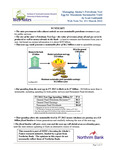
Web Note #7 (How Much Should Alaska Save? February 2011) suggested we should think of Alaska’s petroleum wealth as an asset from which we should spend only the earnings—thus preserving that wealth for future generations, while at the same time providing a sustainable annual flow of income for current Alaskans. Based on the value of state financial assets and a projection of future petroleum revenues, in early 2011 we estimated total petroleum wealth—the Petroleum Nest Egg—to be $126 billion. That total could generate an annual sustainable flow of income, or Maximum Sustainable Yield, of $5 billion. That year actual state spending from petroleum revenues, along with the Permanent Fund dividend, was $5.5 billion, or $.5 billion more than the sustainable amount. This put a Fiscal Burden on future generations of Alaskans because it reduced the size of the nest egg. The state could have avoided that burden either by increasing non-petroleum revenues $.5 billion, or by reducing spending that much. Doing one or the other would have added $.5 billion of saving to the nest egg and so maintained its value. This Web Note revisits the calculation of the Petroleum Nest Egg, the Maximum Sustainable Yield, and the Fiscal Burden, taking into account both changes in expectations of future revenues and the size of the state budget. The estimated size of the nest egg has increased since last year, to $155 billion, because of higher oil prices and more optimistic production assumptions, so the estimated sustainable yield is up to $6.2 billion a year. But that growth has been more than offset because spending of petroleum revenues has also increased. The FY 2012 state budget exceeds the Maximum Sustainable Yield by $.8 billion, passing a Fiscal Burden of that amount on to the next generation of Alaskans. Looking beyond FY 2012, continued spending growth would have dramatic effects on the Nest Egg and Sustainable Yield. For example, if spending growth of 6% a year were to go on year after year and the growth was funded by petroleum revenues, the currently estimated Nest Egg would shrink at an accelerating rate and the Fiscal Burden would grow at an increasing rate. The Maximum Sustainable Yield for the next generation of Alaskans would drop by half in 20 years. Looked at another way, sustaining spending growth of 6% a year would require a Nest Egg of $350 billion—more than twice the current estimate. To put that amount in perspective, $350 billion is more than half the current size of the Norwegian government’s pension fund.
Publication Date
3-17-2012
Recommended Citation
Goldsmith, Oliver Scott, "Managing Alaska’s Petroleum Nest Egg for Maximum Sustainable Yield" (2012). ISER Reports. 36.
https://scholarworks.alaska.edu/uaa_iser_reports/36
Handle
http://hdl.handle.net/11122/3930