

-
Overview of Sexual Assault in Alaska
André B. Rosay
This Powerpoint slide presentation provides an overview of key results from UAA Justice Center research and statistics from other sources on sexual assault in Alaska, presented before a roundtable discussion with officials from the U.S. Department of Justice sponsored by the Alaska Native Justice Center.
-
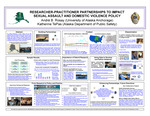
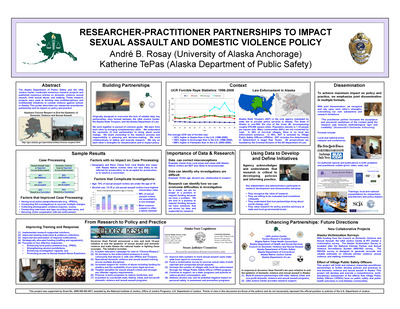
Researcher-Practitioner Partnerships to Impact Sexual Assault and Domestic Violence Policy
André B. Rosay and Katherine H. TePas
The Alaska Department of Public Safety and the UAA Justice Center conducted numerous research projects and published numerous articles on domestic violence, sexual assault, child sexual abuse, and stalking. These research projects were used to develop new multidisciplinary and multifaceted initiatives to combat violence against women in Alaska. This poster describes our researcher-practitioner partnership and its impact on policy and practice.
-
Overview of UAA Justice Center Violence against Women Research
André B. Rosay
This Powerpoint presentation presents an overview of key results from Justice Center research on violence against women in Alaska, including studies on sexual assault, stalking, and domestic violence through February 2009.
-
Sexual Assault in Alaska
André B. Rosay
This Powerpoint slide presentation provides an overview of key results from Justice Center research on sexual assault in Alaska through August 2009, with discussion of victimization and its costs, victim characteristics, suspect characteristics, victim-suspect relationships, alcohol use, and criminal case processing (referral, prosecution, and disposition), and recidivism.
-
Sexual Violence in Alaska
André B. Rosay
This Powerpoint presentation presents an overview of key results from Justice Center research on violence against women in Alaska through June 2009, with a particular focus on sexual assault, including victim characteristics, suspect characteristics, victim-suspect relationships, alcohol use, and criminal case processing (referral, prosecution, and disposition).
-

UAA Research on Violence against Women
André B. Rosay
This Powerpoint slide presentation presents an overview of key results from Justice Center research on violence against women in Alaska, including studies on sexual assault, stalking, and domestic violence through March 2009.
-
Descriptive Analysis of Sexual Assault Incidents Reported to Alaska State Troopers: 2003–2004
André B. Rosay
This Powerpoint presentation provides an overview of findings of a statewide study of all sexual assault and sexual abuse of minor incidents reported to the Alaska State Troopers (AST) from January 1, 2003 to December 31, 2004.
-
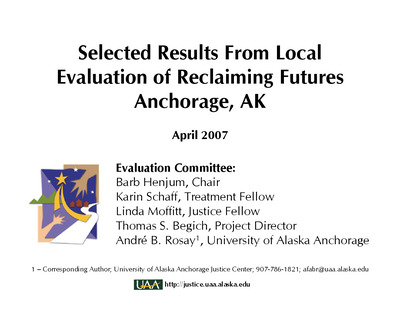
Selected Results from Local Evaluation of Reclaiming Futures, Anchorage, AK
Barb Henjum, Karin Schaff, Linda Moffitt, Thomas S. Begich, and André B. Rosay
This Powerpoint presentation briefly reports on results of an evaluation of Reclaiming Futures Anchorage, which is one of 10 founding Reclaiming Futures projects funded by the Robert Wood Johnson Foundation to create new approaches to help teens in trouble with drugs, alcohol and crime. It partners with courts, treatment facilities, detention facilities, and community to promote new opportunities and standards of care in juvenile justice to improve the improvement of drug and alcohol treatment, expand and coordinate services, and find jobs and volunteer work for young people in trouble with the law.
-

Disproportionate Minority Contact in Anchorage
André B. Rosay and Ronald Everett
This slide show presentation presents recently collected data on disproportionate contact with the juvenile justice system of minority youth in Anchorage, Alaska. The data examine minority contact with local law enforcement and juvenile justice authorities at McLaughlin Youth Center. Disproportionate minority contact (DMC) occurs when the rate of referral for minority youth exceeds the rate of referral for white youth. DMC occurs for almost all non-white minority groups in Anchorage; it is more prevalent for Pacific, Native, and Black youth, both males and females, and more prevalent for referrals for probation/conduct violations, especially for females.
-
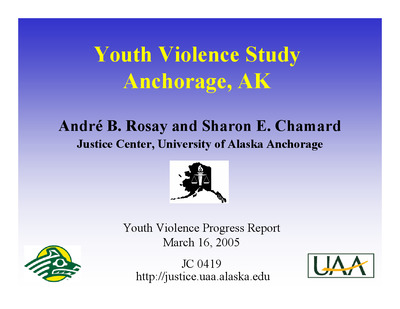
Youth Violence Study, Anchorage, AK: Youth Violence Progress Report
André B. Rosay and Sharon Chamard
This slide presentation describes youth violence in Anchorage by providing initial comparisons between current Anchorage conditions and conditions of the past five to ten years, as well as initial comparisons between Anchorage and the rest of the U.S. Data shows that youth violence in Anchorage is not a serious problem, is at levels similar to or lower than national rates of youth violence, and is declining in Anchorage as it is nationally. Youth violence is also not perceived to be a serious problem in Anchorage, according to a public survey of Anchorage residents. Nonetheless, efforts to reduced and prevent youth violence in Anchorage are necessary; this progress report identifies some successful programs, and suggests how to develop policies to reduce levels of youth violence in Anchorage.
-
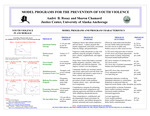
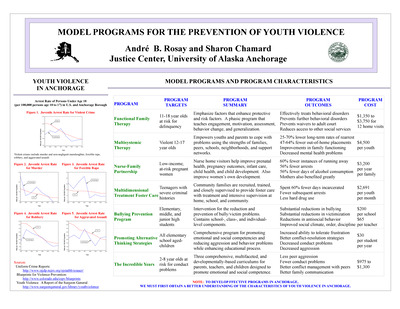
Model Programs for the Prevention of Youth Violence
André B. Rosay and Sharon Chamard
This poster compares levels of youth violence in Anchorage to U.S. levels and identifies effective programs to reduce levels of youth violence, including functional family therapy, multisystemic therapy, nurse-family partnership, multidimensional treatment foster care, bullying prevention program, promoting alternative thinking strategies, and "the incredible years." Estimated program costs are also detailed.
-
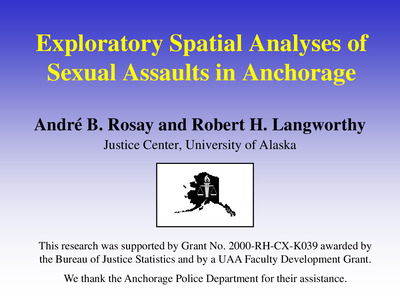
Exploratory Spatial Analyses of Sexual Assaults in Anchorage
André B. Rosay and Robert H. Langworthy
Using data on the locations of sexual assaults reported to the Anchorage Police Department in 2000 and 2001, the authors used Exploratory Spatial Data Analysis techniques to (1) identify the locations where sexual assaults were concentrated and (2) examine the correlates of these spatial concentrations. In both analyses, the authors also examined differences between white and Native victimizations. The spatial concentrations of sexual assault victimizations vary significantly by race, as do the correlates of the respective spatial concentrations. The authors conclude that there is a relationship between assault locations and bar locations, but that the relationship far from perfect and the question of whether there is a causal mechanism exists remains unknown. Nonetheless, successful interventions to prevent sexual assaults must involve bars; but targeting bars will be both inefficient and insufficient for fully addressing the problem of sexual assault prevention in Anchorage.
-
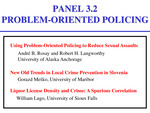
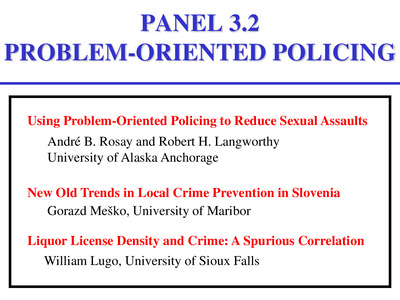
Using Problem-Oriented Policing to Reduce Sexual Assaults
André B. Rosay and Robert H. Langworthy
Alaska generally and Anchorage specifically have been plagued by the incidence of sexual assaults. From 1982 to 2001, the rate of forcible rape per 100,000 in Anchorage was, on average, 122 percent higher than the U.S. rate. To combat this problem, the authors engaged in a problem-oriented policing exercise in cooperation with the Anchorage Police Department. They began this exercise by performing a detailed descriptive analysis of sexual assaults in Anchorage. Data were collected from 541 reports of sexual assault cases reported to the Anchorage Police Department in 2000 and 2001. These data contain detailed information on the assaults, victims, and suspects. Using crime-mapping technologies, hot spots of sexual assaults were identified and profiles developed for each hot spot. With this detailed understanding of the characteristics of each hot spot, empirically-based strategies were developed to reduce the occurrence of sexual assaults. After implementing each strategy, an evaluation of whether the occurrence of sexual assaults had significantly declined was performed. This presentation focuses on the initial stages of problem-oriented policing—the identification and explanation of hot spots. More specifically, the utility of using crime-mapping technologies in the identification of hot spots of sexual assaults is documented and the necessity of using both quantitative and qualitative methodologies to explain where and why sexual assaults are geographically concentrated is described. With a better understanding of the nature of sexual assaults, it has been possible to develop and implement more successful intervention strategies.
Printing is not supported at the primary Gallery Thumbnail page. Please first navigate to a specific Image before printing.