-
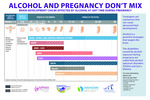
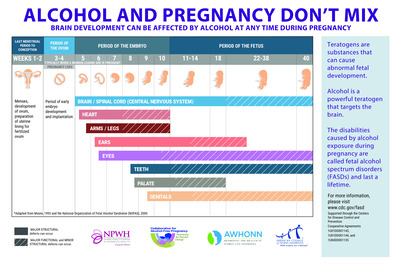
Women's Health Nurses and Midwives Collaborative for Alcohol-Free Pregnancy Infographics
Diane King, Alexandra Edwards, and Oliver Smith
Infographics to increase knowledge and awareness among nurses and midwives about fetal alcohol spectrum disorders and the risks of excessive alcohol use.
-

What do we know about Narcan Utilization among Alaskans? Findings from 3 years
Rebecca Porter, Ryan Druffel, and Bridget Hanson
-
Trends in Bristol Bay Harvest, Production, and Markets
Kevin Berry
This presentation provides graph and chart data related to trends in Bristol Bay harvest, production, and markets for sockeye salmon. Data used is ADFG Commercial Annual Operator Report (COAR) data available through 2017, and Department of Revenue Salmon Price/Production Reports data available through October 2018. Areas covered include harvest volume, ex-vessel price, and ex-vessel value, end markets for Alaska salmon products, wholesale prices for Bristol Bay salmon products.
-
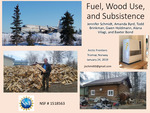
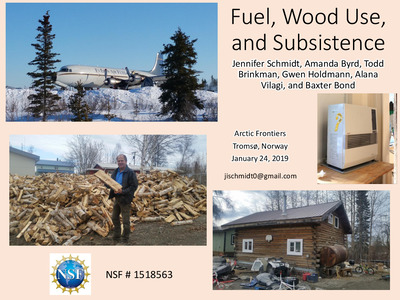
Fuel, Wood Use, and Subsistence
Amanda Byrd, Todd Brinkman, Gwen Holdmann, Alana Vilagi, Jennifer Schmidt, and Baxter Bond
Provides an overview of the use of biomass in a remote Alaskan community. Presented at Arctic Frontiers in Tromsø, Norway on January 24, 2019. Funded as part of a National Science Foundation grant (NSF # 1518563)
-
Alaska's Economic and Fiscal Situation
Mouhcine Guettabi
This presentation includes a number of graphical representations of key economic indicators and also provides some background information regarding the Permanent Dividend Fund. Presented at the 2019 Annual AFN Convention.
-
Alaska's Economic Outlook (Alaska House of Representatives)
Mouhcine Guettabi
This presentation includes information about employment and income from the Permanent Dividend Fund. Presented at the Alaska House of Representatives.
-
Alaska's Economic outlook (Seattle Chamber of Commerce)
Mouhcine Guettabi
This presentation includes information about employment and income from the Permanent Dividend Fund. Presented at the Seattle Chamber of Commerce.
-
Long-Term Trends in the Pacific Salmon Industry
Gunnar Knapp
Prepared for a symposium on “The Science of Pacific Salmon Conservation: Foundations, Myths, and Emerging Insights” at the Annual Meeting of the American Fisheries Society in Reno, Nevada on October 1, 2019.
-
Trends in Atlantic Salmon Markets and Implications for Bristol Bay Salmon Markets
Gunnar Knapp
World salmon markets are dominated by farmed Atlantic salmon. As farmed salmon production has grown, Bristol Bay sockeye salmon has become an ever-smaller share of world salmon supply. Norway and Chile are by far the largest producers of farmed salmon, followed by the UK and Canada. Historically, year-over-year changes in US monthly imports have been inversely correlated with year-over-year changes in prices. What explains changes over time in the price premium or discount of sockeye relative to competing farmed salmon? Looking at the relationship between price and supply changes, we conclude that the market is able to absorb 6-7% more fish at stable prices. As a consequence, we expect a 5% increase in price is 2019 despite 4% supply growth.
-
Can my GPS lead me to a sustainable future? The role of technology and lessons from three remote Arctic communities
Chris Monz, Jennifer I. Schmidt, and Vera Hausner
This presentation outlines research involving 35 residents of Brevig Mission, Noatak, and Noorvik during March 2017 were asked to evaluate values and beliefs regarding technology, climate change, and subsistence. Interviewees indicated that technology was helpful in their hunting and subsistence activities, but it was also expensive and may contribute to taking larger risks. Furthermore, technology was not seen as making up entirely for the impacts arising from changing climate.
-
Planting the Seeds to Examine Food Security Challenges in the Alaska Food-Energy-Water Nexus
Jennifer I. Schmidt
What is the Food-Energy-Water Nexus? It is the relationship between the energy that is used to clean and treat water and to grow food. It is also the recognition that it takes water to grow food and produce electrical power, and that it takes food to power us all to keep these systems running. This set of relationships can be considered at different scales including the "micro" that is most characteristic of small island communities in Alaska. This presentation was delivered at the Alaska Food Policy Council 2019 Festival and Conference.
-
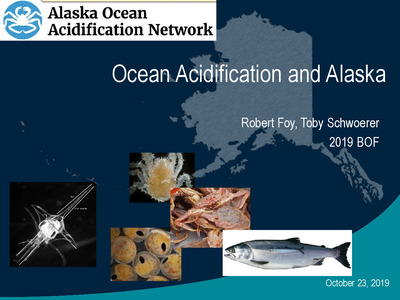
Ocean Acidification and Alaska
Tobias Schwoerer and Robert James Foy
This presentation outlines research questions and existing information regarding key commercial fisheries and the potential impact of ocean acidification in Alaska. Presented to the Alaska Board of Fisheries in October 2019.
-
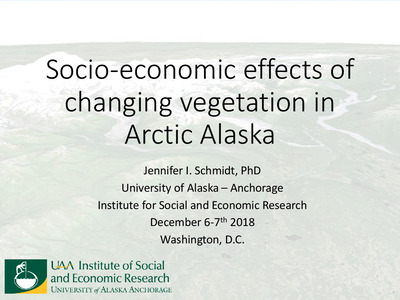
Socio-economic effects of changing vegetation in Arctic Alaska
Jennifer Schmidt
Vegetation change is complex and as a result the socioeconomic impacts vary. Shrubification has consequences for energy production, transportation but more information is needed. Erosion is a major issue for many communities and how vegetation influences erosion is unclear, and communities not experiencing changes in vegetation around them can still be affected.
Printing is not supported at the primary Gallery Thumbnail page. Please first navigate to a specific Image before printing.