-
Comparing Fiscal Policy Proposals
Scott Goldsmith
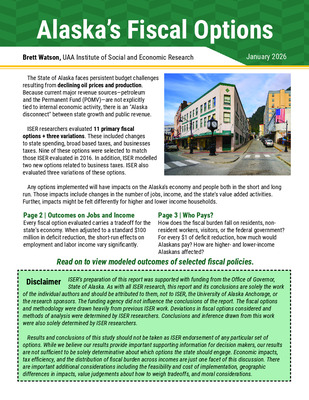
This paper is a summary of a larger report which compares 8 fiscal policy proposals to assess what effects each would have over the next 20 years on state spending, the Permanent Fund Dividend, and state savings. The alternatives we assess range from continuing current policies to freezing the budget, to changing the allocation of Permanent Fund earnings.
-
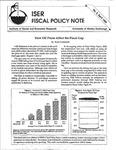
How Oil Prices Affect the Fiscal Gap
Scott Goldsmith
In this short summary based on ISER's Fiscal Policy Papers series, we estimate the timing and size of the state fiscal gap at the currently proposed $2.5 billion level of spending and at various oil prices. Findings are presented in figures and summarized.
-
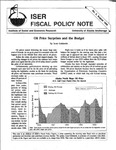
Oil Price Surprises and the Budget
Scott Goldsmith
Policy makers drawing up state budgets each year tend to use the price of oil prevailing during the legislative session as the basis for predicting oil prices and likely state petroleum revenues. Currently these make up about 85 percent of state income. This fiscal policy note examines some recent trends and the implications for short-term volatility, and longer term declines for state spending.
-
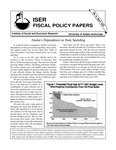
Alaska's Dependence on State Spending
Scott Goldsmith and Lee Gorsuch
It would be hard to exaggerate Alaska’s economic dependence on state government spending. State spending supports nearly one of every three jobs. Three of every ten dollars of personal income grow out of state spending. If state officials balance the budget entirely through spending cuts, economic growth could slow dramatically over the next decade, costing Alaska 35,000 new jobs. We can’t avoid the economic slowdown that the fiscal gap will produce, but we can help ease its effects by a combination of more efficient use of our assets, spending cuts, cost containment, and new taxes or other new revenues. This paper analyzes how different state fiscal policies could reduce economic disruption from the fiscal gap in the coming years.
-
Big Ticket Spending: Transfers and Labor Costs
Lee Gorsuch, Scott Goldsmith, and Jay Hogan
This paper profiles state transfer (grant and claim) programs and labor costs (including both payroll and benefits), which together account for three of every four dollars the state spends on general operating expenses. This analysis is a complement to previous Fiscal Policy Papers in which we have examined different aspects of state government spending and revenue generation. This paper examines how the two biggest categories of spending affect the state operating budget. We conclude by looking at the implications of our analysis for declining revenues.
-
Better Times in Alaska
Alexandra Hill, Linda Leask, and Matthew Berman
The Institute of Social and Economic Research (ISER) has tracked the economic health of Anchorage households since 1987, when the recession that followed the oil price crash was at its worst. In our most recent survey we also questioned residents of Fairbanks and the Mat-Su Borough. This publication compares conditions in the three survey places in early 1990, and describes trends in Anchorage over the past three years. We asked Alaskans about their jobs, incomes, home equity, plans to move, and expectations for the coming year. We end with a snapshot glance of survey households in 1990. That brief discussion simply provides useful basic information on households in the three survey places at the start of the decade.
-
Alaska Review of Social and Economic Conditions: Better TImes in Alaska
Alexandra Hill, Linda Leask, and Matthew D. Berman
-
The Economic Impact of Amateur Sports in Alaska
Pershing Hill and Noble Sean
Amateur sports events and competitions can generate significant net economic benefits for host economies. The major impact of amateur sports on the local and regional economy is an increase in the amenity values enjoyed by the citizenry. Amateur sports provide a wider variety of experiences for the population; sports programs and competitions improve the quality of life. In addition to the amenity value increases, being the venue for amateur sports competitions brings additional spending into the local economy. For instance, it is estimated that the Great Alaska Shootout could be responsible for as much as $300,000 of additional spending into the Anchorage economy. This additional spending is added to the income of the local economy and generates subsequent levels of spending. Based on assumptions about the number of visitors and the additional spending that takes place as a result of these competitions and the value of the multiplier process it is possible to estimate their net economic on the economy. This report concludes that there are a number of ways that the public sector could support local organizations and the economic benefits that arise from amateur sports events and competitions.
-
Electric Load Forecast for Ketchikan, Metlakatla, Petersburg, and Wrangell, 1990-2010
Teresa Hull, Scott Goldsmith, and Steve Colt
The study area is composed of the Alaskan communities of Ketchikan, Metlakatla, Petersburg, and Wrangell. In this report we call the area Lower Southeast Alaska (LSE). Like that of Southeast Alaska as a whole, the LSE economy is built on timber (logging, lumber, and pulp), fishing, and tourism. Hard rock mining is an emerging but still relatively unimportant basic sector. Although the region has felt the positive effects of the statewide oil boom through increased construction of public buildings and government employment at all levels, it is far less reliant on the petroleum industry than is the rest of the state. Instead, the people of Southeast Alaska are heavily exposed to swings in the world market prices of wood and fish products. The tourism industry has been growing steadily. This report provides information and scenarios for projections of electricity usage for these communities.
-
Subsistence Use of Renewable Resources by Rural Residents of Southeast Alaska
Jack Kruse and Robert Muth
The Tongass Resource Use Cooperative Survey consists of 1,465 interviews conducted in 30 southeast Alaska communities between October 1, 1987, andMarch 13, 1988. The study was directed by the Institute of Social and Economic Research of the University of Alaska Anchorage. All permanent communities, with the exception of Juneau and Ketchikan, were included in the study. The purpose of this report is to describe the extent of harvest and distribution of renewable natural resources by rural southeast Alaska residents. Eighty-five percent of all households surveyed harvest one or more species of fish, wildlife, or plants. Such resources include deer, salmon, halibut, and other(non-salmon) fin fish, crab, shrimp, clams, other invertebrates, ducks, bear, harbor seal, berries, firewood, and other resources. Forty-one percent of all households report that at least 25 percent of the meat and fish they eat comes from resources harvested by members of their own households or is given to them by family or friends.
-
Subsistence Use of Renewable Resources By Rural Residents of Southeast Alaska
John A. Kruse and Robert M. Muth
-
Alaska Economy: An Overview
Eric Larson
Understanding the composition of the Alaska economy is important for research, policy analysis, and project assessment. This report provides a fundamental description of the Alaska economy using basic economic principles and measures of economic activity. Measurements such as employment, income, wages, and output serve as the basis for this analysis. When used together, these measures provide a more complete view of the economy than any single economic measure. Section I of this report describes the Alaska economy as a whole by identifying the most important dimensions of economic activity, introducing the measures used to observe this activity, and describing the major changes in these measures over the past twenty years. Section II analyzes the structure of the Alaska economy by breaking the economy into its major components and describing the contribution of each sector.
-
Alaska's Potential Tax Revenues
Linda Leask, Matthew Berman, Lee Gorsuch, Scott Goldsmith, and Teresa Hull
This paper analyzes potential revenues for Alaskan governments, and is a complement to the spending analysis in Fiscal Policy Paper #2. To estimate potential revenues, we need a standard against which to measure Alaska tax efforts. We use national average tax rates; we examine how much tax Alaska's state and local governments currently collect, and estimate how much different tax collections would be if tax rates were at national averages. We look separately at taxes paid by individuals and businesses and by resource industries.
Printing is not supported at the primary Gallery Thumbnail page. Please first navigate to a specific Image before printing.