-
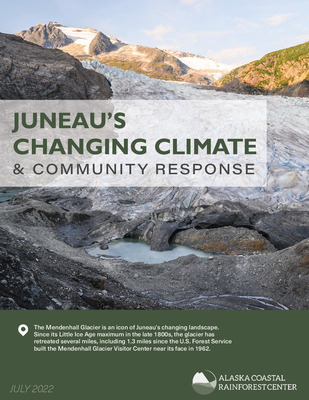
Juneau's Changing Climate and Community Response
James E. Powell, Molly Tankersley, Tom Ainsworth, Jason M. Amundson, Bob Armstrong, Bruce Botelho, Richard Carstensen, David V. D'Amore, Robert James Foy, Eran Hood, Aaron Jacobs, Katie Koester, Linda Kruger, Kevin Maier, Alec Mesdag, Duff Mitchell, Sonia Nagorski, Raymond Paddock, Heidi C. Pearson, Andy Romanof, Darren Sndyer, Richard L. Thoman, Thomas F. Thornton, and Peggy Wilcox
This report is designed as a living document to inform the community, decision makers, and academics and to serve as a learning and teaching tool. The nine key messages summarized on pages 6 and 7 are intended for use as a quick reference. Unique for this type of report, these key messages highlight actions by Juneau's civil society, including local nonprofit organizations.
-
Final Report: International Workshop to Reconcile Methane Budgets in the Northern Permafrost Region
A. David McGuire, Brendan P. Kelly, Lisa Sheffield Guy, and Helen Wiggins
An International Workshop to Reconcile Methane Budgets in the Northern Permafrost Region, organized by the Study of Environmental Arctic Change (SEARCH), was held in Seattle on 7-9 March 2017. The workshop was funded by the National Science Foundation, the National Aeronautics and Space Administration, the U.S. Geological Survey, and the U.S. Arctic Research Commission. The primary goal was to produce a plan for reconciling methane budgets in the northern permafrost region. Forty-two scientists, including representatives of the atmospheric, inland (wetland and lakes), marine (coastal and oceanic), and remote sensing communities studying methane dynamics participated in developing the research plan. Eleven of the participants were early career scientists, and nine of the scientists were from institutions outside the United States. The first day of the workshop included keynote presentations that provided atmospheric, inland, and marine perspectives on developing a plan to reconcile methane budgets. There were also keynote presentations on the role of remote sensing in reconciling methane budgets. The second day of the workshop was devoted to breakout groups that developed plans from disciplinary perspectives, followed by breakouts of mixed disciplinary groups that discussed all three plans. The breakout groups identified key uncertainties and near-term and longer-term priorities for addressing questions about methane dynamics in the northern permafrost region. Participants committed to completing a paper describing a roadmap for the synthesis plan by the end of 2017, and each of the groups developed plans to address, by the end of 2018, near-term priorities to reduce uncertainties in methane budgets. The longer-term priorities include addressing possible sensitivities of methane emissions to climate variability and change in the region and evaluating the degree to which changes in methane dynamics are detectable. To address these longer-term priorities, there is a need to organize extant methane data for the northern permafrost region so that studies using these data can evaluate how enhancements to the methane observation network would improve estimates of methane emissions and the detection of trends. The Permafrost Action Team of SEARCH will develop research summaries and briefs based on the follow-on activities from the workshop.
-

UAA Student Showcase Journal 2014: Volume 30
UAA Student Showcase
UAA Student Showcase Academic Journal 2014: Volume 30
-
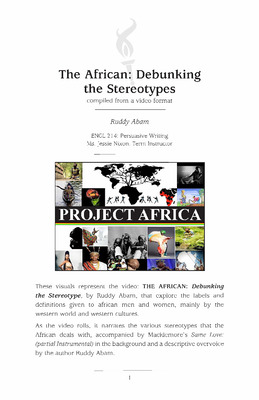
The African: Debunking the Stereotypes
Ruddy Abam
These visuals represent the video: THE AFRICAN: Debunking the Stereotype, by Ruddy Abam, that explore the labels and definitions given to african men and women, mainly by the western world and western cultures. As the video rolls, it narrates the various stereotypes that the African deals with, accompanied by Macklemore’s Same Love: (partial Instrumental) in the background and a descriptive overvoice by the author Ruddy Abam.
-
Total and Merchantable Volume of White Spruce in Alaska
Thomas Malone, Jingjing Liang, and Edmond C. Packee
White spruce (Picea glauca [Moench] Voss) is a valuable commercial species found in interior and southcentral Alaska. Numerous regional and local volume tables or equations exist; however, no statewide model exists or has been tested for accuracy. There is a demand for an accurate model to determine the cubic-foot volume of white spruce trees in Alaska. Multiple models were developed for white spruce to estimate total and merchantable cubic-foot volume to a 2-, 4-, and 6-in. top. These multiple-entry (diameter and height) models were developed for both inside and outside bark volume from a 6-in. stump. The models were tested on a regional basis at various geographic locations and were shown to be highly accurate. The Alaska models chosen have R2 at or near 0.99 and mean square error from 0 to 0.16 for all models. These models are shown to be superior to other white spruce models in Alaska.
-
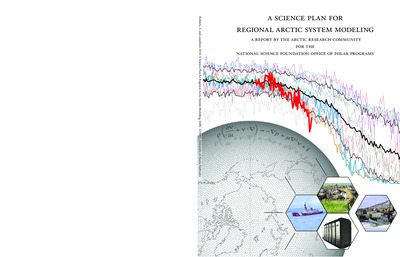
Science Plan for Regional Arctic System Modeling
Andrew Roberts
Data and PDFs for "A Science Plan for Regional Arctic System Modeling" by Roberts, A. and Coauthors, 2010, IARC Technical Report 10-0001. The data collection includes the full report, a NetCDF file containing information used to illustrate and define the Arctic System in Figure 2, and supplemental PDFs of individual figures produced especially for the report. A URL is also provided that links to workshops where outcomes contributed substantially to this report. The purpose of the science plan is to provide a roadmap for understanding variability, complexity and change in the Arctic and it's adjacent environments, including understanding interconnectivity of the geosphere, biosphere and anthroposphere of the high north.
-

Cafe 2010
June Ulz and Marsha Munsell
Welcome! Herein you will find the recipes from the CAFE 2010 evening classes and a little bit more. Mexican soul food (Gloria Fernandez), Philippine cuisine (Betsy Engle), German pastries (Angela Dirks-Eicken), zucchini and chicken in all forms and variations (Marsha Munsell), a touch of the gourmet (Jeanne Yoder), and Alaskan berries front and center (Roxie Dinstel)—all brought to you through the extraordinary coordination of June Ulz. Late in 2009 June was diagnosed with pancreatic cancer. Like every other obstacle that life put in her path, she faced it straight on, moving forward and making the most of every day. She resolved early on that she was going to make it through the summer and she viewed the classes as a gift that gave her the reason she needed to keep going. With the help of her two daughters, Kim and Traci, June pulled it off one more time. Humbly we dedicate this cookbook to the multi-talented, ever smiling, courageous, outrageously funny and loving June who passed away on September 2, 2010. She lives on in her many kindnesses and in the minds and hearts of those who cherish her memory.
-
A Bark Thickness Model for White Spruce in Alaska Northern Forests
Thomas Malone and Jingjing Liang
Here we developed a simple linear model to estimate white spruce bark thickness in the northern forests of Alaska. Data were collected from six areas throughout interior and southcentral Alaska. Geographic variation of bark thickness was tested between the Alaska statewide model and for each geographic area. The results show that the Alaska statewide model is accurate, simple, and robust, and has no practical geographic variation over the six areas. The model provides accurate estimates of the bark thickness for white spruce trees in Alaska for a wide array of future studies, and it is in demand by landowners and forest managers to support their management decisions.
-
Some impacts to paper birch trees tapped for sap harvesting in Alaska
Lori Trummer and Tom Malone
As the non-timber forest products industry increases on a commercial scale, the need for assessments of tree health and sustainability of these practices also increases. Harvesting birch sap for subsistence purposes has occurred for decades but commercial interests in this process and resource is expanding. In this evaluation, we review literature related to birch sap harvesting practices, report on a pilot study that assessed impacts to birch trees from sap harvesting, and review the “Best Practices” guidelines for tree tapping developed by the Alaska Birch Syrupmakers’ Association.
-
Assessment of paper birch trees tapped for sap harvesting near Fairbanks, Alaska
Lori Trummer and Tom Malone
With increased growth in the birch sap extraction industry, the need for assessments of tree health and sustainability of birch tapping practices also grows. Site visits and evaluation of tapping practices were conducted at two commercial harvest locations in the Fairbanks area, Eva Creek in Ester and Cache Creek near Murphy Dome in 2007. In this evaluation we report on walk through observations and a pilot dissection study of tapped trees at each location. Numerous improper tapping practices are reported as well as breach of the Alaska Birch Syrupmakers’ Association (ABSA) “Best Practices Guidelines for Tree Tapping”. There will be a companion biological evaluation to this site visit report produced in 2008 by the same authors that will review the “Best Practices” guidelines developed by the ABSA and evaluate impacts to paper birch trees tapped for sap harvesting in Alaska.
Printing is not supported at the primary Gallery Thumbnail page. Please first navigate to a specific Image before printing.