-
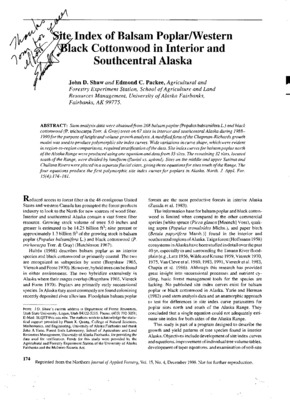
Site Index of Balsam Poplar/Western Black Cottonwood in Interior and Southcentral Alaska
John D. Shaw and Edmond C. Packee
Stem analysis data were obtained from 268 balsam poplar (populus balsamifera L.) and black cottonwood (P. trichocarpa Torr. & Gray) trees on 67 sites in interior and southcentral Alaska during 1988-1990 for the purpose of height and volume growth analysis. A modifiedform of the Chapman-Richards growth model was used to produce polymorphic site index curves. Wide variations in curve shape, which were evident in region-to-region comparisons, required stratification ofthe data. Site index curves for balsam poplar north ofthe Alaska Range were produced using one equation and data from 35 sites. The remaining 32 sites, located south ofthe Range, were divided by landform (fluvial vs. upland). Sites on the middle and upper Susitna and Chulitna Rivers were placed in a separate fluvial class, giving three equations for sites south of the Range. The four equations produce the first polymorphic site index curves for poplars in Alaska. North. 1. Appl. For. 15(4):174-181.
-
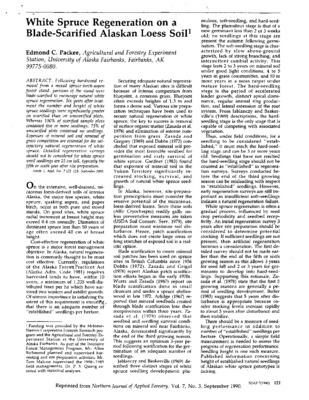
White Spruce Regeneration on a Blade-Scarified Alaskan Loess Soil
Edmond C. Packee
Following hardwood removal from a mixed spruce-birch-aspen forest stand, portions of the stand were blade-scarified to encourage natural white spruce regeneration. Six years after treatment the number and height of white spruce seedlings were significantly greater on scarified than on unscarified plots. Whereas 100% of scarified sample plots contained five or more seedlings, 73% of unscarified plots contained no seedlings. Exposure of mineral soil and removal of grass competition are essential for the sat isfactory natural regeneration of white spruce. Detailed regeneration surveys should not be considered for white spruce until seedlings are 15 em tall, typically the fifth or sixth year after site preparation.
Printing is not supported at the primary Gallery Thumbnail page. Please first navigate to a specific Image before printing.