-
Partnering with the Health Professions to Promote Prevention of an Alcohol-Exposed Pregnancy: Lessons Learned from an Academic–Organizational Collaborative
Leigh Tenkku Lepper, Diane King, Joy Doll, Sandra Gonzalez, Ann Mitchell, and Joyce Hartje
Background: Evidence-based strategies exist to train healthcare professionals to ask their patients and clients about alcohol use, and are successful. Implementation of these strategies utilizing a system-level approach has not been conducted nationwide. This case study reports on the success of academic partnerships with national health professional organizations to increase adoption of evidence-based strategies to prevent alcohol-exposed pregnancies. Methods: Authors reviewed and summarized multi-level strategies created as part of the developmental phase of this project in order to report successes and challenges. We applied the three principles of reflection, sense-making, and reciprocal learning, as identified in the practice change literature, to synthesize our experience. Results: There were five primary lessons learned as a result of this work: Development of technology-based training websites requires significant time to design, implement, and test; project ‘mission-drift’ is inevitable, but not necessarily unwelcome; time and effort is required to create and sustain functioning workgroups when there are different organizational cultures; and changing real-world practice is hard to do, yet changing the conversation on screening and brief intervention is possible. Conclusions: Use of multi-level strategies within an academic–professional organization model was successful in promoting awareness and education of healthcare professionals in the prevention of alcohol-exposed pregnancies.
-
Defining the economic scope for ecosystem-based fishery management
Matthew Reimer
The emergence of ecosystem-based fisheries management (EBFM) has broadened the policy scope of fisheries management by accounting for the biological and ecological connectivity of fisheries. Less attention, however, has been given to the economic connectivity of fisheries. If fishers consider multiple fisheries when deciding where, when, and how much to fish, then management changes in one fishery can generate spillover impacts in other fisheries. Catch-share programs are a popular fisheries management framework that may be particularly prone to generating spillovers given that they typically change fishers� incentives and their subsequent actions. We use data from Alaska fisheries to examine spillovers from each of the main catch-share programs in Alaska. We evaluate changes in participation�a traditional indicator in fisheries economics�in both the catch-share and non�catch-share fisheries. Using network analysis, we also investigate whether catch-share programs change the economic connectivity of fisheries, which can have implications for the socioeconomic resilience and robustness of the ecosystem, and empirically identify the set of fisheries impacted by each Alaska catch-share program. We find that cross-fishery participation spillovers and changes in economic connectivity coincide with some, but not all, catch-share programs. Our findings suggest that economic connectivity and the potential for cross-fishery spillovers deserve serious consideration, especially when designing and evaluating EBFM policies.
-
Aquatic Invasive Species Change Ecosystem Services from the World�s Largest Wild Sockeye Salmon Fisheries in Alaska
Tobias Schwoerer, Joseph Little, and Milo Adkison
This study combines a multi-method approach to structured expert judgment with market valuation to forecast fisheries damages from introduced invasive species. The method is applied to a case study of Alaska�s first submersed aquatic invasive plant, Elodea spp., threatening Alaska�s salmon fisheries. Assuming that Elodea spp. remains unmanaged, estimated mean damages to commercial sockeye fisheries aggregated across Alaska amount to a potential $159 million annually with a 5% chance of exceeding $577 million annually ($2015 USD). The associated mean loss of natural capital amounts to $5.1 billion cumulatively over the next 100 years reaching $400 million after 10 years. Results from the expert elicitation indicate that there is a 35% chance of positive net benefits associated with the believed positive effects of Elodea spp. on sockeye salmon (Oncorhynchus nerka). Despite the potential for positive net gains, the magnitude of the most probable damage estimate may justify substantial investment in keeping productive freshwater systems free of aquatic invasive species. The damage estimate for Alaska is significantly larger than similar estimates in the Great Lakes where ecosystems are already impaired by multiple aquatic invasive species, underscoring the value of keeping functioning ecosystems with global market value productive. This study is the first to estimate ecosystem service loss associated with introduction of an aquatic invasive species to freshwater habitat that supports the world�s most valuable wild sockeye salmon fisheries. Important policy implications related to natural resource management and efficient allocation of scarce resources are discussed
-
Resource rents, universal basic income, and poverty among Alaska’s Indigenous peoples
Matthew Berman
The Alaska Permanent Fund Dividend (PFD) program provides universal basic income (UBI) to all residents from investment earnings of a state sovereign wealth fund created from oil rents. This paper evaluates the effect of the PFD to mitigate poverty among the state’s rural Indigenous (Alaska Native) peoples: a population with historically high poverty rates living in a region with limited economic opportunities. Errors in recording PFD income in data used to calculate official poverty statistics cause them to misrepresent poverty in Alaska and understate the effect of the PFD. Estimating poverty rates with and without PFD income therefore requires reconstruction of family incomes from household-level data. Estimated poverty rates from reconstructed income show that the PFD has had a substantial, although diminishing mitigating effect on poverty for rural Indigenous families. The PFD has had a larger effect on poverty among children and elders than for the rural Alaska Native population as a whole. Alaska Native seniors, who receive additional sources of UBI derived primarily from resource rents besides the PFD, have seen a decline in poverty rates, while poverty rates for children have increased. Evidence has not appeared for commonly hypothesized potential adverse social and economic consequences of UBI.
-
The Economic Case for a Pandemic Fund
Kevin Berry
The rapid urban spread of Ebola virus in West Africa in 2014 and consequent breakdown of control measures led to a significant economic impact as well as the burden on public health and wellbeing. The US government appropriated $5.4 Billion for FY2015 and WHO proposed a $100 Million emergency fund largely to curtail the threat of future outbreaks. Using epidemiological analyses and economic modeling, we propose that the best use of these and similar funds would be to serve as global insurance against the continued threat of emerging infectious diseases. An effective strategy would involve the initial investment in strengthening mobile and adaptable capacity to deal with the threat and reality of disease emergence, coupled with repeated investment to maintain what is effectively a �national guard� for pandemic prevention and response. This investment would create a capital stock that could also provide access to safe treatment during and between crises in developing countries, lowering risk to developed countries.
-
Teaching SBIRT through simulation: Educational case studies from nursing, psychology, social work, and medical residency programs
Diane King, Lucía L. Neander, Bridget L. Hanson, Alexndra Edwards, Ryan Shercliffe, and Emilie Cattrell
The prevalence of substance use disorders remains high in the United States and healthcare professionals are largely ill-equipped to intervene with patients experiencing substance misuse or use disorders. To address this issue, substance abuse intervention curricula such as Screening, Brief Intervention, and Referral to Treatment (SBIRT) are being integrated into university healthcare programs through the use of simulation to provide healthcare students with the necessary skills to address patient substance use. Teaching SBIRT with simulation provides students with an authentic clinical environment in which to learn and refine clinical skills. Simulation also supports reflective practice by providing an opportunity for instructors and peers to directly observe and provide feedback on students' patient care. Additionally, students can review (through video recording) and reflect on their own performance within the simulation to build self-awareness and improve their skills and approach to clinical work. This paper describes how SBIRT simulation was integrated into nursing, psychology, and social work curricula at a medium-sized northwest university and a family medicine residency program in the same community. Satisfaction with SBIRT simulation as well as students’ perceived change in confidence in addressing substance use was recorded. Overall, instructors, students, and medical residents were highly satisfied with simulation experiences. Students and medical residents also reported increases in understanding of and confidence in executing SBIRT. Simulation implementation strategies and resources are provided and discussed.
-

One Health Economics to confront disease threats
Kevin Berry
Global economic impacts of epidemics suggest high return on investment in prevention and One Health capacity. However, such investments remain limited, contributing to persistent endemic diseases and vulnerability to emerging ones. An interdisciplinary workshop explored methods for country-level analysis of added value of One Health approaches to disease control. Key recommendations include: 1. systems thinking to identify risks and mitigation options for decision-making under uncertainty; 2. multisectoral economic impact assessment to identify wider relevance and possible resource-sharing, and 3. consistent integration of environmental considerations. Economic analysis offers a congruent measure of value complementing diverse impact metrics among sectors and contexts.
-
Transitions of social-ecological subsistence systems in the Arctic
Per Fauchald, Vera Hausner, Jennifer Schmidt, and Douglas A. Clark
Transitions of social-ecological systems (SES) expose governance systems to new challenges. This is particularly so in the Arctic where resource systems are increasingly subjected to global warming, industrial development and globalization which subsequently alter the local SES dynamics. Based on common-pool resource theory, we developed a dynamic conceptual model explaining how exogenous drivers might alter a traditional subsistence system from a provisioning to an appropriation actions situation. In a provisioning action situation the resource users do not control the resource level but adapt to the fluctuating availability of resources, and the collective challenge revolve around securing the subsistence in the community. An increased harvest pressure enabled by exogenous drivers could transform the SES to an appropriation action situation where the collective challenge has changed to avoid overuse of a common-pool resource. The model was used as a focal lens to investigate the premises for broad-scale transitions of subsistence-oriented SESs in Arctic Alaska, Canada and Greenland. We synthesized data from documents, official statistics and grey and scientific literature to explore the different components of our model. Our synthesis suggests that the traditional Arctic subsistence SESs mostly comply with a provisioning action situation. Despite population growth and available technology; urbanization, increased wage labor and importation of food have reduced the resource demand, and we find no evidence for a broad-scale transition to an appropriation action situation throughout the Western Arctic. However, appropriation challenges have emerged in some cases either as a consequence of commercialization of the resource or by severely reduced resource stocks due to various exogenous drivers. Future transitions of SESs could be triggered by the emergence of commercial local food markets and Arctic warming. In particular, Arctic warming is an intensifying exogenous driver that is threatening many important Arctic wildlife resources inflicting increased appropriation challenges to the governance of local harvest.
-
Fisheries Production: Management Institutions, Spatial Choice, and the Quest for Policy Invariance
Matthew Reimer, Joshua Abbott, and James Wilen
The fishery-dependent data used to estimate fishing production technologies are shaped by the incentive structures that influence fishermen’s purposeful choices across their multiple margins of production. Using a combination of analytical and simulation methods, we demonstrate how market prices and regulatory institutions influence a dominant short-run margin of production—the deployment of fishing time over space. We show that institutionally driven spatial selection leads to only a partial exploration of the full production set, yielding poorly identified estimates of production possibilities outside of the institutionally dependent status quo. The implication is that many estimated fisheries production functions suffer from a lack of policy invariance and may yield misleading predictions for even the most short-run of policy evaluation tasks. Our findings suggest that accurate assessment of the impacts of a policy intervention requires a description of the fishing production process that is sufficiently structural so as to be invariant to institutional changes.
-
Measuring Community Adaptive and Transformative Capacity in the Arctic Context
Matthew Berman, Gary Kofinas, and Shauna BurnSilver
Adaptive capacity (AC) plays a prominent role in reducing community vulnerability, an essential goal for achieving sustainability. The related concept, transformative capacity (TC), describes a set of tools from the resilience paradigm for making more fundamental system changes. While the literature appears to agree generally on the meaning of AC and TC, operational definitions vary widely in empirical applications. We address measurement of AC and TC in empirical studies of community vulnerability and resilience, with special attention to the problems of arctic communities. We discuss how some challenges follow from ambiguities in the broader vulnerability model within which AC is embedded. Other issues are more technical, such as a confounding of stocks (capacity) with flows (time-specific inputs or outcomes). We view AC and TC as forms of capital, as distinct from flows (i.e., ecosystem services, well-being), and propose a set of sequential steps for measuring the contribution of AC and TC assets to reducing vulnerability. We demonstrate the conceptual application in a comparative analysis of AC in two arctic Alaska communities responding to an increase in the price of fuel. The comparative case study illustrates some key empirical challenges in measuring AC for small arctic communities.
-
Conducting rigorous research with subgroups of at-risk youth: lessons learned from a teen pregnancy prevention project in Alaska
Kathryn Hohman-Billmeier, Margaret Nye, and Stephanie Martin
In 2010, Alaska Department of Health and Social Services (DHSS) received federal funding to test an evidence-based teen pregnancy prevention program. The grant required a major modification to an existing program and a randomized control trial (RCT) to test its effectiveness. As the major modifications, Alaska used peer educators instead of adults to deliver the program to youth aged 1419 instead of the original curriculum intended age range of 1214. Cultural and approach adaptations were included as well. After 4 years of implementation and data collection, the sample was too small to provide statistically significant results. The lack of findings gave no information about the modification, nor any explanation of how the curriculum was received, or reasons for the small sample. This paper reports on a case study follow-up to the RCT to better understand outcome and implementation results. For this study, researchers reviewed project documents and interviewed peer educators, state and local staff, and evaluators. Three themes emerged from the data: (a) the professional growth of peer educators and development of peer education, (b) difficulties resulting from curriculum content, especially for subpopulations of sexually active youth, youth identified as lesbian, gay, bisexual, transgender, queer, intersex and/or asexual, pregnant, and parenting youth and (c) the appropriateness of an RCT with subpopulations of at-risk youth. Three recommendations emerged from the case study. First, including as many stakeholders as possible in the program and evaluation design phases is essential, and must be supported by appropriate funding streams and training. Second, there must be recognition of the multiple small subpopulations found in Alaska when adapting programs designed for a larger and more homogeneous population. Third, RCTs may not be appropriate for all population subgroups.
-
Perspectives of LGBTQ Older Adults on Aging in Place: A Qualitative Investigation
Diane K. King, Jennifer M. Boggs, Jennifer Dickman Portz, Leslie A. Wright, Kenneth Helander, Jessica H. Retrum, and Wendolyn S. Gozansky
This qualitative study conducted by a community-research partnership used multiple types of data collection to examine variables relevant for LGBTQ older adults who wished to age in place in their urban Denver neighborhood. Focus groups, interviews, and a town hall meeting were used to identify barriers and supports to aging in place. Participants (N=73) primarily identified as lesbian or gay, aged 50–69, and lived with a partner. Ageism, heterosexism, and/or cisgenderism emerged as cross-cutting themes that negatively impact access to healthcare, housing, social support, home assistance and legal services. Resilience from weathering a lifetime of discrimination was identified as a strength to handle aging challenges. Recommendations for establishing an aging in place model included: establishing welcoming communities, resource centers, and increasing cultural competence of service providers. This study provides a unique contribution to understanding the psychosocial, medical, and legal barriers for successfully aging in place.
-
Ocean Acidification Risk Assessment for Alaska's Fishery Sector
Jessica Cross, Wiley Evans, Claudine Hauri, T.P. Hurst, Julia Ekstrom, Steve Colt, Noelle Lucey, Sarah Cooley, Jeremy Mathis, and Richard Feely
The highly productive fisheries of Alaska are located in seas projected to experience strong global change, including rapid transitions in temperature and ocean acidification-driven changes in pH and other chemical parameters. Many of the marine organisms that are most intensely affected by ocean acidification(OA) contribute substantially to the state’s commercial fisheries and traditional subsistence way of life. Prior studies of OA’s potential impacts on human communities have focused only on possible direct economic losses from specific scenarios of human dependence on commercial harvests and damages to marine species. However, other economic and social impacts, such as changes in food security or livelihoods, are also likely to result from climate change. This study evaluates patterns of dependence on marine resources within Alaska that could be negatively impacted by OA and current community characteristics to assess the potential risk to the fishery sector from OA. Here, we used a risk assessment framework based on one developed by the Intergovernmental Panel on Climate Change to analyze earth-system global ocean model hindcasts and projections of ocean chemistry, fisheries harvest data, and demographic information. The fisheries examined were: shellfish, salmon and other fin fish. The final index incorporates all of these data to compare overall risk among Alaska’s federally designated census areas. The analysis showed that regions in southeast and southwest Alaska that are highly reliant on fishery harvests and have relatively lower incomes and employment alternatives likely face the highest risk from OA.Although this study is an intermediate step toward our full understanding, the results presented here show that OA merits consideration in policy planning, as it may represent another challenge to Alaskan communities, some of which are already under acute socio-economic strains.
-
Mall Walking Program Environments, Features, and Participants: A Scoping Review
Diane K. King, Laura Farren, Basia Belza, Peg Allen, Sarah Brolliar, David R. Brown, Marc L. Cormier, Sarah Janicek, Dina L. Jones, David X. Marquez, and Dori E. Rosenberg
Introduction Walking is a preferred and recommended physical activity for middle-aged and older adults, but many barriers exist, including concerns about safety (ie, personal security), falling, and inclement weather. Mall walking programs may overcome these barriers. The purpose of this study was to summarize the evidence on the health-related value of mall walking and mall walking programs. Methods We conducted a scoping review of the literature to determine the features, environments, and benefits of mall walking programs using the RE-AIM framework (reach, effectiveness, adoption, implementation, and maintenance). The inclusion criteria were articles that involved adults aged 45 years or older who walked in indoor or outdoor shopping malls. Exclusion criteria were articles that used malls as laboratory settings or focused on the mechanics of walking. We included published research studies, dissertations, theses, conference abstracts, syntheses, non research articles, theoretical papers, editorials, reports, policy briefs, standards and guidelines, and non research conference abstracts and proposals. Websites and articles written in a language other than English were excluded. Results We located 254 articles on mall walking; 32 articles met our inclusion criteria. We found that malls provided safe, accessible, and affordable exercise environments for middle-aged and older adults. Programmatic features such as program leaders, blood pressure checks, and warm-up exercises facilitated participation. Individual benefits of mall walking programs included improvements in physical, social, and emotional well-being. Limited transportation to the mall was a barrier to participation. Conclusion We found the potential for mall walking programs to be implemented in various communities as a health promotion measure. However, the research on mall walking programs is limited and has weak study designs. More rigorous research is needed to define best practices for mall walking programs’ reach, effectiveness, adoption, implementation, and maintenance.
-

'The park a tree built': Evaluating how a park development project impacted where people play
Jill Litt, James Hale, Katherine M. Burniece, Colleen Ross, and Diane K. King
Community parks have achieved recognition as a public health intervention to promote physical activity. This study evaluated changes in population-level physical activity when an undeveloped green space adjacent to transitional housing for refugees was transformed into a recreational park. A prospective, nonrandomized study design used the System of Observing Play and Recreation in Communities (SOPARC) to document the number and activity levels of park users over time, and to compare trends pre- and post-construction. T-tests or tests of medians (when appropriate) were used to compare pre- and post- construction changes in use of non-park and park zones for physical activity and changes in park use by age and gender. Pre- and post-comparisons of people observed using non-park zones (i.e., adjacent streets, alleys and parking lots) and park zones indicated a 38% decrease in energy expended in non- park zones and a 3-fold increase in energy expended within the park (P = 0.002). The majority of park users pre- and post-construction were children, however the proportion of adolescent males observed in vigorous activity increased from 11% to 38% (P = 0.007). Adolescent females and elderly continued to be under-represented in the park. Our findings support an association between creation of accessible outdoor spaces for recreation and improvements in physical activity. Community involvement in park design assured that features included in the park space matched the needs and desires ofthe communities served. Some demographic groups were still under-represented within the park, suggesting a need to develop targeted outreach strategies and programming.
-
Alaska Native-focused Teacher Preparation Programs: What have we learned?
Bernice Ttepon, Diane Hirshberg, Audrey Leary, and Alexandra Hill
There are too few indigenous teachers in Alaska, as fewer than 5% of Alaska�s certified teachers are Alaska Native. However, Alaska�s Indigenous students make up 80% of student enrollment in the state�s rural schools, and over 22% of the school population statewide. Moreover, 74 % of teachers hired by Alaska�s public schools come from outside the state. Teachers new to rural Alaska typically remain on the job just one or two years, and high turnover rates in Alaska are strongly correlated with poorer student learning outcomes (Hill & Hirshberg, 2013). Many community and education leaders believe rural schools could benefit from having more Indigenous teachers, because they would likely stay on the job longer, be more familiar with their students� communities and cultures, and provide more powerful role models for Alaska Native students. This paper discusses why Indigenous teachers are important, and provides an overview of the initiatives from the past four decades aimed at preparing Alaska Native teachers.
-
Suicide Among Young Alaska Native Men: Community Risk Factors and Alcohol Control
Matthew Berman
Indigenous residents of Alaska (Alaska Natives) die by suicide at a rate nearly 4 times the US average and the average for all American Indians and Alaska Natives (AI/ANs).1---3 An astonishing 7% of Alaska respondents to a 2003 international household survey of Arctic Indigenous people indicated that they had seriously contemplated suicide within the past year.4 Studies have shown that alcohol is directly or indirectly involved in most of these deaths.5---9 Although Alaska Natives have encountered alcohol for well over a century, the high suicide risk is an entrenched but comparatively recent phenomenon affecting only the past 2 generations.9,10 Figure 1 shows that crude suicide rates for this group rose rapidly in the decade after Alaska achieved statehood in 1959. The 3-year moving average rate peaked at more than 50 per 100 000 in the early 1980s, before declining to a level of about 40 per 100 000 during the past decade. The dip in suicide rates in the late 1970s likely represents faulty data rather than a real departure from the secular trend.11 An emerging new pattern of risk drove the increase in suicide rates in the 1960s. Higher suicide rates among young men led the rise in suicide as a whole.9,12,13 More recently, another important pattern of differential risk emerged as more Alaska Natives moved to the state’s growing urban areas in search of jobs. Suicide rates among Alaska Native residents remaining in small rural communities are more than twice as high as those among Native residents of urban areas and vary greatly among communities even in the same region (Alaska Bureau of Vital Statistics, unpublished data).13 In fact, suicide rates may have declined since the peak in the 1980s (Figure 1) only because the lower risk population of urbandwelling Alaska Natives has grown relative to the more vulnerable rural population. The large disparities among populations with similar ethnicity and histories suggest that the elevated suicide risk is not simply an unfortunate side effect of rapid social change but may be influenced directly by contemporary living conditions. The association
-
Examining Perceptions of a Smartphone-Based Intervention System for Alcohol Use Disorders
Danielle Giroux, Samantha Bacon, Diane K. King, Patrick Dulin, and Vivian Gonzalez
This study presents results from qualitative interviews conducted with participants in a study on the effectiveness of the Location-Based Monitoring and Intervention System for Alcohol Use Disorders (LBMI-A), a smartphone-based, stand-alone intervention application (app) for adults with alcohol use disorders. Materials and Methods: Participants were provided an LBMI-A-enabled smartphone to use during a 6-week pilot study. The LBMI-A was composed of psychoeducational modules, assessment and feedback of alcohol use patterns, geographic high-risk location monitoring and alerts, and in vivo assessment and intervention for alcohol cravings and help with managing psychological distress. Semistructured interviews were conducted with all participants following 6 weeks of interacting with the LBMI-A app (n=26). Interviews explored user perceptions of the ease and utility of LBMI-A features, module helpfulness, barriers to use, and recommendations for improvements to the program. Researchers applied a systematic qualitative coding process to transcripts that included both a priori themes identified as important by the research team and new themes that emerged during the coding process. Results and Conclusions: Narrative analysis found the emergence of five main themes identified by LBMI-A users as the most helpful functions of the phone: (1) Awareness, (2) Accountability, (3) Skill Transference, (4) Tracking Progress, and (5) Prompts. These themes are explored, and implications of these findings for future smartphone-based interventions are discussed.
-
The Determinants of Small Business Success in Alaska: A Focus on the Creative Class
Mouhcine Guettabi
Although the contribution of small businesses and entrepreneurship to regional communities and the economy at large is widely supported in the literature, there does not seem to be a universally accepted definition for small businesses and entrepreneurship. Without an agreed upon definition, it is challenging for governments and policy makers to address the needs, concerns, and issues of these firms. It also makes it difficult to understand the link between small businesses and economic growth.
-

Indigenous Regulatory Advocacy in Canada’s Far North: Mobilizing the First Mile Connectivity Consortium
Heather E. Hudson, Robert McMahon, and Lyle Fabian
Marginalized groups such as Indigenous communities and residents of remote and rural areas face daunting challenges as they attempt to influence regulatory decision-making. Can these under-resourced groups hope to have their voices heard in regulatory proceedings, in the face of well-funded corporate interests? Applying a participatory research method to regulatory hearings regarding telecommunications services in Canada’s far north, the authors argue that they can, and identify specific strategies and tactics that they can employ when doing so.
-
Fate Control and Human Rights: The Policies and Practices of Local Governance in America's Arctic
Mara Kimmel
The loss of territoriality over lands conveyed under the Alaska Native Claims Settlement Act had adverse impacts for Alaskan tribal governance. Despite policy frameworks that emphasize the value of local governance at an international, regional, and statewide level, Alaskan tribes face unique obstacles to exercising their authority, with consequences for both human development and human rights. This Article examines how territoriality was lost and analyzes the four major effects of this loss on tribal governance. It then describes two distinct but complimentary strategies to rebuilding tribal governance authority that rely on both territorial and non-territorial authority.
-
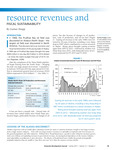
Resource Revenues and Fiscal Sustainability: Lessons of the Alaska Disconnect
Gunnar Knapp
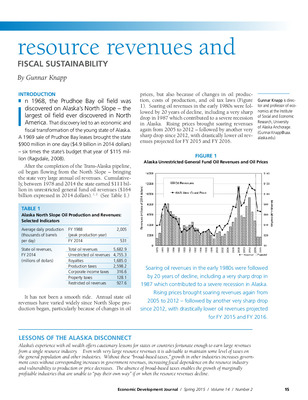
In 1968, the Prudhoe Bay oil field was discovered on Alaska’s North Slope – the largest oil field ever discovered in North America. That discovery led to an economic and fiscal transformation of the young state of Alaska. A 1969 sale of Prudhoe Bay leases brought the state $900 million in one day ($4.9 billion in 2014 dollars) – six times the state’s budget that year of $115 million (Ragsdale, 2008). After the completion of the Trans-Alaska pipeline, oil began flowing from the North Slope – bringing the state very large annual oil revenues. Cumulatively, between 1978 and 2014 the state earned $111 billion in unrestricted general fund oil revenues ($164 billion expressed in 2014 dollars). 1, 2 (See Table 1.) It has not been a smooth ride. Annual state oil revenues have varied widely since North Slope production began, particularly because of changes in oil prices, but also because of changes in oil production, costs of production, and oil tax laws (Figure 1). Soaring oil revenues in the early 1980s were followed by 20 years of decline, including a very sharp drop in 1987 which contributed to a severe recession in Alaska. Rising prices brought soaring revenues again from 2005 to 2012 – followed by another very sharp drop since 2012, with drastically lower oil revenues projected for FY 2015 and FY 2016.
-
Alaskan fishing community revenues and the stabilizing role of fishing portfolios
Gunnar Knapp, Sethi Suresh, and Matthew Reimer
-
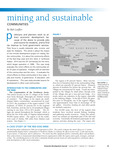
Mining and Sustainable Communities: A Case Study of the Red Dog Mine
Bob Loeffler
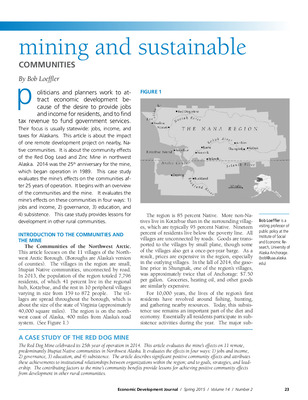
Politicians and planners work to attract economic development because of the desire to provide jobs and income for residents, and to find tax revenue to fund government services. Their focus is usually statewide: jobs, income, and taxes for Alaskans. This article is about the impact of one remote development project on nearby, Native communities. It is about the community effects of the Red Dog Lead and Zinc Mine in northwest Alaska. 2014 was the 25th anniversary for the mine, which began operation in 1989. This case study evaluates the mine’s effects on the communities after 25 years of operation. It begins with an overview of the communities and the mine. It evaluates the mine’s effects on these communities in four ways: 1) jobs and income, 2) governance, 3) education, and 4) subsistence. This case study provides lessons for development in other rural communities
Printing is not supported at the primary Gallery Thumbnail page. Please first navigate to a specific Image before printing.