-
How has Alaska’s K-12 education spending changed? Trends from 2017-2023
Matthew Berman and Dayna Jean DeFeo
Education funding in Alaska, as in most states, is one of the largest allocations in the state operating budget. In 2022, K-12 schools in Alaska spent $20,191 per student for current operations, which was 29% more than the national average of $15,633. However, many things are more expensive in Alaska than they are in other parts of the nation, and this is also true for operating schools. After adjusting Alaska’s spending for its higher relative costs, we find that Alaska’s per-pupil current expenditures fall below the national average by 15%. In the five years between 2017 and 2022 (the first year we conducted this analysis and the most recent year with full data available, respectively), per pupil current spending in other US states increased by 26%, whereas Alaska’s spending increased by only 13%. The PDF addendum contains updated data and the 2023 national average, which were not available when the report was initially published.
-
Alaska’s Type M teacher workforce: An overview
Noah Burke, Dayna Jean DeFeo, Douglas Cost, Matthew Berman, and Olga Skinner
This policy brief gives an overview of Alaska’s Type M teacher workforce with information about the demographics, teaching assignments, and retention rates of Type M teachers. The paper discusses the state policies around teacher certification, and considers the implications and limitations of the Type M certificate in the context of teacher retention and representation.
-
Alaska’s transportation workforce detours: Maximizing training opportunities and outcomes in DOT&PF’s key industries
Staci Corey, Dayna Jean DeFeo, Brett Watson, and Trang C. Tran
Commissioned by the Alaska Department of Transportation & Public Facilities in fall 2023, this report examines Alaska’s workforce in nine priority construction occupations, including laborers, carpenters, electricians, and truck drivers. The study aimed to assess current workforce characteristics, forecast growth, and explore strategies to increase participation by underrepresented groups such as women, people of color, and rural residents. Using interviews, surveys, labor data, and public datasets, the report presents detailed industry profiles that cover job nature, wages, workforce demographics, growth projections, training availability, and recruitment challenges. Key findings show that Alaska’s construction workforce is aging, with significant shortages projected across all priority occupations - particularly for truck drivers and operating engineers. Women represent a small fraction of the workforce, though training programs report higher female enrollment than current field representation. Rural and minority student participation remains low. Common challenges cited by employers include worker shortages, lack of skills, competition, and limited rural workforce availability. The report outlines crosscutting strategies to grow the workforce: expanding accessible training, targeted outreach, improving job value and retention, building partnerships, offering competitive compensation, and providing support services such as travel, housing, and childcare.
-
Alaska educator survey: Instrument development report
Dayna Jean DeFeo, Staci Corey, and Trang C. Tran
This report details the survey development methodology for a statewide survey of in-service K-12 educators in Alaska. It describes the comprehensive literature review, document analysis, shareholder listening sessions, and cognitive interviewing activities that went into survey development.
-
Dual enrollment at the University of Alaska, 2018-2024
Dayna Jean DeFeo, Carolyn Tix, and Trang C. Tran
This paper details trends in dual enrollment participation and student outcomes at the University of Alaska.
-
Are Alaska teacher salaries competitive?
Matthew Berman and Dayna Jean DeFeo
This paper explores how Alaska teacher salaries compare to the national average, between 1969 and 2021, adjusted for cost of living differences. It examines trends in salaries of Alaska and US teachers adjusted for inflation, and how the salary differentials have changed over time. The analysis reveals that Alaska teacher salaries have been lower than competitive levels for the past several decades, although the emerging national teacher shortage has increased the challenge that less competitive salaries pose for recruiting and retaining Alaska teachers. The paper discusses the implications of this trend, with attention to hiring and retaining teachers in Alaska schools.
-
Negotiated Success: Contractual Benefits that Enhance Recruitment and Retention
Hella Bel Amor, Staci Corey, and Dayna Jean DeFeo
This report summarizes monetary and non-monetary items used in Collectively Bargained Agreements (CBAs) to enhance retention and recruitment of educators in and outside of Alaska. This report is one of a series commissioned by the Alaska Department of Education and Early Development to support a stakeholder-informed action plan to address the state’s recurring critical challenges in recruiting and retaining teachers. To approach this task, we narrowed our focus to a review of provisions contained within CBAs in Alaska and a sample of districts in the nation, reviewed relevant literature, and collected stakeholder feedback to further inform the report content and organization. We restrict our analysis to the information contained in CBAs, which are negotiated at the district level, with the noted limitation that CBAs are not exhaustive of all educator benefits (e.g., retirement is an important benefit that is managed at the statewide level). The report details benefits in five broad categories and 15 subcategories, which are bookmarked in this abstract for easy access: coming and staying (signing bonus, longevity/retention bonus); benefits – health and wellbeing (healthcare, sick leave, other leave); benefits – moving and living (travel and relocation, housing and utilities, childcare); knowledge and growth (transferable experience, education and certification, professional development); and work life (contract length and workday, extra duties, hard-to-staff areas, performance pay). Overall, we find that benefits and compensation vary significantly across districts in Alaska, and even more substantially across districts in the national sample, reflecting the diversity in the sample in terms of state, region, size, and location.
-

How much does Alaska spend on K-12 education?
Matthew Berman and Dayna Jean DeFeo
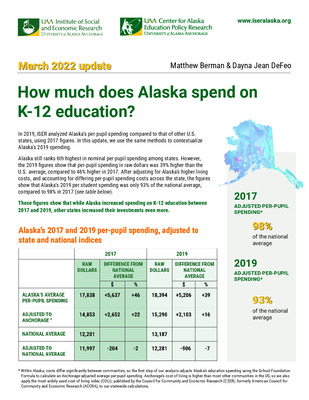
In 2019, ISER analyzed Alaska’s per-pupil spending compared to that of other U.S. states, using 2017 figures. In this update, we use the same methods to contextualize Alaska’s 2019 spending. Alaska still ranks 6th highest in nominal per-pupil spending among states. However, the 2019 figures show that per-pupil spending in raw dollars was 39% higher than the U.S. average, compared to 46% higher in 2017. After adjusting for Alaska’s higher living costs, and accounting for differing per-pupil spending costs across the state, the figures show that Alaska’s 2019 per student spending was only 93% of the national average, compared to 98% in 2017 (see table below).
-

How much does Alaska spend on K-12 education?
Dayna Defeo, Matthew Berman, Alexandra Hill, and Diane Hirshberg
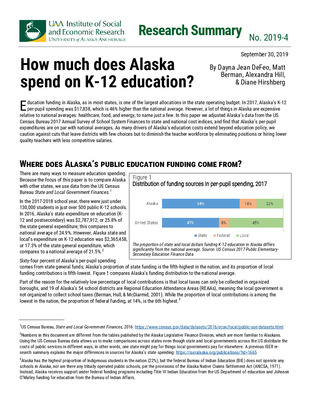
Education funding in Alaska, as in most states, is one of the largest allocations in the state operating budget. In 2017, Alaska�s K-12 per-pupil spending was $17,838, which is 46% higher than the national average. However, a lot of things in Alaska are expensive relative to national averages: healthcare, food, and energy, to name just a few. In this paper we adjusted Alaska�s data from the US Census Bureau 2017 Annual Survey of School System Finances to state and national cost indices, and find that Alaska�s per-pupil expenditures are on par with national averages. As many drivers of Alaska�s education costs extend beyond education policy, we caution against cuts that leave districts with few choices but to diminish the teacher workforce by eliminating positions or hiring lower quality teachers with less competitive salaries.
-
How much does Alaska spend on K-12 education? Research Summary
Dayna Jean DeFeo, Matthew Berman, Alexandra Hill, and Diane Hirshberg
Education funding in Alaska, as in most states, is one of the largest allocations in the state operating budget. In 2017, Alaska’s K-12 per-pupil spending was $17,838, which is 46% higher than the national average. However, a lot of things in Alaska are expensive relative to national averages: healthcare, food, and energy, to name just a few. In this paper we adjusted Alaska’s data from the US Census Bureau 2017 Annual Survey of School System Finances to state and national cost indices, and find that Alaska’s per-pupil expenditures are on par with national averages. As many drivers of Alaska’s education costs extend beyond education policy, we caution against cuts that leave districts with few choices but to diminish the teacher workforce by eliminating positions or hiring lower quality teachers with less competitive salaries.
-
Dual Enrollment in Alaska: A 10-year retrospective and outcome analysis
Dayna DeFeo and Trang Tran
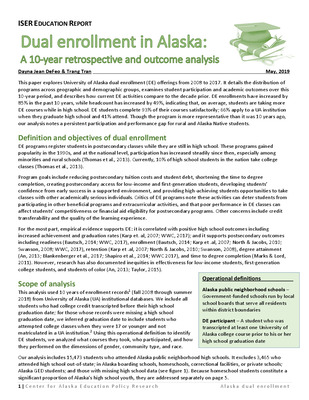
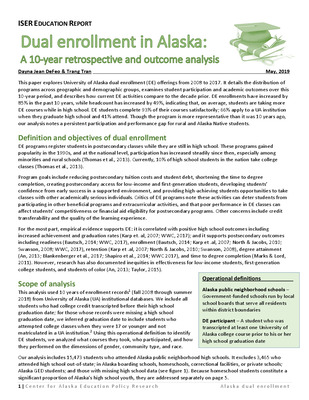
This paper explores University of Alaska dual enrollment (DE) offerings from 2008 to 2017. It details the distribution of programs across geographic and demographic groups, examines student participation and academic outcomes over this 10-year period, and describes how current DE activities compare to the decade prior. DE enrollments have increased by 85% in the past 10 years, while headcount has increased by 49%, indicating that, on average, students are taking more DE courses while in high school. DE students complete 93% of their courses satisfactorily; 66% apply to a UA institution when they graduate high school and 41% attend. Though the program is more representative than it was 10 years ago, our analysis notes a persistent participation and performance gap for rural and Alaska Native students.
-
Dual Enrollment in Alaska: A 10-year retrospective and outcome analysis
Dayna Defeo and Trang Tran
This paper explores University of Alaska dual enrollment (DE) offerings from 2008 to 2017. It details the distribution of programs across geographic and demographic groups, examines student participation and academic outcomes over this 10-year period, and describes how current DE activities compare to the decade prior. DE enrollments have increased by 85% in the past 10 years, while headcount has increased by 49%, indicating that, on average, students are taking more DE courses while in high school. DE students complete 93% of their courses satisfactorily; 66% apply to a UA institution when they graduate high school and 41% attend. Though the program is more representative than it was 10 years ago, our analysis notes a persistent participation and performance gap for rural and Alaska Native students.
-
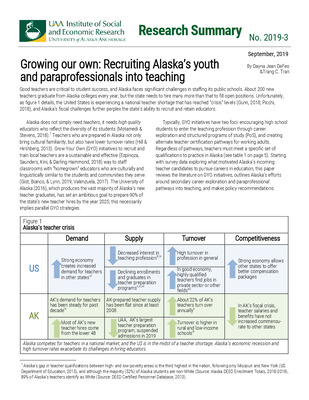
Growing our own: Recruiting Alaska�s youth and paraprofessionals into teaching
Dayna Defeo and Trang Tran
Good teachers are critical to student success, and Alaska faces significant challenges in staffing its public schools. About 200 new teachers graduate from Alaska colleges every year, but the state needs to hire many more than that to fill open positions. This paper explores two key Grow Your Own (GYO) initiatives: education career exploration courses for high school students and career pathways for paraprofessional educators. It reviews the current literature on these initiatives, outlines Alaska's efforts in these areas, and makes policy recommendations.
-
Alaska High School Graduation Rate Trends
Trang Tran and Alexandra Hill
This paper examines trends in Alaska public high school graduation rates from academic year 2010-11 to 2015-16 and explores differences across demographic groups. We focus specifically on students from public neighborhood high schools. These are publicly-funded schools run by district or Regional Educational Attendance Area school boards serving all residents within school attendance boundaries. These schools represent about 88% of Alaska�s high school students.
-
Early college placement testing: Outcomes and impacts of the Early ACCUPLACER partnership
Dayna Jean DeFeo
The Early ACCUPLACER Program was administered in partnership between the University of Alaska (UAA) and Anchorage School District (ASD) between 2006 and 2013. Using the UAA placement test (ACCUPLACER) as an instructional tool, the program intended to help students understand the differences between high school graduation requirements and college-level coursework. Test scores were used to advise students to take more rigorous high school curricula so they would be better prepared for the academic expectations of the college environment. In its seven years of operation, the program served thousands of ASD students. This report reviews Early ACCUPLACER test scores and subsequent academic performance for high school juniors and seniors who tested in the 2009-2010 and 2010-2011 academic years. The data show that, at the time of testing, many of those high school students’ test scores would place them into developmental classes in college. This analysis was unable to examine high school transcripts to see whether or not students heeded advice to take additional and more rigorous high school courses; however, by following the participants who subsequently attended college in the UA system1, the data show: • Students who participated in the program did not exhibit substantively higher college placement test scores than other incoming students who did not receive the intervention. • Most students who participated in the program performed better on the test at the time of college matriculation than when they took it in high school, but the increases in performance, on average, were not large enough to change their recommended course placements. For approximately a quarter of students, test performance decreased between high school and college. • Upon matriculation, more students needed developmental coursework in math than in English or reading. • Upon attending college, between two-thirds and three-quarters of the Early ACCUPLACER program participants performed well enough in their first year to meet eligibility requirements for federal financial aid. • Persistence rates for Early ACCUPLACER participants were slightly higher than the overall UAA rates; however they were similar to other recent high school graduates, who tend to have higher persistence rates than nontraditional-aged students. The data suggest that the program did not significantly impact the college readiness or later college performance for its participants who later attended UA. However, the data and literature suggest opportunities to use high school-college partnerships as part of a robust outreach agenda. Recommendations include evaluating the relationship between high school course-taking behavior and college readiness, and broadening the definition of “college readiness” to include other attributes known to promote success.
-
The Cost of Teacher Turnover in Alaska
Dayna Jean DeFeo, Trang Tran, Diane Hirshberg, Dale Cope, and Pamela Cravez
Low teacher retention - high turnover - affects student learning. Teacher recruitment and retention are challenging issues in Alaska. Rates vary considerably from district to district and year to year, but between 2004 and 2014, district-level teacher turnover in rural Alaska averaged 20%, and about a dozen districts experienced annual turnover rates higher than 30%. High turnover rates in rural Alaska are often attributed to remoteness and a lack of amenities (including healthcare and transportation); teachers who move to these communities face additional challenges including finding adequate housing and adjusting to a new and unfamiliar culture and environment. Though urban districts have lower teacher turnover rates, they also have challenges with teacher recruitment and retention, particularly in hard-to-fill positions (such as special education and secondary mathematics) and in difficult-to-staff schools. Annually, Alaskan school districts hire about 1,000 teachers (500-600 are hired by its five largest districts), while Alaska’s teacher preparation programs graduate only around 200. The costs associated with teacher turnover in Alaska are considerable, but have never been systematically calculated,1 and this study emerged from interests among Alaska education researchers, policymakers, and stakeholders to better understand these costs. Using data collected from administrators in 37 of Alaska’s 54 districts, we describe teacher turnover and the costs associated with it in four key categories: separation, recruitment, hiring, and induction and training. Our calculations find that the total average cost of teacher turnover is $20,431.08 per teacher. Extrapolating this to Alaska’s 2008-2012 turnover data, this constitutes a cost to school districts of approximately $20 million per year. We focused on costs to Alaskan school districts, rather than costs to individual communities, schools, or the state. Our calculation is a conservative estimate, and reflects typical teacher turnover circumstances - retirement, leaving the profession, or moving to a new school district. We did not include unusual circumstances, such as mid-year departures or terminations. Our cost estimate includes costs of separation, recruitment, hiring, and orientation and training, and excludes the significant costs of teacher productivity and teacher preparation. We suggest that not all turnover is bad, nor are all turnover costs; and emphasize the need to focus on teacher retention as a goal, rather than reducing turnover costs. Even with conservative estimates, teacher turnover is a significant strain on districts’ personnel and resources, and in an era of shrinking budgets, teacher turnover diverts resources from teaching and learning to administrative processes of filling teacher vacancies. Our recommendations include: • Better track teacher turnover costs • Explore how to reduce teacher turnover costs • Support ongoing research around teacher turnover and its associated costs • Explore conditions driving high teacher turnover, and how to address them
-
Good collaborations: A case study of the Health Information Technology partnership
Dayna Jean DeFeo
The Health Information Technology grant was a collaborative partnership between the Cook Inlet Tribal Council (CITC), the University of Alaska Community & Technical College (UAA CTC) and the University of Alaska Southeast (UAS) to establish the infrastructure for a distance-delivered Occupational Endorsement in Health Information Technology. This document describes a case study research project that explored the activities of the collaboration, specifically as they pertain to student services and outcomes. Student eligibility criteria included: Alaska Native, low-income, GED or high school diploma, and a 10th grade TABE test score; many of the student participants exhibited demographic characteristics that placed them at high risk for noncompletion. Ultimately, 10 of 25 (40%) completed the credential, and of these graduates, five are continuing their postsecondary studies for an associate’s or bachelor’s degree. These success rates that exceed national averages for community college students prompted the team to explore the program elements that contributed to student success. A qualitative case study collected interview data from student completers, program staff, and faculty. It also reviewed program documents, and included visits to the physical spaces where the program was delivered. Tangible or material resources that contributed to the program’s success included stipends for student tuition and fees plus hourly compensation for time spent in class; the provision of laptops; adequate technology; staff and services that supported college transitions, social and personal needs, and academic success; a face-to-face kickoff event; and a cohort model. Qualitative aspects of the program that fostered success include staff commitment and positive attitude; clear roles for partners with a distributed workload; alignment of program objectives to each of the partners’ missions; communication; and student perseverance. Program elements that need to be revised, expanded, or improved prior to a second iteration include course sequencing, recruitment, technology, class times, and additional stipends. Opportunities for additional programming include industry involvement, career exploration, options for students who “change majors” or decide that the HIT field is not a good fit for their interests, job seeking and career planning support, additional attention to college readiness and soft skills, and incorporation of Alaska Native culture. A review of program elements that worked and need improvement identified opportunities to better align theory and philosophy, and to strengthen communication between staff and faculty who have complementary responsibilities to one another and to students. These discussions are recommended in order to develop more intentional and focused recruiting, to strengthen communication, and to develop a more culturally responsive curriculum. Though the program does not yet present itself as a best practice model, the program strengths and lessons learned were used to develop considerations for other programs and partnerships wishing to develop similar delivery methods.
-
Good collaborations: A case study of the Health Information Technology partnership
Dayna Jean DeFeo
The Health Information Technology grant was a collaborative partnership between the Cook Inlet Tribal Council (CITC), the University of Alaska Community & Technical College (UAA CTC) and the University of Alaska Southeast (UAS) to establish the infrastructure for a distance-delivered Occupational Endorsement in Health Information Technology. This document describes a case study research project that explored the activities of the collaboration, specifically as they pertain to student services and outcomes. Student eligibility criteria included: Alaska Native, low-income, GED or high school diploma, and a 10th grade TABE test score; many of the student participants exhibited demographic characteristics that placed them at high risk for noncompletion. Ultimately, 10 of 25 (40%) completed the credential, and of these graduates, five are continuing their postsecondary studies for an associate’s or bachelor’s degree. These success rates that exceed national averages for community college students prompted the team to explore the program elements that contributed to student success. A qualitative case study collected interview data from student completers, program staff, and faculty. It also reviewed program documents, and included visits to the physical spaces where the program was delivered. Tangible or material resources that contributed to the program’s success included stipends for student tuition and fees plus hourly compensation for time spent in class; the provision of laptops; adequate technology; staff and services that supported college transitions, social and personal needs, and academic success; a face-to-face kickoff event; and a cohort model. Qualitative aspects of the program that fostered success include staff commitment and positive attitude; clear roles for partners with a distributed workload; alignment of program objectives to each of the partners’ missions; communication; and student perseverance. Program elements that need to be revised, expanded, or improved prior to a second iteration include course sequencing, recruitment, technology, class times, and additional stipends. Opportunities for additional programming include industry involvement, career exploration, options for students who “change majors” or decide that the HIT field is not a good fit for their interests, job seeking and career planning support, additional attention to college readiness and soft skills, and incorporation of Alaska Native culture. A review of program elements that worked and need improvement identified opportunities to better align theory and philosophy, and to strengthen communication between staff and faculty who have complementary responsibilities to one another and to students. These discussions are recommended in order to develop more intentional and focused recruiting, to strengthen communication, and to develop a more culturally responsive curriculum. Though the program does not yet present itself as a best practice model, the program strengths and lessons learned were used to develop considerations for other programs and partnerships wishing to develop similar delivery methods.
-
Pathways to College Preparatory Advanced Academic Offerings in the Anchorage School District
Rosyland Frazier
There are many ways a child in the Anchorage School District (ASD) can access advanced course offerings. To a parent these pathways may seem complex. ASD offers options for gifted and highly gifted students at the elementary and middle school level, and accelerated, and enriched learning opportunities such as honors and advanced placement courses at the secondary level. These opportunities, though linked, are not the same, nor do they necessarily follow from one to another in a straight path. Moreover, pathways to and through these opportunities can be quite different. Offerings are different at the elementary, middle and high school levels, with differing qualifications and eligibility. And, some of the programs are only offered in a few particular schools. This variety provides lots of flexibility. It also creates a complex path of choices and decisions. In all of these pathways and choices, active advocacy by a parent is necessary to ensure that their child receive the best and most appropriate opportunities. In this report we describe the many advanced and accelerated learning opportunities available in Anchorage elementary, middle and high schools, and the ways students can access these opportunities. We provide visuals including figures, tables and text to highlight the pathways to and through advanced offerings from Kindergarten to 12th grade. This document is based upon publicly available information. We have combined information from the ASD gifted program website the ASD High School Handbook, the ASD High School Program of Studies guide, and minutes of the ASD Board meetings. We also spoke with staff in the gifted program at ASD. Individual school-level issues that are outside of ASD policy and procedures have not been included. This report focused on the services, programs and schools within the Anchorage School District that service as pathways to college preparation and advance academic course offerings. As we describe in more detail in this report, there are very different offerings and paths at the elementary, middle and high school. In general, there are gifted and highly gifted programs at the elementary and middle school level, and a highly gifted program at the high school level. At all school levels, the highly gifted programs are offered at a limited number of schools. In high school, all students (including those in the highly gifted program) have the opportunity to take honors and advanced placement classes. Math is not included in the middle and high school gifted program. Math instead is a curriculum progression. Advanced math opportunities usually start in 6th grade, when students can choose placement into math courses that are a higher than the usual level. Opting for advanced math in 6th grade puts a student on track to reach Algebra I in 8th grade and calculus in 12th. At the elementary school level ASD operates gifted programs in all schools and a highly gifted program in one. There are also alternative and optional schools, which offer accelerated and enriched learning environments. If a student is in the highly gifted or gifted program in elementary school, he or she usually transitions to gifted and highly gifted middle school programs. In middle school these programs 3 include gifted language arts and science classes. Students who were not a part of the gifted program in elementary school can access the middle school gifted program, by testing in. Many optional and alternative programs provide enriched and accelerated classes to all students in them. For high school students there is a greater variety of advanced offerings. Starting in 9th grade there are honors and Advanced Placement (AP) courses, Credit-by-Choice options, and optional programs within the high schools and alternative schools. Students in the middle school gifted and highly gifted program have the opportunity to transition into the high school Highly Gifted Program. The following table provides a look at advanced offerings at different school levels. Each of these offerings is discussed in the report.
-
Pathways to College Preparatory Advanced Academic Offerings in the Anchorage School District
Diane Hirshberg and Rosyland Frazier
There are many ways a child in the Anchorage School District (ASD) can access advanced course offerings. To a parent these pathways may seem complex. ASD offers options for gifted and highly gifted students at the elementary and middle school level, and accelerated, and enriched learning opportunities such as honors and advanced placement courses at the secondary level. These opportunities, though linked, are not the same, nor do they necessarily follow from one to another in a straight path. Moreover, pathways to and through these opportunities can be quite different. Offerings are different at the elementary, middle and high school levels, with differing qualifications and eligibility. And, some of the programs are only offered in a few particular schools. This variety provides lots of flexibility. It also creates a complex path of choices and decisions. In all of these pathways and choices, active advocacy by a parent is necessary to ensure that their child receive the best and most appropriate opportunities. In this report we describe the many advanced and accelerated learning opportunities available in Anchorage elementary, middle and high schools, and the ways students can access these opportunities. We provide visuals including figures, tables and text to highlight the pathways to and through advanced offerings from Kindergarten to 12th grade. This document is based upon publicly available information. We have combined information from the ASD gifted program website the ASD High School Handbook, the ASD High School Program of Studies guide, and minutes of the ASD Board meetings. We also spoke with staff in the gifted program at ASD. Individual school-level issues that are outside of ASD policy and procedures have not been included. This report focused on the services, programs and schools within the Anchorage School District that service as pathways to college preparation and advance academic course offerings. As we describe in more detail in this report, there are very different offerings and paths at the elementary, middle and high school. In general, there are gifted and highly gifted programs at the elementary and middle school level, and a highly gifted program at the high school level. At all school levels, the highly gifted programs are offered at a limited number of schools. In high school, all students (including those in the highly gifted program) have the opportunity to take honors and advanced placement classes. Math is not included in the middle and high school gifted program. Math instead is a curriculum progression. Advanced math opportunities usually start in 6th grade, when students can choose placement into math courses that are a higher than the usual level. Opting for advanced math in 6th grade puts a student on track to reach Algebra I in 8th grade and calculus in 12th. At the elementary school level ASD operates gifted programs in all schools and a highly gifted program in one. There are also alternative and optional schools, which offer accelerated and enriched learning environments. If a student is in the highly gifted or gifted program in elementary school, he or she usually transitions to gifted and highly gifted middle school programs. In middle school these programs 3 include gifted language arts and science classes. Students who were not a part of the gifted program in elementary school can access the middle school gifted program, by testing in. Many optional and alternative programs provide enriched and accelerated classes to all students in them. For high school students there is a greater variety of advanced offerings. Starting in 9th grade there are honors and Advanced Placement (AP) courses, Credit-by-Choice options, and optional programs within the high schools and alternative schools. Students in the middle school gifted and highly gifted program have the opportunity to transition into the high school Highly Gifted Program.
-
Salary & Benefits Schedule and Teacher Tenure Study
Matthew Berman, Alexandra Hill, Diane Hirshberg, and Dayna DeFeo
-
Salary & Benefits Schedule and Teacher Tenure Study
Diane Hirshberg, Matthew Berman, Dayna Jean DeFeo, and Alexandra Hill
House Bill 278, passed by the legislature in spring 2014, instructed the Department of Administration to “present to the legislature a written proposal for a salary and benefits schedule for school districts, including an evaluation of, and recommendations for, teacher tenure” (Sec. 52). In order to meet this mandate, the Alaska Department of Administration contracted with the UAA Center for Alaska Education Policy Research (CAEPR) to produce the following deliverables: Develop geographic cost differentials for different school districts Develop base salary and benefit schedules for teachers and principals Describe superintendent duties, compensation, and responsibilities in Alaska districts Prepare a list of different benefit options school districts offer their employees and their associated costs Provide recommendations regarding teacher tenure policy Describe similarities and differences between the certified and classified labor markets in Alaska Each section of this report responds to a specific task or responsibility from this list.
Printing is not supported at the primary Gallery Thumbnail page. Please first navigate to a specific Image before printing.