-
Evaluation of the U.S. Army Corps of Engineers' Water and Sanitation Project in the Village of Buckland, Alaska - Phase 2
Sharman Haley and Amy Wiita
The U.S. Army Corps of Engineers is the lead agency for a multi-year sanitation pilot project in the village of Buckland, in Alaska's Northwest Arctic Borough. Providing safe drinking water and sewage disposal for rural communities has been and continues to be a major public policy goal in Alaska. The federal and state governments have spent more than $1 billion building sewer and water facilities in rural Alaska in the past several decades, but many unsafe and inadequate water and sewer systems remain. A wide range of government agencies and Native organizations have been involved in rural sanitation projects, but until recently one notable exception was the U.S. Army Corps of Engineers. The corps has regulatory authority over and provides technical expertise for water-related projects across Alaska—for example, oil, gas, and mining activities that affect wetlands. But historically it has not been involved in providing sanitation systems in rural Alaska. That changed in 1997, when Congress asked the corps to apply its expertise with cold region design, construction, and operation of water and sewer facilities to projects in rural Alaska. This report evaluates just the planning and the phase one design activities of that pilot project. The Environmental Protection Agency hired the Institute of Social and Economic Research (ISER) to do this evaluation.
-
An Assessment of Safety Belt Use In Alaska Summer 2003
Virgene Hanna
To be eligible for certain federal grants, states must document levels of compliance with seatbelt laws. During June, July and August of 2003, ISER researchers recorded and analyzed seat belt use by drivers and front seat passengers in both passenger cars and trucks. In the sample area (which includes 85 percent of the state's population), 80 percent of drivers and 76 percent of outboard passengers were wearing seatbelts. these numbers reflect an increase of just over 13 percent over what was observed in 2002.
-
Kids Count Alaska 2003
Virgene Hanna and Claudia Lampman
This year's spotlight for the Kid's Count Alaska Data Book is child health. As many as 12,000 more children in Alaska could qualify for a government-funded program that provides health care coverage for children without health insurance, according to a non- profit group working to let more Alaskans know about the program. Denali KidCare is an extension of Medicaid for children from uninsured families whose income is somewhat too high to qualify them for Medicaid. In 2003, children whose family income was less than 175 percent of the federal poverty level could apply. About 22,000 children were enrolled in the program during 2002, and the estimate of 12,000 additional children who could be eligible is based on U.S. census information about family income. The 2003 Youth Risk Behavior Survey found that Alaska high-school students are only about half as likely to use inhalants or smoke cigarettes as they were in 1995, and significantly less likely to drink, to fight, and to have sex without using condoms. The decline in inhalant use is especially welcome news, since sniffing gasoline fumes has killed a number of teenagers in Alaska Native villages in recent years. Students in Alaska are also now less likely than students nationwide to use inhalants—and to smoke or get into fights. On almost all measures, fewer Alaska students reported risky behavior in 2003 than in 1995, the last time this survey was administered in school districts statewide. So the recent news is good, but many high-school students are still putting their health—especially their long-term health—and safety at risk.
-
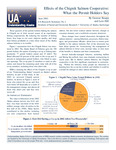
Effects of the Chignik Cooperative: What the Permit Holders Say
Alexandra Hill and Gunnar Knapp
The value to fishermen of the 2002 Alaska salmon harvest was $141 million—less than one-third of the $481 million average value of catches in the first half of the 1990s. Many factors contributed to this decline, including not only competition from farmed salmon, but also lower sockeye salmon harvests, changes in consumer demand, and a worldwide economic slowdown. These changes have created discussions throughout the salmon industry—among fishermen, processors, fishery managers, and government officials—about how to restore profitability to the salmon industry. Part of the discussion has been about options for “restructuring” the management of salmon fisheries to lower costs, increase value, or steer more of the benefits to Alaskans and their communities.
-
Human Dimensions of the Arctic System: Interdisciplinary Approaches to the Dynamics of Social Environment Relationships
Henry Huntington, Matthew Berman, Lee W. Cooper, Larry Hamilton, Larry Hinzman, Knut Kielland, Elizabeth Kirk, Jack Kruse, Amanda Lynch, A. David McGuire, D. W. Norton, and Astrid Ogilvie
In 1997 the National Science Foundation Arctic System Science (ARCSS) program launched the Human Dimensions of the Arctic System (HARC) initiative. Its goal is to “understand the dynamics of linkages between human populations and the biological and physical environment of the Arctic, at scales ranging from local to global.” ....This section describes several HARC projects to give an idea of the scope of the initiative and the breadth of inquiry that has so far been undertaken.
-
Leaving Home, Returning Home: Migration as a Labor Market Choice for Alaska Natives
Lee Husky, Matthew D. Berman, and Alexandra Hill
We investigate determinants of the pattern of recent migration of Alaska Natives between rural homelands and urban areas. A review of the literature on moving in the North American North suggests that economic opportunities draw migrants, although such opportunities must be viewed in the context of the mixed subsistence-cash economy prevailing in rural areas of the region. Consequently, we model Native migration as a simultaneous decision with labor market participation in a mixed economy. Estimated equations explaining individual Alaska Native migration choices using the U.S. Census Public Use Microdata Sample (PUMS) are consistent with the model, and also suggest that perceived opportunities differ between women and men.
-
University of Alaska Engineering Programs: A Community View
Mary Killorin and Patricia DeRoche
The University of Alaska is developing a strategic plan for using its engineering resources to meet the needs of the engineering community. The goal of the university is to graduate enough engineers to meet the current and anticipated employment needs in engineering, as well as to provide appropriate professional development courses. Working from a list provided by the UAF and UAA engineering deans, we conducted 35 interviews with representatives of 30 private companies and government agencies. This report summarizes what we learned in those interviews. We start with a description of our methodology (including a summary of the limited information we were able to collect on the numbers and types of engineers employed by organizations we surveyed). In the main part of the report we present a qualitative analysis of respondents’ answers, grouped under four headings—current and future needs for engineers; ability of the University of Alaska engineering programs to meet the employment needs of the engineering community; recommended changes and initiatives for the university’s engineering programs; and observations to share. We then summarize our conclusions. Appendixes A and B present our letter to respondents and our telephone interview script.
-
Options For Restructuring Alaska Salmon Fisheries
Gunnar Knapp
The paper provides a very brief introduction to the very complicated topic of options for restructuring Alaska salmon fisheries. By "restructuring" we mean any change in the rules affecting how, where, when, and by whom, salmon are harvested in Alaska. The main goal of this paper is to show that there are many different ways to go about restructuring. the choices are not simply between broad options such as "permit stacking" or "buybacks" or "co-ops", but also - and critically - how those options are designed and implemented. Prepared for a panel discussion for the Alaska Legislature's Fish Caucus on "Restructuring the Salmon Industry: A discussion of Fishery Management Models".
-
Federal Spending and Revenues in Alaska
Eric Larson and Scott Goldsmith
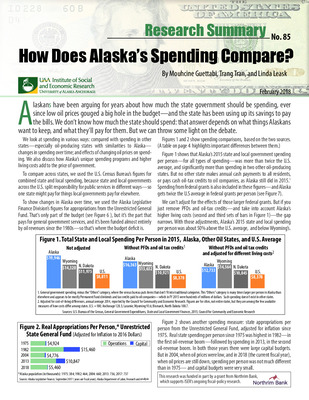
This report describes the flows of federal money in and out of Alaska. The report focuses on the period from 1983 through 2002 to identify patterns and changes in federal spending in the state. The report identifies the major components, departments, programs, and types of federal spending in Alaska and describes how each has changed over time. This analysis provides the basis for understanding the significant role the federal government has played in the Alaska economy
-
What Does $7.6 Billion in Federal Money Mean to Alaska?
Eric Larson, Linda Leask, and Scott Goldsmith
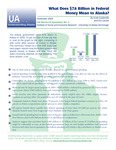
The federal government spent $7.6 billion in Alaska in 2002. To get an idea of how big that is, look at the graph to the right, comparing it with some other sources of money in Alaska. This summary—based on a new ISER study —reports how the federal government spends money in Alaska and how much the state’s economy depends on that spending. The short answer: a lot. This summary is based on the ISER report, Federal Spending and Revenues in Alaska (2002).
-
Healthy Nations Initiative Evaluation: The Stories and Lessons of Fighting Substance Abuse in Native American Communities
Philip May, Timothy Taylor, and Randy Moss
In this program, tribes and urban American Indian organizations were invited to submit proposals for projects to address their high-priority health problems, emphasizing activities to prevent illness and injury and to improve the health of infants, children, youth, and the elderly. Although the 15 grantees selected in Healthy Nations were a diverse group, ranging from the Eastern Band of Cherokee in North Carolina to the Norton Sound Health Corporation in Alaska, there were many similarities in their strategies. The grantees' prevention worldview began with "culture" including its dynamic for community acceptance. Program mobilization followed a "recreation" (most frequently based on traditional activities) strategy targeting youth and families. This report will present the stories of these grantees—their successes, the obstacles they have overcome, the challenges that were met.
-
Program Evaluation: Rose Urban Rural Exchange 2003
G. Williamson McDiarmid and Rosyland Frazier
" The Rose Urban Rural Exchange is made possible by a partnership between the Alaska Humanities Forum and the Alaska Native Heritage Center. It's intended to build understanding and a state- wide sense of community by bringing urban students to rural Alaska, and rural students to urban Alaska, to learn about each other's cultures. It will continue through 2004. As in the first year. Urban students traveled from Anchorage to 11 villages in southwest and central Alaska. About 20 urban and 20 rural students participated in the second year of the program-twice Alaska-Shungnak, Kiana, Old Harbor, Ruby, King Cove, Alakunuk, Nanwalek, Kaltag, Pilot Station, Quinhagak, and Scammon Bay (see map). Rural students from these same villages traveled to Anchorage. In most cases, parents of students who traveled from Anchorage hosted the visiting rural students, and vice-versa. Parents also typically attended orientation sessions."
-
Teacher Training Rose Urban Exchange Program Evaluation 2003
G. Williamson McDiarmid and Rosyland Frazier
-
Evaluation of Special Olympics Curriculum
Williamson McDiarmid and Rosyland Frazier
When the 2001 Special Olympics World Winter Games were held in Anchorage in March 2001, among the many benefits Anchorage residents reported was better understanding of people with disabilities. The games brought close to 2,000 athletes with mental disabilities and more than 740 coaches from 70 countries to Alaska. Schools offer one of the best forums to help children with mental disabilities be accepted and included. The Special Olympics World Winter Games Organizing Committee developed several programs to help Alaska school administrators, teachers, and athletic coaches build meaningful opportunities for all students to train and complete together. These included programs for school enrichment, athlete leadership, unified sports, sports partnership, and a partners club. Chapter II provides more detail about the curriculum evaluation surveys. Chapter III profiles the responses of Alaskan educators. Chapter IV discusses the results of our evaluation, and Chapter V describes how future Special Olympics organizing committees might use this information for planning. The appendixes include the survey questionnaires and copies of relevant documents.
-
Special Olympics and Alaska's Special Education Students
Williamson McDiarmid and Rosyland Frazier
The 2001 Special Olympics World Winter Games were held in Anchorage in March 2001, bringing close to 2,000 athletes with mental disabilities and more than 740 coaches from 70 countries to Alaska. As part of the planning for the 2001 winter games, the Game Organizing Committee established the Special Olympics School Enrichment Program. With funding from the U.S. Department of Education, the School Enrichment Program contracted with the Institute of Social and Economic Research (ISER), at the University of Alaska Anchorage, to learn more about Alaska’s special education students. Knowing how many special education students there are in Alaska, where they live, and what their disabilities are could be quite useful to Special Olympics Alaska in its efforts to recruit more school-age athletes into local area and school programs. Also, more information about Alaska’s special education students can also help Special Olympics Alaska move toward another of its goals: bringing children with and without disabilities together in classrooms, on the playing fields, and in other activities.
-
Rural Educator Preparation Partnerships: Partnering to Success
Williamson McDiarmid and Alexandra Hill
Alaska, like other states, faces a teacher shortage. Like other states, the shortage is geographically specific. That is, shortages occur only in some schools and some communities. In Alaska, the majority of the schools facing shortages are in rural communities off the road system. These schools, year in and year out, have difficulty attracting and retaining teachers. In fact, the 18 school districts with the highest turnover rates in the state-that is, rates averaging 20 percent annually over the period 1996-2000-are all, with one exception, remote rural districts (McDiarmid, 2002). Averaging turnover rates and using district rather than school data mask the fact that, each year, some remote rural schools experience I00 percent turnover. Section 2 of this report evaluates the program's success in meeting objectives one through four. The fifth objective-to evaluate REPP graduates in the classroom-calls for more directly assessing whether REPP has succeeded in putting well- qualified teachers into rural Alaskan classrooms. Section 3 discusses our methodology for and findings from those observations.
-
Effective Local Institutions for Collective Action in Arctic Communities
David Natcher, Sharman Haley, Gary Kofinas, and Walt Parker
-
Methods for Rural / Non-Rural Determinations for Federal Subsistence Management in Alaska - Final and Summary Reports
Robert Wolfe and Victor Fischer
This report presents alternative methodologies for identifying rural and non-rural areas for federal subsistence management in Alaska. It is the final report for the project, Rural/Non-Rural Determinations for Federal Subsistence Management in Alaska (Contract No. 701811CO58), U.S. Fish and Wildlife Service, Alaska Region. The project was a joint research effort of the Institute of Social and Economic Research (ISER) at the University of Alaska, Anchorage, and Robert J. Wolfe and Associates. The report develops two alternative methodologies for distinguishing rural and non-rural populations in Alaska for federal subsistence management. The methodologies use measures drawn from the federal decennial census and the State of Alaska’s harvest records, among other relevant data sources. An overriding goal of the project was to use a minimal number of criteria that clearly, effectively, and defensibly distinguish between rural and non-rural populations. The two methodologies are tested on a selection of Alaska communities.
-
Cataloging of Historical and Current Legislative Decisions, Medical Practices and Agency Policies Regarding FAS
Alexandra Edwards
As part of the conditions of funding the statewide Alaska FAS Prevention Project, SAMHSA requested that the project be evaluated by an independent team of evaluators. This evaluation contract was awarded to the Center for Human Development (CHD) at the University of Alaska Anchorage (UAA), with the request that the evaluation be conducted by an interdisciplinary team of evaluators from across the UAA campus. Staff at CHD subsequently selected various professionals from the UAA community to build the Evaluation Team and to divide the work involved in the evaluation of the FAS Prevention Project. The FAS Project Principal Evaluation Team selection began in February 2001 (3rd Quarter of FY 01 of the grant). In August 2001, a comprehensive evaluation plan was submitted to the FAS Advisory Team and State Office of FAS for review and approval. Following submittal of the evaluation plan application to the University of Alaska Institutional Review Board (IRB) and receipt of funding from the state in August 2001, the detailed actions defined in the Diagnostic Evaluation Plan were initiated in October 2001 (2nd Quarter of FY 02 of the grant). The Alaska Comprehensive and Specialized Evaluation Services (ACSES) was one of the groups approached by CHD to participate as a member of the FAS Project Principal Evaluation Team. ACSES was honored to take on the evaluation of diagnosis-related activities, committing to activities to meet five overarching goals. One of these goals was the development of a catalog of historical and current legislative decisions, medical practices, and agency policies regarding FAS and ARBDs in Alaska. This report provides an update on activities and findings about this goal to date.
-
Summary Report of the Alaska Multidisciplinary FAS Diagnostic Team Data
Alexandra Edwards
This report presents a thorough analysis of the diagnostic data reported by the Alaska Multidisciplinary FAS Diagnostic Teams. Included is a summary of the teams’ data from 1999 through June 2002. The primary purpose of this report is to provide feedback to teams regarding their productivity and outcomes, with an emphasis placed on providing information that will be useful to individual teams, the State Office of FAS, and ultimately the citizens of Alaska. As of the writing of this report, six fully functional diagnostic teams are conducting FASD diagnoses in the state of Alaska, six additional teams are in developmental stages, and two teams have been disbanded. Using the DHSS Office of FAS Diagnostic Team Data Collection Reports, eight of these 14 diagnostic teams submitted 314 completed datasheets. Of these 314 datasheets, two did not include a 4-digit diagnosis and nine were duplicates, leaving a total of 303 usable datasheets. The teams that submitted datasheets and their corresponding number of assessments are as follows: Barrow (one), Bethel (80; one without diagnosis), Bristol Bay (4), Copper Center (18), Fairbanks (11), Kenai/Soldotna (86), Providence Alaska Medical Center (13), and Southcentral Foundation (92; one without diagnosis). Of the 303 individuals for whom diagnoses were submitted, 32 (10.6%) were diagnosed with FAS or atypical FAS.
-
Long-Term Outlook for Salmon Returns to Alaska
Bruce Finney and Milo Adkison
With the exception of some western Alaska stocks, Alaska's salmon populations are numerically healthy. However, even fisheries on abundant stocks are suffering economically due to sharp declines in the value of the catch. The abundance of Alaskan salmon stocks has fluctuated greatly, both in modern times and prehistorically. These fluctuations are thought to be caused by multi-decadal changes in environmental conditions over large areas that affect many other species as well as salmon. Forecasts of salmon returns are not very reliable, and the potential for significant improvement in their accuracy is low in the short term. A viable fishing industry must be able to adapt to dramatic, persistent, and unanticipated changes in harvest levels. Nonetheless, Alaska's salmon stocks should continue to produce healthy harvests for the foreseeable future, barring significant damage to their habitat either via local activities or global warming.
-
The Alaska Permanent Fund Dividend: An Experiment in Wealth Distribution
Oliver Scott Goldsmith
For 20 years every Alaska citizen has received an equal share annual Dividend distribution from the Alaska Permanent Fund, capitalized by a portion of the revenues from publicly owned oil production. As the fund has grown in value, the size of the annual dividend has increased so that today about $1 billion (US) is distributed annually to 600 thousand citizen- directly accounting for about 6 percent of total household income. This paper begins by reviewing the creation, history, and structure of the Fund and Dividend. It then discusses the economic, social, and political impacts of the Dividend. Next it considers possible changes in the Dividend and Fund in response to changing economic conditions within the state. Finally it discusses the possible implications of the Alaska experience for other regions and for the concept of the basic income.
Printing is not supported at the primary Gallery Thumbnail page. Please first navigate to a specific Image before printing.