-
Sustainable Economic Development for the Prince William Sound Region
Ginny Fay, Steve Colt, and Tobias Schwoerer
The Prince William Sound area possesses an array of the attractions that draw people to visit and live in Alaska: dramatic peaks and glaciers, an intricate coastline, old growth rainforest, alpine meadows, abundant wildlife, and distinct small towns and villages. It offers a valuable combination of accessibility and wilderness solitude. The area has many of the resources and products needed to position itself as a premier destination for the adventure, cultural, educational and ecotourism market segments. A key challenge for the region is to capture these economic opportunities while maintaining control over residents’ economic future and quality of life. The goals of this project are to: • Identify opportunities and challenges to diversify and grow the Prince William Sound economy while improving the quality of life for Prince William Sound residents and maintaining the exceptional natural environment. • Help foster and strengthen partnerships for economic development. • Consider new pathways to a prosperous economic future.
-
Program Evaluation: Rose Urban Rural Teacher Training 2005 (Amended)
Rosyland Frazier and Williamson McDiarmid
Based on successful experiences in the Student Exchange component of the Rose Urban- Rural Exchange, the Alaska Humanities Forum developed Teacher Training to give urban teachers hands-on experience in rural Alaska Native culture. In 2002, the forum began this summer program for teachers, sending middle- and high-school teachers to Alaska Native culture and spirit camps in rural Alaska. At these camps, urban teachers are exposed to Native arts and crafts, history, subsistence lifestyle, language, and dance. Also at these camps, Alaska Native elders pass on their stories and culture to young people. Teachers go through an orientation before they leave for camp, and after their return they complete lesson plans based on their experiences. These individual lesson plans are compiled in a notebook of lesson plans that are available to all Alaska teachers to help them bridge the urban-rural divide. Also, because a semester of Alaska Studies is now a statewide graduation requirement, these lesson plans constitute a valuable resource for Alaska studies courses.
-
Memorandum on the Economic and Demographic Impacts of a Knik Arm Bridge
Scott Goldsmith
The base case projection for the economy and population of the state is very similar to the base case projection prepared in 2004 for the Alaska Railbelt electric utilities and published in the document entitled Economic Projections for Alaska and the Southern Railbelt 2004-2030 (ISER, November 2004). A comparison of the major state economic and demographic variables for the two projections is presented in a later chapter of this memorandum. The major difference between the two projections at the state level results from differences in the scenario assumptions driving the projections, as well as some revisions and recalibrations of the model used in the projections. The scenario assumptions driving the base case, as well as the high and low case projections for this study, are presented in a later chapter....Major differences between the current base case and the 2004 base case result from inclusion of ANWR production and gas line construction in the current base case. Prepared for Northern Economics as input to Knik Arm Bridge and Toll Authority [KABATA] Environmental Impact Statement "
-
The DOD Economic Analysis of Eielson Realignment Is Seriously Flawed
Scott Goldsmith
The DOD analysis of the economic impact on Fairbanks of the realignment of Eielson air base concludes that the net loss of 2,940 military and civilian jobs at Eielson would result in the loss of 1,770 additional jobs in the Fairbanks MSA (Fairbanks North Star Borough). This would represent a loss of 8.6% of all jobs, based on an estimate of 54,469 total jobs in the Borough. The loss of 8.6% of all jobs represents the 4th largest hit as a percentage among all 234 regions that would by effected by implementation of the BRAC recommendations. Netting out those bases recommended for closure, and thus available for redevelopment, the negative economic impact on Fairbanks would be exceeded in only one other region (Clovis, New Mexico).
-
The Kenai National Wildlife Refuge: Economic Importance, 2004
Scott Goldsmith, Alexandra Hill, and Darcy Dugan
The Kenai National Wildlife Refuge contributes to the borough economy primarily through the tourism and seafood industries. The refuge’s lakes, mountains and forests are home to abundant animals, birds, and fish. They provide sport fishing and hunting opportunities as well as a variety of non-consumptive activities such as hiking, rafting and bird watching. The refuge also contains breeding and rearing habitat for substantial salmon populations that support sport fishing both on and off the refuge as well as commercial fishing in Cook Inlet. Three changes in the significance and impact of the refuge emerge in comparing this report with ISER’s previous estimates published in The Kenai National Wildlife Refuge: Economic Importance (May, 2000). The most striking is the continued decline in the value of Cook Inlet commercial salmon fisheries. Harvest values since 2000 are among the lowest in the last 30 years. Increased competition keeps prices low enough that even years with good returns have low total harvest values. Employment generated by commercial fishing attributable to the refuge has declined by 40 percent and income by almost 70 percent.
-
2005 Alaska Construction Spending Forecast
Scott Goldsmith and Mary Killorin
Construction spending is one of the important contributors to overall economic activity in Alaska. It supports firms not only in the construction industry itself, but also construction activity “hidden” in other sectors of the economy such as oil and gas and mining. This is the second year we have prepared a forecast of construction spending, and our categories of spending are not exactly comparable to those last year. Consequently it is not possible to directly compare the forecasts by category between 2004 and 2005. Although we have not conducted a formal year-end review of construction spending in 2004, in the process of collecting information for 2005 we have determined that our projection for 2004 was robust.
-
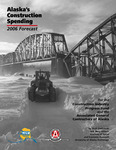
2006 Alaska's Construction Spending Forecast
Scott Goldsmith and Mary Killorin
Total construction spending in Alaska in 2006 will be $6.525 billion, an increase of 13% from a revised figure of $5.755 billion in 2005. This is the amount of money that will “hit the street” for construction during the year. Because of increases in the cost of materials during 2005, industry employment and other measures of activity will not expand as much as spending, but 2006 will be another very strong year for the construction industry with some sectors, most notably education, up sharply from 2005. Uncertainty in the forecast for 2006 comes from the likelihood that material prices will continue to be volatile due to strong demand. This may negatively impact some major projects, as was the case in 2005. For example the Alyeska pipeline reconfiguration project was originally scheduled for completion last year, but cost overruns (and possibly other factors) caused total spending to increase substantially and the estimated time for completion to be moved into 2006."
-
Anchorage at 90: Changing Fast, With More to Come
Scott Goldsmith, Linda Leask, and Lance Howe
Anchorage began as a boom town, headquarters for construction of the Alaska Railroad. It’s seen many ups and downs since. But after 35 years of growth triggered by oil development—and boosted lately by an infusion of federal money—the city has grown to 277,000 and its economy is bigger, broader, and more dominant statewide. Despite that growth, the city still depends on resource development and state and federal spending (including military spending). It’s still subject to forces beyond its control, chiefly oil prices and production and federal and state policies affecting the flow of money into the economy. As long as Alaska prospers—and that depends a lot on how the state deals with its long-term fiscal problems - Anchorage will prosper.
-
The Alaska Natural Gas Pipeline: What's It All About?
Lee Gorsuch, Arlon R. Tussing, Larry Persily, Peter Larsen, Scott Goldsmith, Mark Foster, Victor Fischer, Steve Colt, Tim Bradner, and Matthew Berman
Alaska has collected nearly $100 billion in oil revenues (adjusted to today’s dollars) since it became a state. Almost all those revenues have been from oil produced on the North Slope, where the largest known oil field in the U.S. was discovered in 1968. Construction of the trans-Alaska oil pipeline in the 1970s made development of that oil possible. The North Slope also has one of the largest accumulations of natural gas in the country—and for 30 years Alaskans have been hoping for construction of a second pipeline, to carry that gas to market. Gas pipelines have been proposed at times over the years. But none has been built, because investors did not think it was economic. Now, with higher natural gas prices and changes in the North American market, many people think a gas project may be possible. Alaska stands to gain a ot if a gas pipeline is built—a new long-term source of state revenues; more jobs and increased business activity; an increased local property tax base; and a potential new in-state source of natural gas for home heating, electricity, and industrial uses. With future supplies of natural gas from Cook Inlet uncertain, many Alaskans want one or more “spur” pipelines to be built from the main pipeline, to make natural gas available to Alaska communities. But access to the gas will come at a price, and not all Alaskans will benefit equally.
-
Alaska School District Cost Study (2005 Update)
Alexandra Hill, Matthew Berman, and Bradford Tuck
The Legislative Budget and Audit Committee of the Alaska Legislature has asked The Institute of Social and Economic Research (ISER) at the University of Alaska Anchorage to make certain changes and adjustments to the Geographic Cost of Education Index (GCEI) that the American Institutes for Research (AIR) constructed and reported on in Alaska School District Cost Study (January 2003). The requested changes address a number of the questions and criticisms that were raised by ISER in its review of the AIR study (A Review of Alaska School District Cost Study, January 29, 2004). The specific tasks included updating data sets, adjusting the index for actual energy costs, and reviewing travel and budget share assumptions. The most significant task was to address deficiencies in AIR’s certificated personnel compensation component that had been identified in ISER’s initial review. ISER was also asked to re- estimate the overall cost index, once other tasks were accomplished.
-
Alaska Partnership for Teacher Enhancement Survey Summary
UAA Institute for Social and Economic Research
Provides high level results for open-ended questions from the Alaska Partnership for Teacher Enhancement District Questionnaire Fall 2004. No interpretation is provided.
-
Enrollment Trends at University of Alaska Community Campuses
Mary Killorin, Scott Goldsmith, and Alexandra Hill
The level of tuition is only one of many determinants of participation. For example, in recent years strength in job growth, reduced grant funding, and a more restrictive residency requirement for instate tuition have all also negatively impacted participation. Conditions specific to individual campuses, such as consistency of leadership and the natural maturation cycle associated with the introduction of new programs, have also been important. Some of these factors, such as the size and composition of the population and the structure and health of the economy, are beyond the control of the University. However, other factors such as financial aid, program offerings, and marketing can be managed to not only maximize participation but, more importantly, to obtain the best possible balance between access and program availability within the fiscal constraints of the University budget.
-
Salmon Restructuring: Changing Alaska's Salmon Harvesting System: What are the challenges?
Gunnar Knapp and Fran Ulmer
The Chignik fishing co-op is a cautionary tale about why restructuring in Alaska’s salmon fisheries is so hard and so controversial—and why it’s unlikely to happen until Alaskans clarify their goals for the fisheries and establish ways to achieve those goals. It won’t be easy to make changes in Alaska’s salmon harvesting system. Not everyone will benefit; some people could end up worse off. But the costs of doing nothing are also high. Thousands of Alaskans have already seen severe losses in fishing income and in boat and permit values, and many have had to quit fishing for salmon. Salmon is no longer Alaska’s dominant resource industry. But it remains a mainstay of many communities, and if the industry is to become and remain profitable, we need to face—and find ways of addressing—the complex, difficult issue of restructuring. This summary is based upon a longer paper by the same authors, "Challenges in Restructuring Alaska’s Salmon Fisheries" (2004).
-
Student Exchange Rose Urban Rural Exchange Program Evaluation 2005
G. Williamson McDiarmid and Rosyland Frazier
-
Longitudinal Study of First-Year Participants Rose Urban Rural Exchange Program
G. Williamson McDiarmid, Rosyland Frazier, and Alexandra Hill
-
Program Evaluation: Rose Urban Rural Sister School 2005
Williamson McDiarmid and Rosyland Frazier
The Rose Urban-Rural Program has a goal of annually doubling the number of urban and rural schools participating in the Sister School Exchange. In it's third year, the number of schools recruited quadrupled- exceeding the program goal- with eight urban and eight rural schools agreeing to participate in a 2004-2005 school-year exchange. The Sister School program expanded its urban locations to include Juneau, Alaska. This is the first time an urban Southeast Alaska community has been involved with the Rose Urban-Rural Exchange. Spirit Camps in rural Southeast Alaska have previously been a part of the Student and Teacher Training parts of the Rose Urban-Rural Exchange.
-
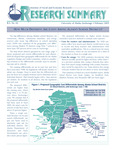
How Much Different Are Costs Amongst Alaska School Districts?
Bradford Tuck, Matthew Berman, and Alexandra Hill
The big differences among Alaska’s school districts—in remoteness, climate, community amenities, and energy sources—also mean big differences in school operating costs. ISER’s new estimates of the geographic cost differences among Alaska’s 53 districts range from 7 percent to more than 100 percent above costs in Anchorage. The existing differentials are set in state law and have been used since 1998; the legislature will decide whether to adopt any changes. Keep in mind that the differentials are just one factor in a complex formula used to determine aid for individual districts. That formula begins with a base amount per student, for students in all districts, that the legislature sets each year. The proposed differentials are higher than the existing ones, which range from 1 to 70 percent above Anchorage’s costs. This summary is based on a more detailed report, Alaska School District Cost Study Update, by Bradford Tuck, Matthew Berman, and Alexandra Hill.
-
The Past and Future of LNG in Alaska
Arlon R. Tussing
Why do negotiations between the State and the North Slope gas producers ignore LNG [liquefied natural gas] export proposals, including that of the Alaska Gasline Port Authority [AGPA]? The three main North Slope gas producers [ConocoPhillips, BP and ExxonMobil], and Alaska’s Murkowski Administration, agree that an overland pipeline from Prudhoe Bay, crossing Canada to the U.S. Midwest, is the most promising transport system under present and foreseeable conditions, for marketing Arctic gas. Nevertheless, plans to ship LNG in “cryogenic” [low-pressure refrigerated] tankers from a Southcentral Alaska port such as Valdez or Kenai, to the Lower 48 or East Asia remain technically plausible marketing alternatives to a transcontinental gas pipeline. Currently, the most prominent proposal for such an alternative is sponsored by the Alaska Gasline Port Authority [AGPA], a coalition of three municipalities—the North Slope and Fairbanks North Star Boroughs, and the City of Valdez—which are located North to South along the route of the TransAlaska oil pipeline from the Arctic Ocean to Prince William Sound.
-
Technology and Managed Care: Patient Benefits of Telemedicine
Matthew D. Berman and Andrea Fenaughty
-
Alaska Air Carrier Operator and Pilot Safety Practices and Attitudes: A Statewide Survey
Matthew D. Berman, Alexandra Hill, and Stephanie Martin
-
Hunting for Models: Grounded and Rational Choice Approaches to Analyzing Climate Effects on Subsistence Hunting in an Arctic Community
Matthew D. Berman and Gary Kofinas
Climate change and uncertain economies challenge small Native communities of the North American Arctic, with their reliance on local fish and wildlife resources. Methodological boundaries of single-discipline analyses limit the contribution of academic research to the real-world questions facing Arctic residents. Oversimplified assumptions and lack of data hamper mainstream economic approaches to project the effects of climate changed on subsistence hunting in a Canadian Arctic community. In our collaboration, we find that rational choice modeling suggests specific questions that help direct the grounded research. Grounded methods provide general relationships and hypotheses as well as data for economic modeling. Using local knowledge (LK) obtained from grounded methods, we estimate a discrete-choice travel-cost model of subsistence hunting, projecting that climate warming may cost a typical household the equivalent of a half day of lost time during a hunting season. Besides providing data needed to make rational choice applications realistic, grounded methods reveal qualitative information essential for understanding relationships. We conclude that integration and synthesis of these disparate analytical approaches provides insights that neither method alone could have produced.
-
Alaska Felony Process: 1999
Teresa White Carns, Larry Cohn, Susie Mason Dosik, Matthew Berman, Stephanie Martin, and Susan McKelvie
The Alaska Supreme Court's Advisory Committee on Fairness and Access recommended that the state assess the relationships between defendants' ethnicities and their treatment by the criminal justice system. At the time of the request, the disproportionate numbers of ethnic minorities at all points in Alaska's criminal justice system were well-known. The main purpose of this work was to identify whether. those disproportions resulted from unjustifiable reasons and amounted to discrimination. Another purpose was to identify other unwarranted disparities, if they existed, based on the defendant's gender, the defendant's type of attorney, the location of the defendant's case, or other inappropriate characteristics. A third purpose was to update descriptive data about the criminal justice system. The Judicial Council collected and examined data from Alaska felony cases from 1999, beginning from the time formal charges were filed through case dispositions by way of dismissal, acquittal, or sentencing. At the time charges were initially filed, the Alaska felony defendants in these cases included disproportionally large numbers of young males, Alaska Natives, and Blacks. The report showed that, after charges were filed, justice for felony defendants in Alaska was, in many respects, substantially equal....In the area of non-presumptive sentencing, sentences were uniformly imposed among ethnic groups in all but Drug offenses. The disparity in this category was limited to Blacks in Anchorage and to Natives outside Anchorage. Matt Berman and Stephanie Martin at the UAA Institute for Social and Economic Research contributed the multivariate analyses used in this report.
Printing is not supported at the primary Gallery Thumbnail page. Please first navigate to a specific Image before printing.