-
Alaska Natives and the "New Harpoon": Economic Performance of the ANCSA Regional Corporations
Steve Colt
In this paper I develop and analyze 20 years of data on the economic performance of the 12 regional corporations created by the Alaska Native Claims Settlement Act of 1971 (ANCSA).The act was a radical departure from previous U.S. policy toward indigenous peoples. Alaska's 75,000 Aleuts, Eskimos, and Indians received almost $1 billion in cash and acquired clear title to more than 40 million acres of land, an area larger than New England. This wealth was vested in 12 regional and almost 200 village-level business corporations. As a group, the 12 regional corporations lost 80 percent of their original cash endowment -- about $380 million -- in direct business operations between 1973 and 1993. But behind this poor overall financial performance is a surprising amount of cross-sectional variation. I first show that allocation of business assets to different economic sectors plays a statistically significant but empirically minor role in explaining this differential performance. I then construct panel data on shareholder employment, wages, and quasirents and test the hypothesis that the regional corporations traded off business profits for Native jobs. The data strongly reject this hypothesis. Quasirents from Native shareholder employment were important to only three firms -- the rest lost money without any countervailing employment. Case history evidence suggests that internal sharing networks and common preferences helped the high-employment firms to deliver both jobs and dividends. Overall, these results suggest caution in the use of group-based lump-sum transfers as economic development tools.
-
Economic Importance of Healthy Alaska Ecosystems
Steve Colt
Alaska's healthy ecosystems are scarce and valuable economic resources. As population, income, education and development pressures increase worldwide, the relative scarcity -- and hence the value -- of these ecosystems is almost certain to increase significantly. However, because most ecosystem services are provided as public goods rather than through private markets, the value of these services must be registered and acted on within the public policy arena. this report presents an itiial assessment of the economic importance of Alaska's ecosystesm in their unimpaired state.
-
What's the Economic Importance of Alaska's Healthy Ecosystems?
Steve Colt
About one quarter of Alaska’s jobs depend in one way or another on the state's fish, wildlife, scenic beauty, recreational opportunities, and public lands. That’s a rough estimate of what healthy ecosystems contribute to the economy. Salmon and other natural assets depend on habitat, clean water, and other benefits from Alaska’s ecosystems.2 Those natural assets in turn support jobs—about 84,000, once we adjust for some double-counting across industries. We include only jobs that depend on healthy ecosystems and natural assets and that are sustainable year after year. About half the ecosystem-related jobs rely on commercial, sport, and subsistence harvests of fish and wildlife. Tourism, recreation, and government management of public lands and resources support the other half. Another way of measuring the economic importance of Alaska’s ecosystems is what economists call “net willingness to pay.” That’s an estimate of how much more Americans would be willing to pay—besides what they already spend— to maintain Alaska’s natural assets. That method allows economists to assign a dollar value to things like scenery. Why would we want to put an economic value on such intangibles? It’s a useful way of show- ing that—aside from other kinds of value—Alaska’s healthy ecosystems have enormous economic value. Our ability to estimate net (or additional) willingness to pay for ecosystem benefits does vary, depending on what’s being valued.
-
Environmental Report for Trans Alaska Pipeline System Renewal Volume 1 of 2 Sections 1, 2, 3, 4
Oliver Scott Goldsmith
This report provides a comprehensive environment analysis of the impacts associated with the renewal of the TAPS right-of-way. The federal council on Environment Quality guidelines contained in 40 CFR 1500-1517 have used to prepare this report so that the requirements of the National Environmental Policy are satisfied. As such, this report describes the proposed action and the dismantlement and removal of TAPS , and restoration of the right-of-way. The report then details the physical, biological, and social-economic environments and the impacts of the proposed action the no-action alternative on the environment, including cumulative effects. Measures to mitigate these impacts are also described.
-
Economic Projections: Alaska and the Southern Railbelt, 2000-2025
Scott Goldsmith
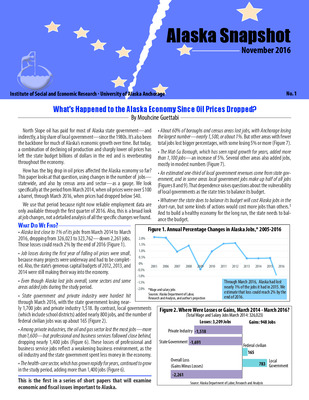
In the 30 years between statehood and 1990, Alaska was dominated by petroleum-driven growth punctuated by a number of boom and bust cycles, each of which has brought the economy to a higher plateau of activity (Figure 1.) Since 1990 the Alaska economy has moved into a period of slower growth because petroleum production—the source of half of state value added—is now in decline. Continued exploitation of petroleum resources, even as production declines, as well as growth in other basic industries such as tourism and mining, will help to offset this loss and stabilize the economy. But dependence on commodity-producing industries means that cycles in the petroleum, fishing, timber, and mining sectors will continue to generate business cycles at the state and regional levels. The large federal and state government presence in the economy means that political decisions made in Washington and Juneau will continue to exert a strong influence on the economy.
-
Reflections on the Surplus Economy and the Alaska Permanent Fund
Scott Goldsmith
The Alaska Permanent Fund was created in 1977, shortly after oil form Alaska's North Slope began flowing to market through the Trans-Alaska Pipeline. It was originally envisioned to serve two general purposes - to set aside a share of oil revenues for the benefit of future generations of Alaskans after the depletion of the oil reserves, and to keep a share of oil revenues out of the hands of the current generation of politicians who could be counted to spend it on wasteful government operations and capital expenditures....The issue is how to design a set of public fiscal institutions that, taking this new revenue into account, will maximize long-term social welfare. Paper presented at a conference held at the University of Alberta, Sept. 2001.
-
Ted Stevens Anchorage International Airport: Economic Significance 2000
Scott Goldsmith
Employment at the Ted Stevens Anchorage International Airport in 2000 is estimated at 9,119 ( annual average), generating an annual payroll of $367 million. This represents about 7% of all the wage and salary jobs in Anchorage and 8% of total payroll. Adding the offsite jobs generated by airport businesses making purchases and workers spending their earnings within the community, the total economic significance of the airport grows to 14,750 jobs with a payroll of $515 million. If the airp01i were a separate community it would be the 5th largest economy in the state. The airport is about 5 times the size one would expect for a community of 260 thousand, but only partly because most of the travel between Anchorage and the rest of the US is by air. Most of the activity at the airport is associated with international air cargo, nonAlaska visitors, and non-Anchorage residents of Alaska. Together these activities at the airport, which bring new money into the economy and contribute directly to the economic base of Anchorage, account for 6,443 jobs and $259 million of payroll. Adding the off site activity generated by these onsite jobs results in a total impact of these basic activities of 10,352 jobs and $361 million of payroll. By way of comparison, the headquarters activity of the oil and gas industry in Anchorage directly employed 3,515 in 1999 with a payroll of $316 million. Viewed this way it is clear that the basic activities at the airport are an important part of the economic base of the community.
-
The Alaska Permanent Fund Dividend Program
Scott Goldsmith
This paper provides a short introduction to the Alaska Permanent Fund Dividend Program - a method for returning a portion of the revenues from petroleum development to the citizens of Alaska as a direct cash payment. It briefly touches on 5 topics - the mechanics of the Dividend, why it was established, its history, its economic, political and social effects, and the future of the Dividend.
-
Racial and Ethnic Diversity in Anchorage
Scott Goldsmith and Rosyland Frazier
In the spring of 2001, the Mayor of Anchorage, George Wuerch, tasked a Kitchen Cabinet Task Force with the goal of developing recommendations to help heal racism in Anchorage. The Institute of Social and Economic Research (ISER) of the University of Alaska Anchorage agreed to assist the Task Force by conducting a series of focus groups in the community. The purpose of these focus groups was to obtain an assessment of attitudes and opinions about the quality of life in Anchorage from the perspective different racial groups and to solicit recommendations for improving race relations within the community....A more detailed analysis of the focus groups, based on a review of the focus group transcripts, would add more depth and detail, but we feel the main ideas identified during the focus groups are described in this report.
-
ANILCA and the Seward Economy
Scott Goldsmith and Stephanie Martin
The Alaska National Interest Lands Conservation Act of 1980 (ANILCA) established the Kenai Fjords National Park and the Alaska Maritime National Wildlife Refuge on the doorstep of Seward, a small community on Resurrection Bay in the Kenai Peninsula of south central Alaska. The community originally opposed both, primarily because citizens felt they would preclude economic development through restrictions on the use of the natural resources of the region. In the first decade after statehood, Seward had lost a large share of its economic base virtually overnight as a result of the Good Friday earthquake in 1964. It struggled through the rest of the decade, but was never able to recover its role as the transportation gateway into south central Alaska, which shifted to the port at Anchorage. In the 1970s growth in the seafood and timber industries, the pipeline construction boom, and state government spending combined to help the economy grow. Still, Seward never was a partner in the oil and gas development that stimulated growth in the western half of the Kenai Peninsula, and market driven fluctuations in both the seafood and timber industries were a continuing source of economic instability. As a result when ANILCA became law, Seward residents saw it as another obstacle to development rather than an opportunity. In fact since ANILCA the Seward economy has expanded and strengthened. Annual average employment has increased at a rate of 3.7 percent per year. The economy hasbecome less dependent on the unstable harvesting and processing of seafood and timber. Through the 1980s the seafood and timber industries did expand, but their economic contributions to the community have fallen in the 1990s. The opening of a state prison in 1988 added another source of stable employment and income. Most of the economic growth, particularly since 1990, has been driven by the visitor industry. Although there is no direct way to track this industry, employment in trade, services, and transportation—the sectors that provide the most visitor-related jobs—grew at an annual rate of 5.9 percent. Retail sales from summer visitors have grown at an 9.9 percent annual rate (inflation adjusted) since 1987.
-
Effectiveness and Fiscal Impact of Homeward Bound
Sharman Haley, Mary Killorin, Priscilla Hensley, Alexandra Hill, Stephanie Martin, Amy Lynn Wiita, and Ben Ungadruk
The Rural Alaska Community Action Program and the Homeward Bound program contracted with ISER to evaluate Homeward Bound, which began in February 1997. This analysis is based on limited data and a small sample - 33 Homeward Bound clients and 35 people who were referred to the program but did not enter. We found a wide variation in how often people use services and which services they use - and the small sample and wide variation limit the ability of statistics to say whether apparent difference are real of chance variations....There are only an estimate 300 chronic, homeless alcoholics in Anchorage (defined as people who have been picked up by the Community Service Patrol at least 30 time in one year). But they're expensive to the community - because they so frequently use state and city rescue and protection services, emergency medical care, and alcohol treatment facilities, among other things. This report finds that the clients of the Homeward Bound program cost the justice system less, use some city services less frequently, and are less likely to need advanced life support services when an ambulance is required.
-
An Assessment of Safety Belt Use In Alaska Summer 2001
Virgene Hanna
To be eligible for certain federal grants, states must document levels of compliance with seatbelt laws. During June, July and August of 2001, ISER researchers recorded and analyzed seat belt use by drivers and front seat passengers in both passenger cars and trucks. In the sample area (which includes 85 percent of the state's population), 63 percent of drivers and 60 percent of outboard passengers were wearing seatbelts. these numbers reflect an increase of just over 1 percent over what was observed in 2000.
-

Kids Count Alaska 2001
Virgene Hanna and Claudia Lampman
Children living in small isolated places lead much different lives from those in bigger communities on the road system. Many villages still lack adequate water and sewer systems, and some still rely on honey buckets. In the past 20 years, state and federal agencies have built sanitation systems in many rural places–but it’s an enormous and ongoing job. Part of the problem is that many areas of Alaska require specially adapted systems that are very expensive to build and operate. In this data book, we look at (1) the indicators of children’s well-being the Kids Count program uses nationwide; and (2) other measures that reflect conditions Alaskan children face—and that illustrate the sharp differences among regions of a state twice the size of the original 13 American colonies.
-

A Village Fish Processing Plant: Yes or No?
Gunnar Knapp
People in many Alaska villages are interested in starting fish processing plants. A fish processing plant can provide markets for fishermen, processing jobs and income for village residents, and many other benefits. But starting and operating a village fish processing plant is not easy, and fish processing plants may not work in every village. This handbook is to help you get started in planning a fish processing plant in your village. It can help you think clearly about whether or not you should start a fish processing plant. It provides step-by-step advice about questions you need to ask and decisions you need to make. As part of this handbook, we have included case studies of experiences some western Alaska villages have had with fish processing plants. These may give you ideas of things to do–and things to avoid–when you are thinking about a fish processing plant for your village.
-
Challenges and Strategies for the Alaska Salmon Industry
Gunnar Knapp
Alaska salmon industry is facing many different challenges. The problem is not just competition from farmed salmon. Other challenges include variable and uncertain salmon runs, overproduction for traditional canned salmon markets, changes in consumer demand, and the current world economic slowdown - to name just a few.... Experience - from Alaska and elsewhere - shows that it is important to be very careful in establishing rights-based management systems....The issues are complex.
-
A Review of Denali Highway Lifecycle Costs
Eric Larson
The Alaska Department of Transportation and Public Facilities (DOT/PF) has considered several alternatives for maintaining the Denali Highway. The Alaska Center for the Environment asked the Institute of Social and Economic Research (ISER) to review published estimates of the cost of maintaining the road to see if they are consistent with standard economic methodology. To conduct this review we relied primarily on two DOT/PF memorandums and a spreadsheet. DOT/PF confined that these documents are the most recent estimates of several relevant publications listed at the end of this report....We supplemented this information with several relevant publications listed at the end of this report. The remainder of this report summarizes our review of maintenance and construction costs of the Denali Highway. We describe the data used in the study, present the primary findings, describe the sensitivity of results to changes in assumptions, suggest future areas of research, and make final recommendations.
-
Preliminary Estimates of the Economic Impact of the Anchorage Smoking Ordinance
Eric Larson
This report outlines preliminary estimates of the economic impact of an ordinance that implemented a ban on smoking in Anchorage restaurants and bars (2000 CIA). This analysis found that there was no detectable negative effect on employment in the hospitality industry by August of 2001. Between 2000 and 2001, employment increased by 10% in restaurants that went from restricted smoking before the ordinance to non-smoking after the ordinance, while employment increased by only 6% in restaurants that continued to allow restricted smoking after the ordinance.
-
Trends in Alaska's People and Economy
Stephanie Martin, Mary Killorin, and Linda Leask
This 16 page document outlines expected trends for Alaska's people and economy between 2001 and 2020. It was prepared for the Alaska Humanities Forum in October 2001 under the theme of "Alaska 20/20 Partnership - Bringing Alaskans Together to Chart Our Future".
-
Alcohol Control and Injury Death in Alaska Native Communities: Wet, Damp and Dry under Alaska's Local Option Law
Matthew D. Berman, Teresa Hull, and Phillip May
-
Alcohol Control by Referendum in Northern Native Communities: The Alaska Local Option Law
Matthew Berman and Teresa Hull
When Alaska became a state in 1959, state laws removed control of alcohol regulation from the federal government and Native communities. In 1981, however, the state legislature changed alcohol laws to give residents broad powers to regulate how alcohol comes into their communities via a local option referendum. By mid-1999, 112 small communities had held 197 alcohol control elections under the state law. Sixty-nine percent of these elections added new restrictions on alcohol, while 13% removed restrictions previously imposed. The remaining 18% of elections did not receive a majority vote needed to change the existing status. Most communities passing local option restrictions chose to ban sale and importation. Although most of these elections occurred during the first eight years after the law was passed, elections continue to occur as the law evolves and as communities debate the merits of alcohol control. Although growing evidence suggests that the local option law may reduce adverse effects of alcohol abuse in Alaska Native communities, its most important contributioncmay be to restore to these communities a limited form of self-government.
-
Cost Analysis of Selected Flush Haul Water and Wastewater Systems in Rural Alaska
Steve Colt
This research memorandum presents and compares estimates of the operating costs of selected flush haul sanitation systems in rural Alaska. The estimates are based on actual operating experience. An accurate picture of operating costs is important when evaluating flush haul systems because communities are generally responsible for paying these costs. People need to know these costs in advance when choosing among alternative systems.In previous work (Colt 1994) I estimated life-cycle costs for prospective flush haul systems in Buckland and Mekoryuk. These systems have now been operating for several years. In addition, flush haul systems have recently been installed in Galena, Napakiak, Nunapitchuk, Quinhagak, Shishmaref, and Tuntutuliak. As part of the Alaska Native Health Board Operation and Maintenance Demonstration Project, we collected operating data from the communities of Buckland, Galena, and Nunapitchuk. Additional data for systems in Mekoryuk, Quinhagak, and Tuntutuliak has been collected by others (Yukon-Kuskokwim Health Corporation 1998). This paper therefore considers the six communities listed above. This work was undertaken with the assistance and contributions of the Alaska Native Health Board Operation & Maintenance Demonstration Project.
-
Kids Count Alaska 2000
Norman Dinges, Claudia Lampman, and Shawna Ragan
Children living in small isolated places lead much different lives from those in bigger communities on the road system. Many villages still lack adequate water and sewer systems, and some still rely on honey buckets. In the past 20 years, state and federal agencies have built sanitation systems in many rural places–but it’s an enormous and ongoing job. Part of the problem is that many areas of Alaska require specially adapted systems that are very expensive to build and operate. In this data book, we look at (1) the indicators of children’s well-being the Kids Count program uses nationwide; and (2) other measures that reflect conditions Alaskan children face—and that illustrate the sharp differences among regions of a state twice the size of the original 13 American colonies.
Printing is not supported at the primary Gallery Thumbnail page. Please first navigate to a specific Image before printing.