-
Alaska Economic Database: Charting Four Decades of Change
Scott Goldsmith
This document contains data collated over four decades between 1961 and 1998. Data included in this document relate to employment, Alaska and state gross product, earnings, wages, salaries, labor market, price indices, and other economic indicators considered to be important at the time of collection.
-
Preliminary Investigation of the Economic Effects of Critical Habitat Designation for the Spectacled Eider and Steller's Eider on Alaska's North Slope
Scott Goldsmith
This report was prepared for BP Exploration (Alaska) Inc. and Phillips Alaska Inc. in response to the call for comments on a potential Critical Habitat Designation.
-
Tax Cap 2000: Five Economic Studies
Scott Goldsmith and Alexandra Hill
Passage of the tax cap would result in a substantial shift in purchasing power away from local government toward households, the federal government, state government, certain businesses, and non-residents. It would reduce the cost of owning property and impact the price of real estate. It would change the way local government finances public services. It would change the quality of life. Whether one views these economic changes as positive or negative depends on them perspective of the viewer. Clearly the tax cap would have far reaching economic effects that should be carefully considered before deciding whether it would be good or bad for the economy.
-
Evaluation of the Alaska Native Health Board Sanitation Facility Operation and Maintenance Program: Phase II
Sharman Haley
The Alaska Native Health Board is administering a demonstration grant program intended to improve the capacity of rural Alaska communities to operate and maintain their water and sewer systems. This multi-year program began in 1996 and is funded by the U.S. Environmental Protection Agency, Office of Wastewater Management. The Institute of Social and Economic Research at the University of Alaska Anchorage is evaluating the individual projects and the program overall. This report is the final evaluation of the 16 Phase II community projects for which data collection was substantially complete as of September 30, 1999. Phase II started in 1997. A coordinating committee for the project reviewed applications from 68 communities. It selected 18 whose proposed plans focused on improving operations and maintenance by improving utility structure and management and by educating customers about utility operations. ANHB also offered two Phase I communities continuation funding. We report here on 16 rather than 20 communities because several extended their projects past September 1999 and one was dropped from the program. There are several parts to this evaluation included with this report.
-
Financing Water and Sewer Operation and Maintenance in Rural Alaska
Sharman Haley
Are existing sanitation systems simply too expensive for many Alaska villages? Or could small utilities operate in the black if they increased their charges and toughened collection policies? How much difference do village leadership and commitment to good sanitation make? Could alternative technologies provide adequate sanitation for less? To help shed some light on these questions, the Institute of Social and Economic Research (ISER) at the University of Alaska Anchorage prepared this volume. It presents seven recent analyses, by various authors, of some aspects of financing water and sewer operations and maintenance in rural Alaska. We added an introductory chapter, a final chapter drawing some conclusions from the various analyses and discussing policy issues, and an executive summary. The analyses look at methods villages use to pay for O&M; the share of small sanitation systems operating in the red; the costs of selected closed-haul systems (one alternative to piped systems); the fiscal capacity of small rural communities; and steps that might help small sanitation systems meet their costs. These studies are not comprehensive, and in some cases they raise as many questions as they answer. But they provide valuable information on a public policy issue Alaska will continue to grapple with for the foreseeable future.
-
Evaluation of the Alaska Native Health Board Sanitation Facility Operation and Maintenance Program: Final Report on Phase III Projects and Extended Phase II Projects
Sharman Haley, Eric Larson, Rosyland Frazier, and Patricia DeRoche
The Alaska Native Health Board (ANHB) has a multi-year project funded by the U.S. Environmental Protection Agency, Office of Wastewater Management, to administer sanitation facilities operations and maintenance (O&M) demonstration grants in rural Alaska. Nine projects were funded in the first wave, beginning in April 1996. Nineteen projects, including two carry- overs from the first wave, were funded in the second wave, which started in April 1997. The third and last wave, with seven projects, started in April 1998. The Institute of Social and Economic Research (ISER) at the University of Alaska Anchorage is monitoring and evaluating the individual sanitation facility O&M projects and the program overall. EPA initially funded this work; it is now funded by ANHB. The research design and the underlying program design differ somewhat across the three phases. The innovation in the Phase III design was the addition of mentor communities to assist project communities. This report comprises the final evaluation for the seven Phase III community projects and four Phase II projects that extended beyond the deadline for the Phase II report.
-
An Assessment of Safety Belt Use In Alaska Summer 2000
Virgene Hanna
In 1984, the Alaska State Legislature passed a law requiring children aged six and under to be restrained while being transported in a vehicle. this law was amended in February of 1989 to require the use of safety belts by children under sixteen and by adults. To be eligible for certain federal grants, states must document levels of compliance with seatbelt laws. During June, July and August of 2000, ISER researchers recorded and analyzed seat belt use by drivers and front seat passengers in both passenger cars and trucks. In the sample area (which includes 85 percent of the state's population), 62 percent of drivers and 61 percent of outboard passengers were wearing seatbelts. these numbers reflect an increase of less than 1 percent over 1999.
-
Capping Property Taxes: What's Likely to Happen?
Alexandra Hill
On November 7, Alaskans will vote on whether to cap property taxes at 1 percent of assessed value—which would cost local governments 20 percent of property tax collections in the first year and 40 percent as time passed. Supporters of the tax cap say property taxes are too high, property owners pay an unfair share of local government costs, and government is inefficient. Yet local spending in Anchorage and elsewhere hasn’t changed much in recent years, if you take inflation and population growth into account. And Anchorage’s local government employs fewer workers per resident than almost any U.S. metropolitan area. So what’s going on? Like most fiscal matters in Alaska, it relates to the rise and fall of oil wealth.
-
Kenai National Wildlife Refuge: Economic Importance
Alexandra Hill and Scott Goldsmith
The Kenai National Wildlife Refuge contributes to the borough economy primarily through tourism and seafood industries. The refuge’s lakes, mountains and forests are home to abundant animals, birds and fish. They provide sport fishing and hunting opportunities as well as a variety of non-consumptive activities such as hiking, rafting and bird watching. The refuge also contains breeding and rearing habitat for substantial salmon populations that support sport fishing both on and off the refuge as well as commercial fishing in Cook Inlet. Assessing what portion of the impact of any activity is directly attributable to the refuge is difficult. A sport angler catching salmon in Hidden Lake (on the refuge) is enjoying a resource that depended not only on refuge habitat, but also on several years of marine habitat in the Gulf of Alaska. It’s not possible to say what fraction of the dollars the angler spends in the refuge are attributable to refuge resources and what fraction to marine resources. Likewise, commercial fishers in Cook Inlet are not fishing on the refuge, but many of the fish they catch were dependent on refuge resources for spawning and rearing habitat. Since there is no ‘correct’ allocation of economic activities that depend on both refuge and off refuge resources, we analyze two different sets of activities.
-
Dividing Alaska, 1867-2000: Changing Land Ownership and Management
Teresa Hull and Linda Leask
When the U.S. bought Alaska in 1867, it acquired an area twice the size of the 13 original American colonies and three quarters as big as the Louisiana Purchase. This paper looks broadly at changing land ownership and management in Alaska from 1867 through today. For almost a century, the federal government gave up only a sliver of Alaska’s 375 million acres, mostly through homesteading and other land programs. But when Alaska became a state in 1959, Congress gave the new state rights to about 104 million acres. Then, in 1971, Congress settled Alaska Native land claims with a land grant of 44 million acres and payment of $1 billion. The last major division of Alaska lands came in 1980, when Congress added 104 million acres to national parks, wildlife refuges, and other conservation units.
-
Interim Evaluation: PRAXIS Preparation and Professional Development Institute
Timothy Jester and G. Williamson McDiarmid
The primary goal of the PRAXIS Preparation and Professional Development Institute is to help Alaska Natives pass the PRAXIS exams required for teacher certification in the state. The goal of this evaluation is to provide information to the project staff on how well the Institute is achieving the goals for which it was designed. This report was prepared for the Cook Inlet Tribal Council and the Together Reaching Educational Excellence (TREE) Program.
-
Changing Markets for Alaska Roe Herring
Terry Johnson and Gunnar Knapp
The Pacific herring fishery is one of Alaska’s most important commercial fisheries, with average annual landings during the 1990s of 47,100 tons, an average ex-vessel value of $28.9 million, and an average first wholesale value of $80.1 million. Although total landings have been relatively stable, ex-vessel prices and ex-vessel value are highly variable, and declined during the 1990s. This paper examines factors affecting the prices paid for Alaska herring.
-

Ecology, Economics, Politics, and the Alaska Forest Industry
Gunnar Knapp
Ecology, economics, and politics together define and constrain opportunities for the Alaska forest products industry. Ecology limits potential timber harvest paths and non-timber benefits over time. One kind of ecological limit is the tradeoff between potential harvest levels over time. Another kind of ecological limit is the tradeoff between timber harvests and non-timber forest benefits such as fish and wildlife and scenery. The tradeoffs we make between ecologically possible levels of timber harvests over time and ecologically possible combinations of timber and non-timber benefits are political decisions. Ecology sets broad limits to possible Alaska timber harvest paths over time. But within these broad ecological limits are narrower political limits that reflect the choices we are willing to make about tradeoffs over time and tradeoffs between timber and non-timber benefits.
-
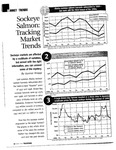
The Wild Salmon Industry: Five Predictions for the Future
Gunnar Knapp
Given the rapid growth in world farmed salmon production, what is the future of wild salmon harvesting? This paper offers five predictions for the future of the wild-caught salmon industry: 1. Wild salmon harvests will continue to fluctuate from year to year due to natural causes. 2. Average wild salmon harvests will decline somewhat from levels of the 1990's due to a combination of natural environmental factors, human-related environmental factors, political factors, and economic factors. 3. Wild salmon will be sold increasingly in markets in which it can best compete with farmed salmon. These include higher-priced markets in which wild salmon competes based on "wild" attributes, lower-priced markets in which wild salmon competes based on price, and canned markets. 4. Wild salmon prices will be driven by farmed salmon prices and wild supply. The more directly wild salmon competes with farmed salmon, the more trends in wild salmon prices will reflect trends in farmed salmon prices. 5. Wild salmon will be harvested and processed more efficiently and the quality of wild salmon products will improve. These predictions are based on several stipulated assumptions concerning the farmed salmon industry.
-
ISER Review 1997-2000
Linda Leask
The Institute of Social and Economic Research has studied public policy in Alaska since 1961. This review summarizes some of our recent research including Economic Projections for Alaska and the Southern Railbelt, 1999-2025 (Scott Goldsmith), : The Economic Significance of the Power Cost Equalization Program (Scott Goldsmith), Alcohol Related Homicide in Alaska Communities (Matthew Bennan, Teresa Hull, and Philip May), Seatbelt Use in Alaska (Virgene Hannah and Jack Kruse), Salmon Trap Profitability(Steve Colt), and changes inthe health, education, and safety of Alaska's children.
-
Rural Sanitation Facilities Operation and Maintenance Demonstration Project - Final Project Report
Nina Miller and Joe Sarcone
-
Supplemental To Analysis of Socio-Economic Aspects of Specified Year 2000 Redistricting Questions
Bradford Tuck
This material supplements a document prepared for the Alaska Redistricting Board in May 2001. This supplement discusses certain socio-economic linkages relative to the Final Plan and Proclamation of Redistricting, prepared by the Alaska Redistricting Board in June 2001. It relies on the same exonomic concepts and methodology used in the initial analysis, including central place theory and interindustry economics. It addresses four issues(1) the integration of the Delta area with the rest of House District 12; (2) the socio-economic integration of Valdez with the rest of the House District 32 and the Anchorage ares; 93) the socio-economic integration of House District 37; and (4) linkages between Cordova and the rest of House District 5.
-
Oil Rents and Political Economy in Alaska
Matthew D. Berman
Oil and gas development has played a central role in the economic and political history of Alaska. This paper analyzes the evolution of fiscal relations between the petroleum industry and the State of Alaska s both landowner of the major oil fields and sovereign in a federal system. the analysis of the fiscal regime focuses on three dimensions: the state's take, its "distance" of administrative relation, and its "immunity" to oilfield financial risk. The paper finds that the state's distance from the industry has diminished steadily in its land management policies and fiscal dispute resolution practices over the past two decades, moving from primarily arms-length transactions-- lease auctions and litigation-- to negotiated terms and settlements. The state's willingness to share oil development risks increased markedly along with the government take in the early years of North Slope oil production, but then declined as the industry matured. That paper then explores the extend to which major economic trends might explain the pattern of change in the change in the state's administrative distance and financial immunity. Over the past 30 years, the state accumulated large savings in a Permanent Fund and reserve accounts, gradually becoming less financially dependent on current oil revenues. Neither the oil-price shifts nor financial exigencies appear to explain the pattern of change in the state's distance and immunity. Instead, the pattern appears to be explained more by the progress of industry in gaining support and influence among elected officials. The proposed BP-ARCO merger tests the limits of the new regime of state-industry accommodation.
-
Endogenous On-Site Time in the Recreation Demand Model
Matthew D. Berman and Hong Jin Kim
Careful modeling of on-site time may substantially improve estimates of the benefits of recreational visits using the travel cost method, especially when on-site time in endogenous. This paper review the theory of endogenous on-site time, and shows how the theory may apply to the Random Utility Model (RUM). An empirical example of a two-level, nested-choice model of sport fishing in southcentral Alaska illustrates a discussion of the relative advantages of the different ways to specify endogenous onsite time. (JELQ26)
-
Climate Change and Alaska's Forests: People, Problems, and Policies
Roger Burnside, Glenn Juday, and Matthew Berman
Forests cover over one-third of the total land area of Alaska, and forests border the communities in which about 90 percent of Alaska’s residents make their homes. Climate change has begun to affect the growth and condition of these forests (Juday et al. 1998). Plausible amounts of additional climate change would likely change both the extent and the character of Alaska’s forests (Juday et al. 1998). Alaska residents and public officials would face significant challenges in coping with hypothesized global change effects in its forests. Forest managers face the dilemma of being required to implement often irreversible plans that influence or even produce future forests and yet they must do so amid many uncertainties (Pollard 1991a). Many Alaska forests regenerated today will be experiencing the climate of the year 2100 and well beyond. This paper discusses potential human effects of climate change on Alaska’s forests. It begins with a summary of the role of forests in Alaska’s economy, including both commercial and ecosystem values contributed by forests. Next, the paper discusses human dimensions of potential climate effects on forests, focusing on what one needs to know to be able to turn projections of changes in forest ecosys- tems into flows of impacts to the human environment. Then, it analyzes climate-driven change specifically hypothesized for Alaska forest ecosystems, emphasizing those effects that are likely to have a significant effect on the regional economy and society. The final section summarizes the most important short-term and long-term regional impacts that emerge from the review of climate effects, and discusses the role of institutions and public policy in reducing costs or increasing benefits of the changes. The paper concludes that hypothesized climate changes on Alaska forests are likely to impose significant short-term costs to the economy and population, and that strategies for mitigating these harmful effects should be considered.
Printing is not supported at the primary Gallery Thumbnail page. Please first navigate to a specific Image before printing.