-
Gaining and Losing Under State Fiscal Policies
Matthew Berman and Alexandra Hill
Sometime soon—just when is uncertain—Alaska’s legislators will run short of money to balance the state budget and will have to make big budget adjustments. Those budget adjustments will be especially difficult, because the generous fiscal policies of the 1980s have had major effects on the jobs and incomes of individual Alaskans. The dividend and bonus programs are reflections of Alaska’s oil wealth at the start of the 1980s—and examples of the many ways the legislature used oil money to make life sweeter for Alaskans. It established the Permanent Fund Dividend program to make annual payments to all residents. It expanded the Longevity Bonus program of monthly payments to older Alaskans. It abolished the personal income tax. It increased aid to local governments, allowing them to cut property taxes while they hired more workers and increased services. And it established loan programs and increased spending for services and facilities, spreading jobs and money throughout the economy. The problem is that the state’s oil revenues for the rest of the 1990s are likely to be smaller on average than they were during the past five years, and much smaller than a decade ago. This paper estimates the effects of selected state policies on different types of households and communities in the 1980s, and assesses the likely consequences of specific policy changes
-
Measured Energy Savings from the Alaska Low-Income Weatherization Assistance Program
Linda Brooks, Marybeth Holleman, and Steve Colt
The Alaska Housing Finance Corporation (AHFC) asked the Institute of Social and Economic Research (ISER) to conduct a evaluation of the actual energy savings achieved by the Low-Income Weatherization Assistance Program. This effort represents one of the first formal attempts to quantify savings from weatherization programs in Alaska on a large scale. This study was limited by design to houses heated piped natural gas. We have divided our study into two phases. In Phase One, we used the PRISM software system to measure overall savings for a group of homes. In PhaseTwo, we plan to explore the effectiveness of particular weatherization measures and other sources of energy saving such as behavioral changes, new occupants, and physical changes to the housing unit. This report presents preliminary results of the Phase One PRISM analysis.
-
ANCSA and Rural Alaska: An Economic Reality Check
Steve Colt
This presentation uses economic and energy data to outline five myths related to the benefit delivered by ANCSA for Alaska Native people. It includes both textual and graphical data. Presented to Commonwealth North.
-
Economic Analysis of the Potential Sale of the Thorne Bay Electric Utility
Steve Colt
This report was prepared as an analysis of different options for the potential sale of the Thorne Bay Electric Utility. It addresses costs of service, rates, fiscal impact on the City of Thorne Bay, financial effect on the residents, future costs and a number of other important factors for evaluating the economic implications of such a sale.
-
Estimated Costs to Alaskans of the Proposed 1993 BTU Energy Tax
Steve Colt
The BTU tax proposed by the Clinton administration in March 1993 levied an excise tax on all forms of energy at the rate of 25. 7 cents per million Btus of heat content. In addition, a surcharge of 34.2 cents per million Btus was to be added for all petroleum-based fuels. The National Association of State Energy Officials (NASEO) developed a worksheet for estimating direct and indirect Btu taxes to households. We used this methodology to estimate overall taxes that would be paid by Alaskans. We made one adjustment to the NASEO methodology by removing the direct consumption of coal by the military from the analysis. Under the adjusted NASEO methodology, the average Alaskan household would pay a total of $154 per year in direct taxes for energy consumed by the household, plus about $251 in indirect taxes, mostly in the form of higher prices for goods and services which use energy in their production. These calculations assign all of the costs of the Btu tax to United States households. Therefore, there is no additional tax burden which falls separately on "business," and in reality some of the tax burden would fall on foreigners.
-
Economic Projections for Alaska and the Southern Railbelt to 2020 - Reports and Summaries
Scott Goldsmith
The Alaska economy will continue to be dominated by commodity producing industries as well as tourism, national defense, and the movement of international freight. High labor costs, sparse and expensive infrastructure, small market size and great distance from market share barriers against the development of significant processing and manufacturing for export. Petroleum, mining, and tourism hold the most potential for employment growth through expansion of the resource base. Growth of the timber and seafood industries will result from more intensive exploitation of the resource coupled with the expansion of value-added processing. Because of its dependence on commodity-producing industries, the Alaska economy will continue to experience localized business cycles as prices in these industries respond to world market conditions. Although the existence of these cycles can be anticipated, their timing cannot be forecast. Consequently these projections have the appearance of smoothness and continuity which is unlikely to be the actual pattern over time. One cycle which can be anticipated would be associated with the construction of a gas pipeline to bring North Slope gas to market. This would cause a significant construction boom followed by a transition to a much smaller operational work force. In the High Case projection, this appears as a cycle similar to, albeit smaller than, the cycle associated with construction of the trans-Alaska oil pipeline in the 1970s.
-
Teaching Economics to Russian Students: Some Preliminary Observations
Gunnar Knapp
In February 1993, I taught a one-week intensive course in "Fundamentals of Market Economics" to thirty-four first and second-year students at Magadan International Pedagogical University in Magadan, Russia. The students, who were enrolled in a new degree program in "Economics and Management," had had only limited previous exposure to the topics usually covered in introductory economics courses in America. My preliminary conclusion from this brief experience in teaching economics to Russian students is that basic principles of economic theory can be taught to Russian students in much the same way as they are taught to American students. Russian students were very interested in concepts of market economics, and seemed able to learn and apply them no less well than American students. Their attitudes towards market mechanisms appear to be generally positive, if slightly less so than for American students. However, their experience with market economics is much more limited than that of American students, at both the macroeconomic and microeconomic levels. In particular, it is difficult to teach about fiscal and monetary policy and institutions to students in a country where both policy and institutions are highly unstable or nonexistent. Nevertheless, Russian students are able to recognize the market forces which are increasingly becoming part of Russian life. Asked to suggest a new product or service which had come into existence in Russia as a result of market signals, one student answered: "Now you can telephone for home delivery of vodka."
-
Western Alaska Fuel Cooperative, Inc. (WAFC) Business Plan
Eric Larson, Alexandra Hill, and Teresa Hull
-
Alaska Salmon Industry and Japan
N/A N/A
Until the late 1980s, Alaska and Canadian wild salmon were the only significant sources of high-quality salmon available to Japan, and Alaska and Canada accounted for an overwhelming share of Japanese salmon imports. That has changed. Japanese processors and consumers have begun to treat farmed Chilean coho as a viable substitute for sockeye. In the past few years, imports from Chile have grown substantially. Chile and other salmon farming countries have the potential to vastly expand their production and their exports to Japan. Japanese imports of salmon from Russia have also grown rapidly. As a result of these changes, the U.S. import share has fallen substantially, from 85 percent in 1987 to less than 60 percent in 1992. We have suffered a very substantial decline in our market share in just a few years. New patterns of supply are not the only changes in the Japanese salmon market. Changes are also happening in consumer demand Japanese consumers, like consumers all over the world, are increasingly demanding higher quality and more variety in the food products that they eat. They are beginning to eat more meat products. This presentation includes graphical data regarding various aspects of harvests, prices, exports for fresh and frozen salmon. Presented at a forum on the Alaska Fishing Industry and Japan at the Anchorage Museum of History and Art, Thursday, September 23, 1993.
-
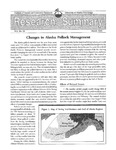
Changes in Alaska Pollock Management
Terrence Smith, Gunnar Knapp, and Matthew Berman
Pollock are the most common groundfish off Alaska, with the 1991 harvest exceeding 2.2 billion pounds - or about 70 percent of the entire groundfish harvest. The North Pacific Fisheries Management Council recently recommended changing the start of the second half of the season from June 1 to August 15, when the fish are heavier and better quality. Before making its recommendations, the council asked iSER to examine potential economic effects of delaying the second half of the pollock season and of establishing exclusive registration in the offshore fisheries of the Bering Sea/Aleutian Islands and the Gulf of Alaska. This summary provides a brief overview of the findings from interviews with fishermen and processors that were used to support an Alaskan economic model aimed at projecting effects of potential changes.
-
Natural Resource Depletion and Social Income Accounting: Sustainable Income in Petroleum-Dependent Economies
Matthew D. Berman, Eric Larson, and Bradford Tuck
-
Technical Report 148 - Final Technical Report Hope Basin Socioeconomic Baseline Study
Ernest Jr. Burch, Edward Busch, Robert Gal, Lee Gorsuch, Teresa Hull, Steven McNabb, Paul Ongtooguk, Linda Rinaldi, and Judith Brogan
Printing is not supported at the primary Gallery Thumbnail page. Please first navigate to a specific Image before printing.