-
Economic Impacts of the 1996 Arctic Winter Games
Pershing Hill
The fourteenth Arctic Winter Games (AWG) were held in Eagle River, Alaska in March 1996. It marked the first time in their 26-year history that the AWG had been held in Southcentral Alaska. This study estimates the impact of the games on the regional economy. The direct initial increase in spending resulting from the AWG was an estimated $2.49 million and the initial equivalent increase in jobs was 43.4 person-years of employment. The total impact of the games - including the indirect effects - was $4.26 million in increased regional income and the equivalent of 62 person-years of employment. Note that these estimates are based on assumptions outlined in the text of the report. Those assumptions qualify the findings. This study does not explicitly consider the 125,000 hours of volunteer time that were required to stage the games. We generated our estimates with the Alaska Input/Output model, which the Institute of Social and Economic Research developed to analyze the Alaska economy. Many additional impacts of the 1996 Arctic Winter Games are not quantifiable but are nonetheless real. Certainly the games increased the sense of community in the area of Eagle River, Chugiak, and Anchorage. The games and the events held in conjunction with them also undoubtedly contributed to increased understanding among the people of the North. Almost two thousand people from across the North came together at the games. The Russian dancers from Magadan, for instance, provided Alaskans and others with a glimpse of their culture. One young girl from Baffin Island in Canada's Northwest Territories had never seen trees before she came to take part in the games.
-
Economic Impacts of the 1995 Carrs Great Alaska Shootout
Pershing Hill and David Gilmore
This study estimates the economic impacts of the 1995 Carrs Great Alaska Shootout on Anchorage and on Alaska. Held in Anchorage every year since 1978, the shootout has become one of the nation's premier college basketball tournaments, drawing some of the top-ranked NCAA teams. The tournament generates significant income and jobs for the Anchorage and state economies. The estimates in this report are based on assumptions and qualify our findings. The basis of the analysis is a diary study, in which participants and spectators record their spending while they were in Anchorage attending the tournament. Tabulated data was then used in an Alaska input/output model to estimate the economic impacts of the tournament.
-
Economic Effects of Management Changes for Kenai River Late-Run Sockeye
Gunnar Knapp, Sharman Haley, Matthew Berman, and Alexandra Hill
If fishery managers allowed more late-run sockeye salmon into the Kenai River in July, what would be the economic gains for the sport fishery and the losses for the Upper Cook Inlet commercial fishery? The Institute of Social and Economic Research at the University of Alaska Anchorage examined that question, under a contract with the Alaska Department of Fish and Game (ADF&G). We looked mainly at the effects of increasing the management target for late-run sockeye by 200,000. Managers could make that change in a number of ways - but for this study, ADF&G provided us with specific assumptions about what they would do. Different assumptions could change our results. To assess the effects of the management changes we studied, it helps to think about three questions: (1) What creates the economic effects? (2) How do we measure those effects? (3) How do different conditions affect the results? We measured the effects of those changes in two ways: changes in net economic value and economic impacts. Net economic value is a measure of benefits minus costs: we add up all the benefits and costs of a change, then subtract the costs. What's left is the net gain or loss in value.
-
The First Year of the Alaska IFQ Program: Survey Reports
Gunnar Knapp and Dan Hull
These three reports present the results of a mail survey conducted in the spring of 1996 by the University of Alaska Anchorage Institute of Social and Economic Research (ISER). The purpose of the surveys was to gather information on changes during the first year of the Individual Fishing Quota program. The survey was funded by the Alaska Department of Commerce and Economic Development, and the Alaska Department of Fish and Game. The report represents a start towards understanding the effects of the IFQ program. More detailed research over a period of years will be needed before the full effects of the program can be understood. The first report details findings from surveys of registered buyers of halibut and sablefish. Major findings include variation in effects on fish processing regardless of the size of the operation. The second report details findings from surveys of halibut quota shareholders. Major findings include the information that IFQ holders were choosing to fish together with more than one IFQ holder on board a fishing vessel. The third report details findings from surveys of sablefish quota shareholders. Again, the findings indicate that IFQ holders were choosing to fish together with more than one IFQ holder on board a fishing vessel.
-
Potential Supplies and Costs of Waste Wood and Paper in Southcentral Alaska
Eric Larson and Patricia DeRoche
During the last three years, the Alaska Center for Appropriate Technology has developed a manufacturing process that would use wood and paper waste to produce a high-quality medium-density fiberboard. The developers of the manufacturing process have determined that a fiberboard plant would require 30,000 to 60,000 tons of wood and paper waste annually to make it feasible. The Alaska Department of Environmental Conservation asked the Institute of Social and Economic Research to determine if there is a sufficient supply of wood and paper waste available in Southcentral Alaska to make a fiberboard plant practical. This study focuses on identifying available sources of wood and paper waste in the Anchorage area because we found it is the only area in Southcentral Alaska where there are adequate supplies. The costs of obtaining these materials for a manufacturing plant depend on the cost of purchasing, collecting, hauling, and sorting waste from many different sources. These costs also vary for many reasons; and to reflect these variations, we have developed low and high estimates of the cost per ton of obtaining each source of wastes. Section III presents these low and high cost estimates.
-
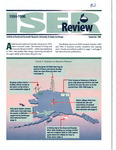
ISER Review 1994-1996
Linda Leask
Alaska has seen rapid and dramatic change since 1959, when it became a state. The Institute of Social and Economic Research (ISER)-which was established in 1961-has studied that change, examining virtually all the major public policy issues along the way. This Review reports on ISER's research between 1994 and 1996. It discusses recently completed and ongoing work. Faculty and staff are profiled on page 7, and page 8 lists selected recent publications. This summary includes Fishery Studies, Social Studies, Community Studies and Economics/Fiscal Studies.
-
Stalking the Schoolwork Module: Teaching Prospective Teachers to Write Historical Narratives
G. Williamson McDiarmid and P. Vinten-Johansen
Few educational slogans have had more play over the last decade than “writing to learn”. The idea is intuitively appealing: that in striving to summarize, organize, synthesize, develop, and communicate ideas and information, we must, in the process, clarify and extend our own understandings. Many have championed the “writing to learn” cause. In the study described below, the first author, Vinten-Johansen, engaged his undergraduates, all of whom planned to teach, in a structured process of writing historical narratives. His purpose was to help them learn not only to make historical arguments in writing—a capacity that has applications far beyond academic history—but also to analyze the narratives of others as contestable products. In what follows, we examine the opportunities that Vinten-Johansen created to help students learn to write, the successive drafts of original narratives they produced, and their discussions of historical methods and reasoning. Our purpose is to explore whether a highly structured experience in writing historical narratives does help students learn this form of writing and the character of historical knowledge.
-
North Star Project: Economic Impacts
Bradford Tuck
This analysis explores the economic impact of developing the Northstar field. The analysis is based on certain assumptions related to total capital development and production spending, recoverable oil, and other parameters, etc. Since the project is undergoing constant planning activity and review, these numbers may differ from others that have been reported. The Northstar field is located in the Alaskan Beaufort Sea, approximately six miles from Prudhoe Bay. It is projected that about 130 million barrels of oil can be recovered, over a fourteen year production period beginning in 1998. Total capital expenditures are estimated at about 379 million dollars, with an additional production related expenditure of about 197 million dollars. All dollar figures are in 1996 dollars.
-
Gas Prices Will Fluctuate
Arlon Tussing
Price patterns for the future are likely to be similar to the recent past when changes ranged from down to nearly $1.00 per million BTu to more than $3.00.
-
Electric Load Forecasts for Haines, Chilkat Valley, and Kake, Alaska
Steve Colt and Alan Mitchell
This report presents separate electric load forecasts for the following areas of upper Southeast Alaska: 1. Haines area (entire service territory of Haines Light & Power (HL&P)); 2. Upper Chilkat Valley (served by Tlingit-Haida Regional Electrical Authority (THREA)); 3. Community of Kake (served by THREA). The Haines and Upper Chilkat Valley areas are contiguous and form a common load center stretching along the Haines Highway from the City of Haines at the head of Lynn Canal to the Canadian border. The Kake load center is located 200 miles to the south, on the northwest corner of Kupreanof Island. In addition we report an estimated load for the village of Klukwan (located within the Chilkat Valley geographic area). We also present a compilation of existing load projections for the communities of Angoon, Hoonah, Juneau, Sitka, and Tenakee Springs. These projections were prepared by others and are reported here for use in assessing possible intertie projects that might serve the communities. The report is organized as follows. The rest of this chapter discusses in general terms how the forecasts were produced. Chapters two through four present the individual load forecasts for each community. Appendix A summarizes the existing load projections for other Southeast communities. Appendix B lays out the assumptions underlying the baseline economic growth projections for the region. Appendix C provides a limited comparison of recent actual loads in Ketchikan and Petersburg with those forecast five years ago using similar methods as we employ here. Appendix D contains comments received on the draft report.
-
Kenai Peninsula Natural Gas Study: Final Report
Mark Foster and Steve Colt
A very large industrial facility such as the proposed Midrex iron ore reduction facility would make a pipeline economically feasible, but the resulting cost of gas to consumers would still be about twice the level of current Enstar rates, due to higher local distribution costs. Also, under this scenario customers along the pipeline route would not automatically have access to cheap gas unless they were clustered in groups of at least 10 people within about one mile of the connection to the main line. This study examines the economics of bringing natural gas to Homer, Seward, and intermediate points along the Sterling Highway. We conclude that natural gas delivered by pipeline to Homer or Seward from the existing Enstar system will remain uneconomical or marginally competitive with diesel under plausible assumptions about economic growth. That's because both Homer and Seward have very small numbers of customers compared to the cost of a pipeline necessary to reach either community.
Printing is not supported at the primary Gallery Thumbnail page. Please first navigate to a specific Image before printing.