-
Alaska Employment with and without MarkAir: Range of Potential Effects
Scott Goldsmith
This report calculates the potential range of employment impacts on the Alaska economy from the removal of Markair and Markair Express from all its markets in Alaska and the Lower 48 states. This report presents 5 cases based on different assumptions about the two main determinants of response in each market area--proportion of flights replaced by other carriers and relative employment needed to replace these flights. The most important assumption underlying this analysis is that these air transport markets are large enough to accommodate all current competitors. If this is a valid assumption then the basis for the calculations of job loss is reasonable. However if there are too many competitors chasing too few customers in some markets, some competitors would eventually leave and employment would fall. Then current employment levels would be above sustainable levels. Since the alternatives described in the 5 cases used in this report represent sustainable market situations, the estimates of employment loss in the 5 cases would be inflated if the comparison case were not sustainable.
-
Alaska's Small Scheduled Air Carriers: Economic Significance
Scott Goldsmith
The smaller Alaska based scheduled air carriers produce annual sales of about $205 million while employing nearly 2,100 Alaskans (annual average) with an annual payroll in excess of $68 million. Including Markair and Markair Express, all Alaska based scheduled air carriers produce annual sales of $415 million while employing about 3,200 with an annual payroll of $103 million. In addition to this direct effect, Alaska vendor purchases by the carriers as well as their employee spending of payroll generate sales and jobs in other businesses in the Alaska economy. The smaller air carriers generate an additional S228 million in sales, 2,200 jobs and $58 million in payroll for businesses providing goods and services to the industry and for businesses serving households with air carrier employees. Including Markair and Markair Express, all Alaska based scheduled air carriers account for 3,400 jobs and $88 million of payroll for other Alaska businesses. Total economic significance was calculated from estimated direct industry employment of 2,081, sales of $205 million, and payroll of $68 million using the ISER Input-Output model of the Alaska economy. This economic model calculates the economic activity which is stimulated in other businesses within the Alaska economy from both the purchases of the air carriers from other businesses in the state as well as from the expenditures of payroll by air carrier employees.
-
Marginal Oil Field Development: The Economic Impact
Scott Goldsmith
The purpose of this study is to provide a framework for analysis of the economic effect of new, small marginal oil fields which may be typical of new petroleum industry activity in Alaska. The analysis is generic and hopefully will lead to more detailed and specific studies where appropriate. The study examines a hypothetical marginal oil field on the North Slope with anticipated recoverable reserves of 100 million barrels of oil. This document was developed for presentation to the State of Alaska Oil and Gas Policy Council.
-
Alaska Timber Harvest and Production - 1994
Alexandra Hill and Dan Hull
Alaska's richest timber resource is its coastal forest, a narrow band of temperate rain forest extending from the southern border of the state north and west to Kodiak Island. Sitka spruce is a major component of this forest, with western hemlock in the southeastern area, replaced by mountain hemlock west of Prince William Sound. This report tries to provide regular and timely information about the timber and wood products industry. It includes data for the entire state and for three regions within the state, and brings together previously available data on public timber harvests and wood products exports, as well as new estimates of private timber harvests. We hope the data will be useful for both public and private planning efforts, as well as informed policy debate over timber management and development of the forest products industry.
-
Petroleum Industry and Fairbanks Economy
Lee Huskey
The petroleum industry plays an important role in the economy of the Fairbanks North Star Borough, but that role is largely hidden from view. A major portion of the local economy is linked to petroleum production, and economic activity in the petroleum sector is one of the most important determinants of the size of the overall economy. The primary task of this report was to estimate the size of the Fairbanks petroleum sector. This report defines the petroleum sector to include all economic activity in the region which would not exist without North Slope oil production. The report looks at the role of the petroleum sector in 1994 and was prepared for BP (Alaska) Inc. for presentation to the State of Alaska Oil and Gas Policy Council.
-
Russian Salmon Industry: An Initial Review
Gunnar Knapp and Terry Johnson
Alaska's share of the world salmon market has declined substantially over the last five years. In most cases market share has been lost to increased farmed salmon production, however, Alaska's wild salmon competitors have made inroads as well. Because Russian salmon runs are the world's only other source of wild salmon comparable in scale to Alaska's, it is important that we better understand this new competitor to the world salmon market. Where once nearly all of Russia's salmon was consumed within the borders of the former Soviet Union, significant changes in the political and economic structure of Russia have caused an increase in salmon exports to Japan and Europe. But despite Russia's emergence as a new competitor in the world salmon market, Russia and Alaska share common interests in international fishery management issues as well as in research, technology and investment opportunities. This report is an attempt to better understand Russian salmon production, management, regulation, and harvesting and processing organizations. It also tries to quantify Russian salmon product forms and export markets as well as threats caused by over-harvesting and pollution.
-
How Would a Road Affect Cordova?
Jack Kruse
The proposed road to Cordova has created controversy for more than 30 years. Several time work has been started and stopped on what is known as the Copper River Highway. In 1992 the Alaska Department of Transportation and Public Facilities hired ISER to study the potential economic and social effects of a road to Cordova. ISER's report provided information for a draft Environmental Impact Statement (EIS) on the road. That EIS was not released at the time of publication, however, the four volumes of the ISER report were released in 1993. Major findings of the report are outlined in this summary research report.
-
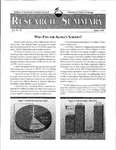
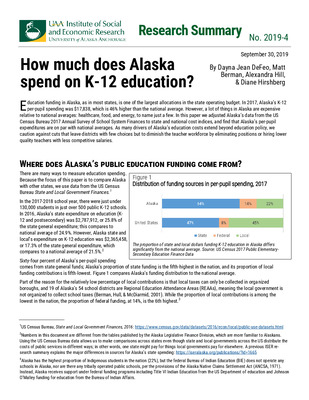
Who Pays for Alaska's Schools?
Eric Larson and Matthew Berman
Alaska's public schools cost $1.2 billion in the 1992-93 school year. That included both operating and capital spending and amounted to about $10,000 for each of the state's 119,000 elementary and secondary students. This research summary looks at where Alaska's public schools got their money and how they spent it in 1992-93. We don't yet have complete figures for the 1993--94 year. The information is based on work by Matthew Berman, and Teresa Hull.
-
Economic Contribution of Anchorage International Airport
Eric Larson and Scott Goldsmith
Airport jobs created by Anchorage residents and by non-local airport users wouldn't exist without the airport. The 750 jobs created by tenants that don't directly rely on air services would still exist without the airport; they could easily be somewhere else in the city. Those jobs are mainly with the U.S. Postal Service and the Alaska Department of Transponation's regional headquarters. Providing air transport services to Anchorage residents doesn't bring new money into the economy - it recycles money already in the economy. But the other airpon users do bring money into the Anchorage economy. The jobs created by those other user groups are what economists call basic jobs: jobs that generate economic growih by producing goods or services that are sold outside the region. The other source of jobs at the airport is Tenants Not Aviation Dependent. These jobs don't depend on the airport, but since they are physically located on airport land, a complete description of the airport as an economic entity must include them. They account for 750 jobs at the airport and another 600 jobs in the community - bringing the total of jobs at the airport and in the community to 12,300. The payroll for the 750 airport jobs is $29 million, and the 600 jobs in the community have a payroll of $15 million-bringing the total payroll for airport and related community jobs to $360 million. This is the economic effect of all of the activities physically located at the airport.
-
Heavy Oil Development: The Economic Impact
Bradford Tuck
The extension of North Slope oil production, through new discoveries, enhanced recovery techniques, and development of marginal fields, has received considerable public policy _ attention. Less discussed have been the reserves of heavy crude oil. While more difficult to produce, there are billions of barrels of reserves in place. The present study looks at the economic impact of an hypothesized development of heavy oil in the Milne Point Unit-Schrader Bluff area. The general dimensions of the project envision development expenditures of about $550 million, with the bulk of that spread over the first nine years of the project. In addition, production expenses are estimated at about $600 million, or an average of $14. 7 million per year over the forty-one year production life of the project. Average production of oil is approximately 20 thousand barrels per day over the life of the field.The economic impact methodology used is based on that employed by Professor Scott Goldsmith in his study Marginal Oil Field Development: The Economic Impact (Institute of Social and Economic Research, University of Alaska Anchorage; June 5, 1995). The basic objective in this type of impact analysis is to measure the change in aggregate expenditure, employment, and population effects in both the private and public sectors that result from the direct project expenditures. In other words, how does the economy look with the project, as compared to without the project. The analysis can look either at impacts on some periodic basis, such as changes in the annual level of activity. or at the aggregate impacts over the life of the project.
-
Common Property, Individual Quotas, and The Domino Effect: Diverse Management of Multiple Species Fisheries
Matthew D. Berman and Marcus Hartley
-
Modern, Postmodern and Northern: A New Approach to The Political Economy of Northern Regions
Matthew D. Berman and Michael Pretes
-
New Crude Oil Reserve Formation: Responsiveness to Changes in Real Prices and the Reserves-to-Production Ratio
Matthew D. Berman and Bradford Tuck
-
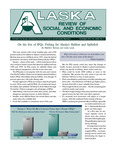
On the Eve of IFQs: Fishing for Alaska's Halibut and Sablefish
Matthew Berman and Linda Leask
This year, anyone with a boat, longline gear, and a $50 permit could try for halibut in Alaska’s commercial fisheries. But that open access will likely end in 1995, when the federal government introduces Individual Fishing Quotas (IFQs). Quotas—shares of the catch—will be issued just to those who owned or leased vessels that fished for halibut between 1988 and 1990. An IFQ system for sablefish (black cod) under federal management will start at the same time. The IFQ plan is not popular with the men and women who fish for halibut: 68 percent of captains (permit holders) believe IFQs will unfairly allocate halibut, even though 78 percent agree they will make fishing safer. But the IFQ system could also cause big changes in wealth, income, and jobs in Alaska’s coastal communities, which rely heavily on fishing. ISER is studying the potential effects of IFQs, especially on small coastal towns, under a Saltonstall-Kennedy grant. As a first step we surveyed captains (most of whom were also owners) of vessels with longline gear. This publication reports our survey findings.
-
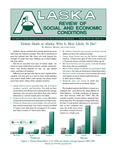
Violent Death in Alaska: Who Is Most Likely To Die?
Matthew Berman and Linda Leask
Alaskans die by accident and commit suicide far more often than the national averages. They die in homicides at near the national rate. But when you look beyond the averages, it’s plain that some Alaskans are at much higher risk than others. This Review describes how rates of violent death—by which we mean deaths from accidents, suicides, and homicides—vary among Alaskans by race, sex, age, marital status, and place of residence. Differences in age and other factors don’t explain all the variation, but they give us a start in better understanding why violent death strikes some groups and places much more than others. The detailed analysis that follows is based on a computer file—provided by the Alaska Bureau of Vital Statistics—of death certificates of Alaskans who died between 1980 and 1990. This file includes recently revised statistics analyzed here for the first time. We calculated average death rates for that 11-year period, allowing us to see trends and to feel confident that rates for small towns don’t just reflect unusual circumstances in a single year.
-
Measured Energy Savings from Weatherization Alaska vs. National Results
Steve Colt
This memorandum reviews the differences in measured energy savings from 102 Alaska weatherized homes (ISER 1993) compared with savings from a "cold-climate" region of the United States (ORNL 1993). The National study found a significantly higher level of gross energy saving (12.5%) in its sample of 1040 gas-heated homes than the Alaska study found in is sample of 102 homes. Alaska' lower level of percentage gas savings, relative to the US cold-climate region, cannot be attributed to differences in sampling, data retention, or analytical technique using PRISM. When measured by gas consumption per degree-day, the Alaska sample of weatherized homes appears to have higher thermal integrity prior to weatherization. From different starting points, both Alaska and US single-family homes appear to be achieving a post-weatherization thermal integrity of about .155 cf per degree-day. Alaska mobile homes reach a roughly similar final level of .142 ccf per HDD, commensurate with their smaller size.
-
Operations and Maintenance Issues in Rural Alaska Sanitation
Steve Colt
Today, many rural Alaskans have inadequate water and sanitation facilities. As a result, they face unacceptable health risks and an unacceptably poor quality of life. While much has been accomplished during the past 30 years, the honey bucket remains the primary form of sanitation in scores of communities. This paper is intended to stimulate discussion about several issues related to operations and maintenance of rural sanitation systems. The paper focuses on operations and maintenance issues because so many observers agree that proper O&M is crucial to success but severely lacking in many communities today. Section 2 reviews the prior recommendations of the Alaska Sanitation Task Force and issues raised during meetings of the Federal Field Work Group. Section 3 provides some discussion of these recommendations and issues, based on subsequent research. Section 4 provides a simple method for quantifying the benefits of preventive maintenance and R&D. Section 5 discusses mechanisms for providing O&M assistance. Section 6 provides three case studies of life cycle costs for three different system types.
-
Alaska's Low-Income Weatherization Program: Three Papers
Steve Colt, Linda Brooks, and Marybeth Holleman
This report combines three papers prepared for the Alaska Housing Finance Corporation (Rural Housing Division) between September 1993 and May 1994. "Measured Energy Savings from the Alaska Low-Income Weatherization Assistance Program" (1993) utilized the PRISM software system to measure energy savings in two phases to first determine potential savings for study homes using piped natural gas, and then measure the effectiveness of behavioral changes of occupants and physical changes to the housing units. This report presents preliminary results of the first phase. "Measured Energy Savings from Weatherization: Alaska vs. National Results" (1994) reviews the differences in measured energy savings from 102 Alaska weatherized homes compared with savings from a "cold-climate" region of the United States. "Cost-Effectiveness Analysis of the Home Energy Rebate Program and the Low Income Weatherization Program" (1994) compares the economic costs and benefits of two programs designed to reduce Alaskans' home energy consumption. This analysis looks at the overall social costs and benefits of both programs.
Printing is not supported at the primary Gallery Thumbnail page. Please first navigate to a specific Image before printing.