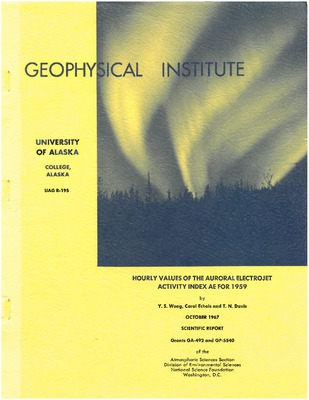
This series consists of Scientific reports, Technical reports and Final reports issued by the Geophysical Institute on all contracts and grants.
-

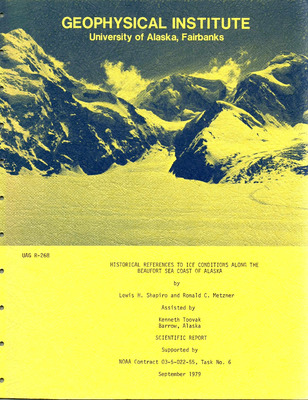
Some remarks on the unusual Beaufort Sea ice conditions in summer 1975
Gerd Wendler and Kolf Jayaweera
In the summer of 1975 the sea ice conditions between Point Barrow and Prudhoe Bay were the severest since 1898 when the ice did not move away from shore at all. In 1975 the movement started later than in any year since that time and was incomplete. From the meteorological point of view this event is very interesting and also had great economic ramifications because the need to resupply the Prudhoe Bay oil fields by barges could not be carried out as planned. These unusual ice conditions were caused by: a) a thicker than normal ice cover for the winter of 1974-75 owing to a cold and snow-deficient winter, b) a cooler than normal summer 1975 which not only slowed down the rate of ice decay but also shortened the period in which melting occurred, and c) the unusual wind conditions in summer 1975 which were caused by a persistent low pressure system over the high Canadian Arctic for July, August, and September, adding a northwesterly wind component to the average wind which kept the ice near to shore. This last reason is believed to be the most important.
-

A geophysical reconnaissance of Pilgrim Springs, Alaska
Robert B. Forbes, L. Gedney, D. VanWormer, and J. (Jerry) Hook
A geophysical survey of Pilgrim Springs, Alaska, including seismic refraction, geomagnetic, microseismic background and water temperature studies indicates that the springs deserve further exploration as a potential geothermal resource. Seismic profiling indicates possible Tertiary reservoir rocks or hydrothermally cemented cap rock at a depth of 205 ft. Subsurface probes detected water temperatures up to 80°C, and local temperature inversions caused by the mixing of spring and groundwater and convective circulation in coarse, permeable sands. Less diluted spring water, when sampled at depth, will probably be more saline and siliceous than that previously sampled at the surface; and estimated reservoir temperatures, based on geothermometry, will probably be increased. A modest exploration program, involving additional geophysical and geochemical studies and the drilling of a test hole, is recommended.
-

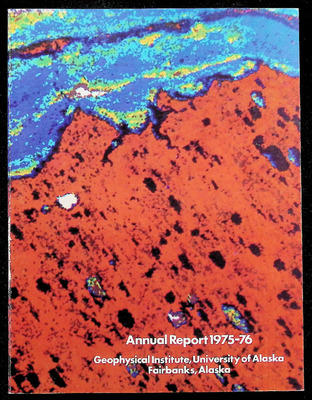
Geophysical Institute Annual Report 1974-75
Geophysical Institute
The 1974-75 Geophysical Institute Annual Report presents an overview of the year’s scientific research achievements across the Institute’s disciplines, alongside operational summaries covering finances, administrative changes, and other key activities.
-

Cold start automotive emissions in Fairbanks, Alaska : an interim report
L. E. Leonard
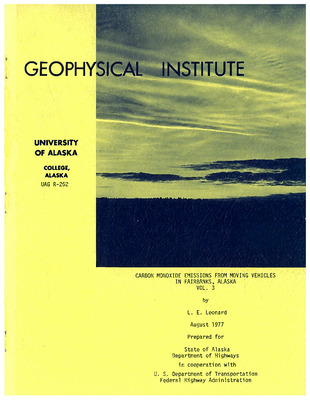
Measurements of the cold start and warm-up emissions of more than one hundred in-use motor vehicles in the Fairbanks area were performed during the winter of 1974-75. It was found that, for densely populated areas of the city where large numbers of vehicles are started and allowed to warm up daily, the major portion of the carbon monoxide (CO) emitted to the ambient is produced during the cold start and warm-up phase of vehicle operation. In some areas the cold start CO contribution could be as much as 76% of the total. It was also found that none of the pollution control devices presently in common use were effective in reducing the cold start CO emissions. Thus, for the cold start phase of operation the older vehicles were not greater emitters of CO than were the newer vehicles. This investigation also shows that the most effective way of reducing cold start emissions on a per vehicle basis is to utilize smaller engine size, as evidenced by the significantly lower CO emissions produced during cold start by the foreign vehicles tested when compared to the American vehicles.
-

Frazil ice nucleation mechanisms
Thomas E. Osterkamp
Frazil ice nucleation mechanisms have been reviewed in the light of recent experimental evidence. The mass exchange mechanism proposed by Osterkamp et al. has been generalized. It is shown that only mass exchange processes and secondary nucleation can account for frazil ice production in streams and rivers.
-

A preliminary study of the formation of landfast ice at Barrow, Alaska, winter 1973-74
Lewis H. Shapiro
During late December 1973, the landfast ice sheet at Barrow broke loose and drifted offshore, following which an intense storm drove the pack ice into the nearshore zone. As a result, a new landfast ice mass was formed, which included a complex array of pressure ridges, shear ridges and hummock fields. The entire process was monitored by radar, and study of the imagery provides information on the velocity vector of the pack ice during this time, and on the sequence of events which lead to the formation of the landfast ice. This data, in conjunction with field observations, gives some insight into the mechanisms by which some of the structural features of the landfast ice mass were formed. An important feature of the landfast ice was a linear hummock field about 4 km long, 135 m wide, and with an average elevation of about 3 m. This feature, termed here as “ice pile”, was approximately aligned along a shoal 4-5 m deep which is oriented at an angle of about 10 degrees to the drift vector of the pack ice. On its offshore side, the ice pile was bounded by a shear ridge which built shortly after the pile under the same conditions of ice drift. The formation of both these features took less than 1.5 hours, and the transition between them is hypothesized to have resulted from the change in water depth along the outer boundary of the shoal. Measurements of the size and shape of blocks in the pressure ridges and hummock fields suggest that the ice failed in bending during the formation of these features. This may serve to put an upper limit on the forces involved in these processes, but the possibility remains that stresses approaching the crushing strength of the ice are attained during the growth of shear ridges.
-

Major late-winter features of ice in northern Bering and Chukchi Seas as determined from satellite imagery
Lewis H. Shapiro and John J. Burns
Imagery from the ERTS-1, DAPP and NOAA 2/3 VHRR satellite systems were used for identification of recurring features of the movement and distribution of sea ice in the Bering and Chukchi seas during late winter. Data acquired during March and April of 1973 and 1974 show several such features including: 1) a shear zone of variable width along the west coast of Alaska which separates landfast ice from drifting sea ice; 2) an area of generally broken pack ice between Bering Strait and Point Hope; 3) persistent polynya off south-facing coasts, such as that east of Point Hope, south of the Seward and Chukchi Peninsula and south of the larger islands; 4) convergence zones on the north sides of St. Lawrence and Nunivak Islands, and 5) narrow shear zones extending generally southward from the boundaries of the Bering Strait and from the east and west ends of St. Lawrence Island. The pattern observed is consistent with a general southward drift of sea ice under the influence of the prevailing northerly winds present in the area during this time of year. Closure of ice against south-facing coasts, reflecting northward ice drift, occurred about 10% of the time. These episodes probably correlate either with short periods of dominantly south winds or drift under the influence of north setting currents when prevailing north winds were light.
-

Utilization of geothermal energy resources in rural Alaskan communities : a feasibility and planning study
Robert B. Forbes, L. Leonard, D. H. Dinkel, L. D. Gedney, D. VanWormer, and Jurgen Kienle
-
Geophysical Institute Annual Report 1973-74
Geophysical Institute
The 1973-74 Geophysical Institute Annual Report presents an overview of the year’s scientific research achievements across the Institute’s disciplines, alongside operational summaries covering finances, administrative changes, and other key activities.
-

Geomagnetic influences on thermospheric winds observed in the auroral zone
Donald Douglas Wallis and Gerald J. Romick
A large body of observations of the wind field in the high-latitude thermosphere (140 to 350 km) is examined to characterize the winds and to determine their probably source. Theories and existing models of these winds are first reviewed. The morphologies of auroral particle precipitation, electric fields, and current systems are discussed to elucidate the effects of these factors upon the wind field. Existing models suggest that the effects of auroral electric fields and heating can be separated in a geomagnetic coordinate frame. It is shown, in this study, that the mean temporal dependence of the (geomagnetic) meridional component is similar to that predicted by tidal models except the magnitudes of the observed winds are smaller than predicted (observed peak speeds – 150 m sec⁻¹). Deviations (up to 200 m sec⁻¹) of the observed meridional winds from this mean behavior are probably caused by heating of the thermosphere by Joule dissipation in the auroral electrojets. Zonal winds are shown to be principally driven by collisions of the neutrals with ions drifting under the action of the auroral zone electric field. Zonal speeds from 200 to 400 m sec⁻¹ are typical. The observed zonal winds are correlated with the direction of the auroral electric fields as inferred from magnetometer records. The response time of the observed winds to changes in direction of the electric field (northward to southward) is found to be ≈ 1¹/₂ hours. Tidal winds are of secondary importance for the zonal component (peak speeds ≈ 150 m sec⁻¹). Electric fields and Joule dissipation in the high-latitude thermosphere are concluded to be responsible for the principal observed characteristics of auroral-zone thermospheric winds.
-

Summer global radiation and albedo-data for three stations in the Arctic Basin : Ice Island T-3, Barrow, Prudhoe Bay, 1971-1973
Gunter Weller and Björn Holmgren
Daily means of the solar global radiation and the albedo are listed for the months of May to October for three stations in the Arctic Basin, namely Ice Island T-3, Barrow and Prudhoe Bay. The data are for the years 1971-1973.
-

The magnet system : a group of computer programs for handling and analysing magnetogram data
Stephen P. Geller, T. Wetmore, M. Buhler, and Syun-Ichi Akasofu
A collection of computer programs called the MAGNET system is described. These programs support an information storage and retrieval facility for magnetogram data which have been digitized to form a time series. A number of data processing and data display programs are described, which make use of the facility. The programs have been written to be easily converted for use at different installations that may employ a variety of computer equipment. (Summary).
-
Geophysical Institute Annual Report 1972-73
Geophysical Institute
The 1972-73 Geophysical Institute Annual Report presents an overview of the year’s scientific research achievements across the Institute’s disciplines, alongside operational summaries covering finances, administrative changes, and other key activities.
-

Central Alaska earthquakes during 1972
D. VanWormer, John Davies, and L. R. Gedney
Monthly maps of epicenters determined by the Geophysical Institute, University of Alaska, showing depths and magnitudes for approximately 3,000 events are presented for the year 1972. Many of the earthquakes tend to occur in clusters which correspond to mapped faults and lineaments observable on ERTS-1 imagery. Epicenter location errors are shown to be usually less than 10 km. Calculated magnitudes tend to be high compared to NOAA results but geologic structure appears to have a significant effect on magnitude determinations.
-

Crustal deformation propagation
Eduard Berg
During the contract period the main emphasis was on the observation of crustal tilts associated with earthquakes, their directions, amplitudes and propagation velocities. Data from the seismology laboratory’s three borehole installations at GLM, PAX, MCK, the COL World Wide Standard Station and the ALPA (Alaska Long Period Array) have been analyzed for tilt steps associated with local earthquakes. Tilt steps from distant earthquakes observed at GLM, PAX and MCK and data presented in the literature are discussed. Observed tilt steps cover a distance range from 8 to 12600 km and a magnitude range from 2 to 8. Tilt step propagation velocities have been observed from 1.2 to 4.0 km/sec, and those corresponding to arrival times of teleseismic S waves. Tilt directions, amplitudes and velocities observed at several stations simultaneously for the same earthquake are internally consistent and are likely to depend on the tectonic environment of the observing station in addition to the focal mechanism. The low velocity of 1.2 km/sec is consistent with a plastic wave propagation. Other velocities are close to the Rayleigh wave short-period group velocity. The tilt amplitude for fixed epicenter distance, focal depth and stress system depends logarithmically on the magnitude, with a possible cut-off, but are too large when compared to existing theoretical dislocation models for a single layered homogeneous isotropic elastic crust. Alternative solutions in terms of more realistic crustal layering and including plastic deformation under preexisting tectonic stress probably could account for a number of observations. The operation of a number of short-period telemetry stations has been discontinued, new ones installed and one was relocated. A seismicity map was published for the period 1968-1971, based on recordings from the telemetry net and the results related to the geology of Alaska. The map and its geology related discussion proved very useful to a number of state agencies (such as the Highways Department) and aroused much interest from private sources as well.
-
Geophysical Institute Annual Report 1971-72
Geophysical Institute
The 1971-72 Geophysical Institute Annual Report presents an overview of the year’s scientific research achievements across the Institute’s disciplines, alongside operational summaries covering finances, administrative changes, and other key activities.
-

Auroral spirals : a consequence of field aligned currents
T. J. Hallinan, T. Neil Davis, and H. F. Webster
A study of large spiral forms in the aurora (up to 600 km diameter) led to the identification of a convective form of the Kelvin-Helmholtz instability which can result from field-aligned currents and can explain the observed auroral configurations. A current density of ~ 6 x 10^-6 amps/m^2, inferred from the spirals theory, is found to be in reasonable agreement with values obtained by others. The westward traveling surge is identified as a spiral and is estimated to contain ~ 8 x 10^5 amps. The rotational sense (clockwise in the Northern Hemisphere, counterclockwise in the Southern Hemisphere) is consistent with an assumed downward electron flux in both hemispheres. Small-scale curls (~ 2 km diameter), which can result from a related electrostatic instability in a sheet of negative space charge, are observed to occur within the spirals. Although the rotational sense of the curls is opposite to that of the spirals, it is theoretically consistent to expect them both to occur in an electron arc.
-

Polar micropulsations
V. P. Hessler, Valerii͡a Alekseevna Troitskai͡a, O. V. Bolshakova, Richard R. Heacock, Jorma Kangas, Matti Kivinen, Jens Olesen, and Christian Sucksdorff
Type Pc 1 micropulsation activity at high latitudes: Statistical analyses were made on structured Pc 1 micropulsation data recorded at College (Alaska), Thule (Greenland), and Sodankyla and Nurmijarvi (Finland) from November 1967 through January 1970. Hourly occurrences of Pc 1 were scaled for mid-frequencies, amplitudes, and “sameness” of event as seen at two or more sites. The data give evidence for the existence of a global effect in Pc 1 activity. The effect is thought to be related to drifting trapped solar wind protons, i.e. to some form of proton ring current. The existence of a midday maximum in Pc 1 production at source latitudes is verified. The Pc 1 diurnal variations observed at other latitudes, including Thule (89°), are mainly shaped by characteristics of propagation in the ionosphere horizontal duct. An event occurring on 23 Feb 1967 propagated from the vicinity of Finland, completely over the polar cap, to Alaska, at a time when the disturbance level over the polar cap was minimal. The evidence suggests that E-region electrojets and other ionospheric irregularities are effective in scattering Pc 1 waves which are propagating polewards in the duct. The scattering mechanism explains some of the occurrence characteristics, e.g. the lack of the 2-4 Hz events within the polar cap though these events are fairly common at subauroral and middle latitudes. Main regularities of micropulsations at the geomagnetic poles: Observations of micropulsations in the range from small fractions of an Hz up to several Hz were conducted at the geomagnetic poles, Thule and Vostok, from 1964 to date. Main morphological regularities of different types of pulsations in these regions were investigated. Most typical for the geomagnetic poles in the family of continuous pulsations are types Pc 2 and Pc 3. A distinct seasonal variation was established for the intensity of Pc 3. It is suggested that Pc 2 pulsations penetrate to the polar cap from the far regions of the magnetospheric tail. The deformation in the shape of the Pi 2 pulsations in the region of the geomagnetic pole is stressed. The character of their propagation from the auroral zone where their amplitude is maximum is different towards the pole and towards middle latitudes. The connection of irregular short period magnetic disturbances of the PD* type with disturbances in the interplanetary field was investigated. It was revealed that the delay in PD occurrence is different for day and night hours. Investigation of pulsation behavior at the geomagnetic poles during the growth phase of substorms led to the discovery of precursors having periods equal to several minutes. Bursts of irregular oscillations with periods of 2 to 7 minutes either appear or are intensified approximately one hour before the substorm. It is suggested that these bursts of pulsations correspond to similar oscillations at the boundary of the magnetosphere discovered by direct measurements. Preliminary results of comparison of pulsation behavior at the geomagnetic poles and of aurora development are outlined. Micropulsations associated with polar magnetic substorms: This paper presents a comprehensive study of the irregular type of electromagnetic micropulsations which occur in association with the polar substorm. An extensive review of the literature serves to define the problem and to guide the ensuing scaling, analysis and discussion of results. The study utilizes data recorded on strip chart and magnetic tape over a period of several years from several stations in Alaska and Finland and from Thule, the Danish station near the North geomagnetic pole. The analysis includes extensive statistical studies of the incidence of Pi 1 and 2 at College in relation to magnetic bays and riometer data. Incidence is measured in terms of both spectral and amplitude characteristics. Individual events are studied in detail to determine the temporal and spatial distributions of the micropulsations in relation to the magnetic substorm and electron precipitation. Charts presenting the development of the polar micropulsation substorm are prepared from the above analysis. The results of the analysis are discussed in relation to the properties of the solar wind, velocity, particle densities, and magnetic field, and to the magnetospheric substorm.
-

Magnetic records from a meridian chain of observatories in the Alaskan sector
Syun-Ichi Akasofu, C. R. Wilson, L. Snyder, and P. D. Perreault
-
Geophysical Institute Annual Report 1970-71
Geophysical Institute
The 1970-71 Geophysical Institute Annual Report presents an overview of the year’s scientific research achievements across the Institute’s disciplines, alongside operational summaries covering finances, administrative changes, and other key activities
-

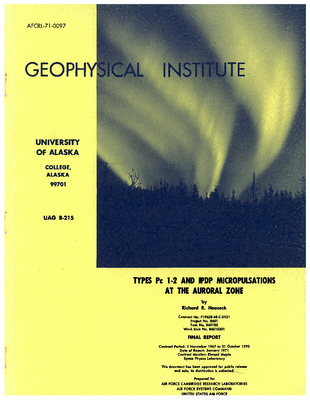
Types Pc 1-2 and IPDP micropulsations at the auroral zone
Richard R. Heacock
A micropulsation recording program was carried out at College and Anchorage, Alaska and at Bar I, Canada, with induction magnetometers. The analysis program centered mainly on synoptic and polarization characteristic for types Pc 1-2, IPDP, and Pi burst micropulsation events. Summaries of the known morphological features for structured Pc 1 and unstructured Pc 1-2 micropulsations are given. The synoptic studies disclosed latitude relationships between unstructured Pc 1-2, IPDP, and Pi burst events. At the onset of a polar substorm, Pi bursts occur near midnight at 65°-70° geomagnetic latitudes. IPDP events follow the Pi burst and are seen in evening hours at 60°-65° latitudes. IPDP events seen in afternoon hours are often preceded by unstructured Pc 1-2 activity which maximizes a few degrees polewards of the IPDP. The IPDP events are seen in the evening “bulge” region of the plasmasphere. The proton plasma requirement for IPDP wave generation suggests that protons which are injected near midnight in the Pi burst event drift westwards into the bulge and generate unstructured Pc 1-2 and IPDPs there. The polarization characteristics of Pc 1 activity indicate that simple structured Pc 1 events originate on a stable tube of force. Unstructured Pc 1 events and events which are superpositions of several events usually display pronounced time-variability in the polarization characteristics.
-

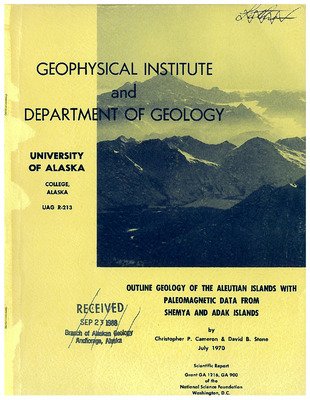
Outline geology of the Aleutian Islands with paleomagnetic data from Shemya and Adak Islands
Christopher P. Cameron and David B. Stone
A brief review of the general geology and tectonic setting of the Aleutian Island Arc is presented, followed by an account of the paleo-magnetism of selected areas. Paleomagnetic results are presented for Tertiary and Quaternary volcanic rocks from Shemya and Adak Islands. The specimens were collected and measured using standard paleomagnetic methods. Alternating field demagnetization techniques were applied to test the stability of the remanence and to remove unwanted secondary components of magnetization. The variation of the intensity of the NRM with the bulk susceptibility is discussed from the standpoint of the magnetic stability of the rocks. Mid-Late Tertiary and Quaternary specimens satisfy several criteria of magnetic stability in igneous rocks, and derived pole positions are thought to reflect the ambient geomagnetic field at the time of the origin of the rocks. By comparison, the remanent magnetization of Early Tertiary rocks investigated is less stable and yields uncertain results in terms of pole positions. The paleomagnetic results from the various sites are discussed with respect to the background geology of each island. Paleomagnetic pole positions derived from the results are compared with pole positions from other Tertiary and Quaternary sites in North Pacific tectonic belts.
-

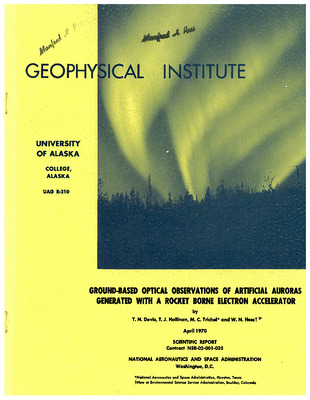
Ground-based optical observations of artificial auroras generated with a rocket-borne electron accelerator
T. Neil Davis, T. J. Hallinan, M. C. Trichel, and W. N. Hess
Ground-based image orthicon television systems detected 5 artificial auroras produced by electron beams directed downward from a rocket-borne accelerator flown January 26, 1969 from Wallops Island. One observed artificial aurora was produced with an electron beam of energy 4.9 kev, current 490 ma and duration 0.1 sec. The other 4 were from electron beams of energy 8.7 kev, current 490 ma and duration 1.0 sec. From the observed duration of these 4 auroras (1.4 sec) and other data it is concluded that the ratio of N2+ 1st Neg to 0I 5577 emission was 3 to 7. Widths of artificial auroral rays (130 + 50 m) and altitudes of lower edges (104 km for 8.7 kev beams) are in agreement with calculations by Berger, Seltzer and Maeda assuming Coulomb scattering. The observations show no delay in the arrival of the electron beam and indicate that a major fraction or all of the energy entered the atmosphere in a well-confined beam.
-
Geophysical Institute Annual Report 1969-70
Geophysical Institute
The 1969-70 Geophysical Institute Annual Report presents an overview of the year’s scientific research achievements across the Institute’s disciplines, alongside operational summaries covering finances, administrative changes, and other key activities.