-

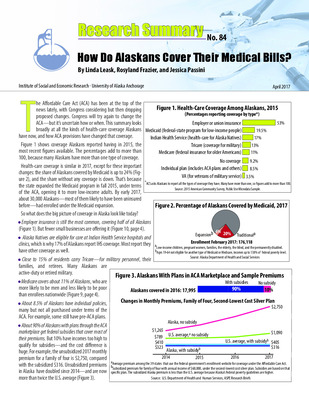
Alaska Health Care Spending Report
Mary Kopriva
This research brief reports on healthcare spending in Alaska since 1991 and compares health care costs and expenditures in Alaska to national averages.
-
Report for AK PANOCESU Collaborative Effort to Develop a Statewide Wildfire Exposure Map (L22AC00566)
Jennifer Schmidt and Owen Larson
To create a 2023 wildfire exposure map by updating the 2014 NASA ABoVE land cover data with recent wildfire activity at the statewide scale and make this map available online to the wildfire community for decision making. Also, to develop a crosswalk between the ABoVE landcover and LANDFIRE EVT to generate a statewide map that has extended coverage. Then test the performance of each wildfire exposure layer. An ABOVE land cover update is still expected by the end of the year that will be based on new Landsat remote sensed imagery and the coverage will be expanded in Alaska.
-
Advancing Wildfire Preparedness and Planning in Anchorage: Wildfire Exposure and Egress Study
Jennifer Schmidt and John See
Advancing Wildfire Preparedness and Planning takes an in-depth look at the dynamic factors that are impacting wildfire occurrence for the most populated geographic area in the 49th State of Alaska, the Municipality of Anchorage (MOA). The length and severity of recent fire seasons pose a threat to those who have chosen a niche in the Wildland Urban Interface (WUI) area to call “home.” This report is a “call to action” in many ways, delving into some of the swings in weather patterns caused by climatic change. These subtle changes are at the root of the evolving wildfire danger and its effect on the 291,247 residents (2020 census) of the MOA. The objective of this report is to combine the knowledge of local wildfire managers with some unique geographic information system tools to help analyze and bring a better understanding of what residents can do to mitigate wildfire risk. The lengthening fire seasons, increase in fuel (vegetation) loadings, the upswing in wildfire occurrence statistics and diminishing budgets to provide for mitigation measures pose an increasingly higher risk for the potential loss of life, homes, and infrastructure. Hopefully, the recommendations found in the conclusion of this report will offer residents some clarity as to what should be in the cross hairs of their efforts as they navigate the potentially cataclysmic danger of a major wildfire within the WUI of the MOA.
-
University of Alaska Economic Research Enterprise
Mouhcine Guettabi
University research contributes to Alaska in numerous ways. In this paper, we provide trends in University of Alaska (UA) research dollars, sources of funding, and their impact on the Alaska economy. At the national level, total R&D expenditures at U.S. academic institutions reached $83.7 billion dollars, an increase of almost $4.5 billion dollars (5.7%) from FY 2018. In fiscal year 2020, UA institutions had research revenues of $173.97 million dollars, an increase of 2.25% from FY 2019. Unrestricted general funding in 2020 represented only 13.3% of the total indicating the success of researchers in generating external dollars. The multiplier, which measures dollars generated for each dollar of general funding, is 7.33 in Alaska. This means that for each dollar of general funding there are 6.33 other dollars generated from external sources.
-
Long-term benefits to Indigenous communities of extractive industry partnerships: Evaluating the Red Dog Mine
Matthew Berman, Bob Loeffler, and Jennifer Schmidt
Mining, and oil and gas companies developing resources on land historically occupied and used by Indigenous peoples have faced criticism for offering few benefits to local communities while inflicting environmental damage. The Red Dog Mine – a joint venture between Teck Resources, Inc. and the NANA Regional Corporation – has often been cited as an example for developing extractive industries in a way that does benefit Indigenous communities. The mine is located in an economically impoverished region in Northwest Alaska that has few other wage-earning opportunities for the largely Inupiat population. Although the mine has brought demonstrable financial benefits to the region, questions persist about its long-term benefits to local communities. This paper assesses a suite of long-term benefits of the Red Dog mine, based on findings from unique 14-year panel dataset. The paper focuses on the direct effects of the mine on the individual Indigenous workers of the region. Specifically, the analysis addressed the following set of questions: How does employment at Red Dog affect workers’ mobility and long-run earnings? How long do most local residents hired to work at the mine keep these jobs? What percentage of the mine workers live in the communities in the region, and what percentage of the total payroll do local workers receive? The findings illustrate the strengths and limitations of partnerships between Indigenous organizations and extractive industries, and offer insights relevant to Indigenous communities across the arctic and around the world as they plan development of local resources.
-
The Impacts of the “Hunker Down” order in Anchorage
Kevin Berry
This brief models the COVID-19 epidemic in Anchorage Alaska to better understand the impact of the Municipality of Anchorage (MOA) “Hunker Down” order and provide insight into the potential benefit of the State of Alaska (SOA) “Stay at Home” order. The economic benefits of the hunker down order are measured in avoided mortality, based on the EPA value of a statistical life of $7.5 million. The benefits are for the epidemic to date based on confirmed cases and a simulation of an Anchorage epidemic based on epidemiological parameters from the scientific literature. Modeling suggests ~5400 deaths were avoided to date. Using a value of a statistical life of $7.5 million, the hunker down order is estimated to have avoided $40.5 billion in mortality due to COVID-19 to date. The economic costs of the shutdown are estimated based on the expected loss of GDP in Alaska, at roughly $4 billion to date. The long run economic costs are not estimated in this report, and will be heavily influenced by efforts by individuals to avoid infection. The estimates of the economic cost are also an upper bound estimate, as many of the costs may have happened regardless of the hunker down order as individuals avoided public spaces to protect themselves.
-
COVID-19's spring 2020 school closures: The effect on teacher candidates
Dayna DeFeo and Trang Tran
In response to the COVID-19 pandemic, Governor Dunleavy mandated that Alaska’s K12 schools closed to in-person instruction; later, these school closures were extended until the end of the 2019-2020 academic year. Across the state, educators worked not only to ensure they met their responsibilities for instruction, but also other key school functions including parent resources, meal services, and social-emotional learning. Concurrently, senior college students in teacher licensure programs at the University of Alaska (UA) were in classrooms fulfilling their clinical experience (student teaching) requirements. During the school closures, students were still “placed” in schools, but the nature of their internship experience changed fundamentally as classes were moved to distance delivery. On March 20, Alaska’s Education Commissioner Michael Johnson announced that the state of Alaska would grant emergency certification to teachers who were unable to complete the required number of clinical placement hours due to COVID-19 school closures. Many of these new graduates will qualify for licensure, but how will the pandemic affect them as they become teachers? In this paper, we explore how teacher candidates perceive their readiness for teaching in the fall, and their career intentions. By comparing survey responses collected from spring 2020 graduates against graduates of spring 2019 (the students who had a “typical” student teaching experience), we find that the 2020 graduating class feels ready for the classroom. However, these new teachers – and those hired from teacher education programs (TEPs) outside of Alaska – will need supports as they transition to teaching.
-
COVID-19 Survey in the Municipality of Anchorage, June 16-18: Highlights
Gabriel Garcia, Joy Mapaye, Rebecca Wyck, Katie Cueva, Elizabeth Snyder, Jennifer Meyer, Jenny Miller, and Thomas Hennessy
-
Needs Assessment Related to COVID-19 with Special Populations: Brief Report
Gabriel Garcia, Joy Mapaye, Rebecca Wyck, Katie Cueva, Elizabeth Snyder, Jennifer Meyer, Jenny Miller, and Thomas Hennessy
-
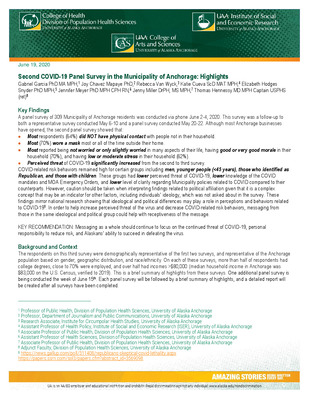
Second COVID-19 Panel Survey in the Municipality of Anchorage: Highlights
Gabriel Garcia, Joy Mapaye, Rebecca Wyck, Katie Cueva, Elizabeth Snyder, Jennifer Meyer, Jenny Miller, and Thomas Hennessy
-
Alaska’s economy and the COVID-19 virus
Mouhcine Guettabi
The Alaska economy, similar to the rest of the world, will contract over the next few weeks and months due to the COVID-19 virus that has forced businesses to close or significantly curtail operations. While it is near impossible to identify the true economic consequences of these measures, we make educated assumptions about the size of the layoffs in the most vulnerable sectors. To get the full scale of the potential losses, we estimate multiplier effects from these losses using an input output model. Layoffs in the directly affected sector could exceed 27,000 with a payroll of almost 80 million dollars in the month of April. The indirect and induced effects of this shock could result in another 21,000 jobs lost if the employment separations are not temporary. In the second quarter of 2020, direct GDP losses due to the decline in economic activity -not including declines in oil prices- could amount to almost 2 billion dollars. If the disruption in economic activity is not short-lived, we could expect another 2 billion dollars in losses due to the indirect and induced effects. The significant Federal aid package which will provide a boost to unemployment insurance, direct transfers to households, and aid to businesses will certainly dampen some of the consequences we estimate. While the short term costs of social distancing are high, Alaska’s long term economic health depends on first containing the virus.
-
Alaska's economy and the pandemic
Mouhcine Guettabi
The Alaska economy has emerged from its longest recession in 2019. The decline in economic activity and government revenues was due to the severe decline in oil prices which resulted in deep spending cuts and significant private sector job losses. The current pandemic has resulted in a significant shock to all facets of the Alaska economy. In this paper, we provide a little bit of background on the Alaska economy, present new high frequency data to asses the extent of the current damage, and then present a forecast for the next 6, 12, and 18 months. In 2020, we anticipate the economy to end the year with almost 25,000 fewer jobs than in 2019. The decrease would represent a 7.4% relative to the previous year. In 2021, we expect the economy to slowly start regaining the jobs lost the previous year and grow at a rate of 2.2%. In 2022, we anticipate a continuing climb for the economy as it is expected to grow at 1.1% percent. By the end of 2022, the Alaska economy should be at about 95% of the pre-pandemic levels. It is important to note there are significant downside risks which could negatively influence the employment outlook.
-
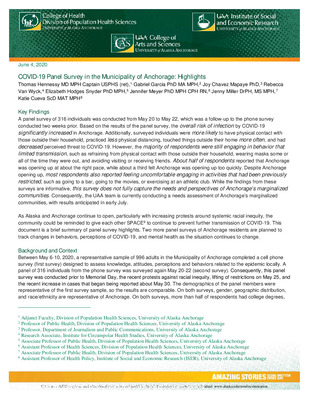
COVID-19 Panel Survey in the Municipality of Anchorage: Highlights
Thomas Hennessy, Gabriel Garcia, Joy Mapaye, Rebecca Wyck, Elizabeth Snyder, Jennifer Meyer, Jenny Miller, and Katie Cueva
-

Air and Water Violations in Alaska 2011-2019
Bob Loefflor
Alaskans care about their environment. Whenever we discuss development and conservation proposals, there is always a discussion about whether our water and air are being protected and whether some industries have a good record protecting our air and water. Or not.
-
K-12 Education Recommendations for Municipality of Anchorage
Elizabeth Snyder, Micah Hahn, Lauren Lessard, Katie Cueva, Lisa Llewellyn Schwarzburg, Laura Grage, Rebecca Wyck, and Thomas Hennessy
-
Adaptation to climate change in coastal communities: findings from seven sites on four continents
Matthew Berman and Gary Kofinas
Climate change is causing wide-ranging effects on ecosystem services critical to coastal communities and livelihoods, creating an urgent need to adapt. Most studies of climate change adaptation consist of narrative descriptions of individual cases or global synthesis, making it difficult to formulate and test locally rooted but generalizable hypotheses about adaptation processes. In contrast, researchers in this study analyzed key points in climate change adaptation derived from coordinated fieldwork in seven coastal communities around the world, including Arctic, temperate, and tropical areas on four continents. Study communities faced multiple challenges from sea level rise and warmer ocean temperatures, including coastal erosion, increasing salinity, and ecological changes. We analyzed how the communities adapted to climate effects and other co-occurring forces for change, focusing on most important changes to local livelihoods and societies, and barriers to and enablers of adaptation. Although many factors contributed to adaptation, communities with strong self-organized local institutions appeared better able to adapt without substantial loss of well-being than communities where these institutions were weak or absent. Key features of these institutions included setting and enforcing rules locally and communication across scales. Self-governing local institutions have been associated with sustainable management of natural resources. In our study communities, analogous institutions played a similar role to moderate adverse effects from climate-driven environmental change. The findings suggest that policies to strengthen, recognize, and accommodate local institutions could improve adaptation outcomes.
-
Universal Cash Transfers and Labor Market Outcomes
Andrew Bibler, Mouhcine Guettabi, and Matthew Reimer
One major criticism of universal basic income is that unconditional cash transfers discourage recipients from working. We estimate the causal effects of a universal cash transfer on short-run labor market activity by exploiting the timing and variation of a long-running unconditional and universal transfer: Alaska's Permanent Fund Dividend. We find evidence of both a positive labor demand and negative labor supply response to the transfers, document important heterogeneity across workers, and provide a set of placebo tests supporting our main results. Altogether, a $1,000 increase in the per-person disbursement leads to a 0.2% labor market contraction on an annual basis.
-
How much does Alaska spend on K-12 education?
Dayna Jean DeFeo, Matthew Berman, Alexandra Hill, and Diane Hirshberg
Education funding in Alaska, as in most states, is one of the largest allocations in the state operating budget. In 2017, Alaska’s K-12 per-pupil spending was $17,838, which is 46% higher than the national average. However, a lot of things in Alaska are expensive relative to national averages: healthcare, food, and energy, to name just a few. In this paper we adjusted Alaska’s data from the US Census Bureau 2017 Annual Survey of School System Finances to state and national cost indices, and find that Alaska’s per-pupil expenditures are on par with national averages. As many drivers of Alaska’s education costs extend beyond education policy, we caution against cuts that leave districts with few choices but to diminish the teacher workforce by eliminating positions or hiring lower quality teachers with less competitive salaries.
-
A simple decomposition of Alaska's labor force participation rate
Mouhcine Guettabi
In Alaska, similar to the rest of the country, the share of people working or seeking employment started declining in the early 2000's. The implications for lower labor force participation rates are numerous and have consequences on the tax base, government revenues, and economic growth. From 2000 to 2010, we find Alaska's labor force declined from 73.5 to 69.6% with more than 90% of the decline attributed to demographic shifts. From 2010 to 2018, the labor force participate rate went from 69.6 to 65% but the reasons for the decline were due to both behavioral adjustments (44.6%) and demographic shifts (55.3%). Lastly, we show that using the unemployment rate as a metric of the economy's health during times of significant labor force change can be misleading.
Printing is not supported at the primary Gallery Thumbnail page. Please first navigate to a specific Image before printing.