-
Analysis of Alaska Transportation Sectors to Assess Energy Use and Impacts of Price Shocks and Climate Change Legislation
Ginny Fay, Tobias Schwörer, Mouhcine Guettabi, and Jeffrey Armagost
We analyzed the use of energy by Alaska’s transportation sectors to assess the impact of sudden fuel prices changes. We conducted three types of analysis: 1) Development of broad energy use statistics for each transportation sector, including total annual energy and fuel use, carbon emissions, fuel use per ton-mile and passenger-mile, and cost of fuel per ton-mile and passenger-mile. 2) Economic input-output analysis of air, rail, truck, and water transportation sectors. 3) Adjustment of input-output modeling to reflect sudden fuel price changes to estimate the potential impact on industry output and employment. Alaska air transportation used approximately 1.9 billion gallons of fuel annually; 961 million gallons were used for intra-state and exiting Alaska flights. Water transportation used 101.8 million gallons annually, approximately 84.3 million gallons for intra-state and exiting segments. Railroad and truck transportation used 5.1 and 8.8 million gallons annually, respectively. Simulated fuel price increases resulted in an estimated $456.8 million in value-added losses to the Alaska economy through the increase in cost of transportation services, as well as an equivalent loss in income to Alaska household of $26.8 million. A carbon emissions tax would have the greatest impact on the cost of air transportation services followed by water, trucking and rail.
-
How Do Higher Fuel Prices Affect Alaska's Transportation System and Economy?
Ginny Fay, Tobias Schwörer, Mouhcine Guettabi, and Jeffrey Armagost
-

2011 Denali National Park and Preserve Visit Characteristics
Peter Fix, Andrew Ackerman, and Ginny Fay
-
Cancer Control Continuum Gap Analysis: Inventory of Current Policy and Environmental Strategies
Rosyland Frazier, Mouhcine Guettabi, and Katie Cueva
"Comprehensive cancer control (CCC) is a process through which communities and partner organizations pool resources to reduce the burden of cancer. These combined efforts help to reduce cancer risk, find cancers earlier, improve treatments, and increase the number of people who survive cancer. ”This analysis has explored both current policies that have been enacted in Alaska at the state and federal level, and those that are acknowledged at a national level. The gap analysis is designed to inform the State DHSS as it takes steps to develop a policy agenda for comprehensive cancer control that aims to; reduce the risk of developing cancer, identify cancer earlier, improve cancer treatment, and increase the number of cancer survivors."
-
Preventive Screenings Gap Analysis
Rosyland Frazier, Mouhcine Guettabi, John Wheeler, and Katie Cueva
-
Maximum Sustainable Yield: FY 2014 Update
Oliver Scott Goldsmith
In fiscal year 2014, Alaska’s state government can afford to spend about $5.5 billion. That’s an estimate of the level of Unrestricted General Fund spending the state can sustain over the long run, based on the current petroleum nest egg of about $149 billion—a combination of state financial assets (the Permanent Fund and cash reserves) and the value of petroleum still in the ground. The size of that nest egg fluctuates, depending on the state’s forecast of petroleum revenues, earnings on investments, and other factors. This Web Note presents the latest in a series of estimates of the maximum amount the state can spend and still stay on a sustainable budget path.
-
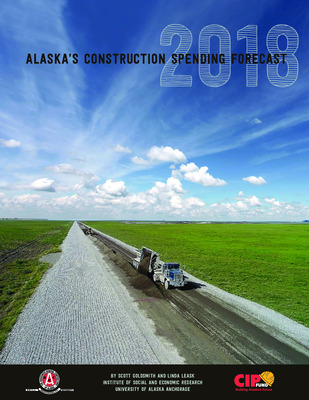
2013 Alaska's Construction Spending Forecast
Oliver Scott Goldsmith and Mouhcine Guettabi
The Construction Industry Progress Fund (CIPF) and the Associated General Contractors (AGC) of Alaska are pleased to have produced another edition of “Alaska’s Construction Spending Forecast.” Compiled and written by Scott Goldsmith and Mouhcine Guettabi of the University of Alaska’s Institute of Social and Economic Research (ISER), the “Forecast” reviews construction activity, projects and spending by both the private and public sectors for the year ahead. The construction trade is Alaska’s third largest industry, paying the second highest wages, employing nearly 16,000 workers with a payroll over $1 billion. It accounts for 20 percent of Alaska’s total economy and currently contributes approximately $8 billion to the state’s economy. The construction industry reflects the pulse of the economy. When it is vigorous, so is the state’s economy. Both CIPF and AGC are proud to make this publication available annually and hope it provides useful information for you. AGC is a non-profit, full service construction association for commercial and industrial contractors, subcontractors and associates. CIPF is organized to advance the interests of the construction industry throughout the state of Alaska through a management and labor partnership.
-
The Economic Importance of the Bristol Bay Salmon Industry
Gunnar Knapp, Mouhcine Guettabi, and Oliver Scott Goldsmith
By any measure, the Bristol Bay sockeye salmon fishery is very large and valuable. It is the world’s most valuable wild salmon fishery, and typically supplies almost half of the world’s wild sockeye salmon. In 2010, harvesting, processing, and retailing Bristol Bay salmon and the multiplier effects of these activities created $1.5 billion in output or sales value across the United States. In 2010, Bristol Bay salmon fishermen harvested 29 million sockeye salmon worth $165 million in direct harvest value alone. That represented 31% of the total Alaska salmon harvest value, and was greater than the total value of fish harvests in 41 states. Salmon processing in Bristol Bay increased the value by $225 million, for a total first wholesale value after processing of $390 million. The total value of Bristol Bay salmon product exports in 2010 was about $250 million, or about 6% of the total value of all U.S. seafood exports. In 2010, the Bristol Bay sockeye salmon fishery supported 12,000 fishing and processing jobs during the summer salmon fishing season. Measuring these as year-round jobs, and adding jobs created in other industries, the Bristol Bay salmon fishery created the equivalent of almost 10,000 year-round American jobs across the country, and brought Americans $500 million in income. For every dollar of direct output value created in Bristol Bay fishing and processing, more than two additional dollars of output value are created in other industries, as payments from the Bristol Bay fishery ripple through the economy. These payments create almost three jobs for every direct job in Bristol Bay fishing and processing. United States domestic consumption of Bristol Bay frozen sockeye salmon products has been growing over time as a result of sustained and effective marketing by the industry, new product development and other factors. This growth is likely to continue over time, which will result in even greater output value figures for the industry’s economic impacts across the U.S. The economic importance of the Bristol Bay salmon industry extends far beyond Alaska, particularly to the West Coast states of Washington, Oregon and California.
-
Sealaska Plaza Wood Pellet Boiler Benefit-Cost and Sensitivity Analysis
Sohrab Pathan
Executives at Sealaska Corporation's headquarters, Sealaska Plaza, in Juneau decided to replace existing oil fired boilers with a wood pellet boiler for heating as a part of the Corporation's green initiative.1 By introducing green energy, the Corporation hopes to reduce its carbon footprint, encourage other business entities in Southeast Alaska to use green energy, help to establish a local wood pellet industry in Southeast Alaska, increase local employment, and reduce the impacts of oil price volatility. Currently there is no wood pellet industry in southeast Alaska and Sealaska Corporation is assuming the leading role to develop the demand for wood pellets by promoting this renewable technology and using the Corporation's building as a demonstration location. The wood pellet boiler that the Sealaska Plaza building is using to heat the building is a Viessmann PYROT boiler that is powered by KÖB biomass technology. The publicly visible silo in front of the Corporation’s headquarters in downtown Juneau is an indication that this is a signature project to increase the public awareness about biomass technology. This paper provides a technical summary of benefit-cost ratios and sensitivity analyses of the biomass project given different fuel price projections and estimates of the social costs of carbon. The costs driving the benefit-cost ratios of this 20-year project are calculated by using the data provided by the Sealaska Corporation. In order to conduct these analyses, some economic assumptions were made and are presented below.
-
Energy Policy Recommendations
Sohrab Pathan, Steve Colt, Ginny Fay, and Matthew Berman
The Senate Finance Committee, through its Senate Energy Working Group, has asked a series of important questions about energy prices, energy costs, and energy use. The Committee also asks the “overarching” question of what can be done to reduce gasoline and heating fuel prices in Alaska? Which of these strategies has the greatest likelihood of success for the least cost to state government? This report contains our responses to both the overarching and specific questions posed. Our answers and recommendations are based on reviews of the most current, publicly available data regarding fuel prices and fuel use. We interviewed numerous agency officials, businesspeople, and residents participating in a range of energy related programs supported by the State of Alaska.
-
Trends in Allegations and Investigations of Child Abuse and Neglect in Alaska
Diwakar Vadapalli and Virgene Hanna
Rates of child abuse and neglect in Alaska have been high for years, compared with national averages and under various measures. To find ways of better protecting children in our state, it’s important for Alaskans to understand more about child maltreatment —which includes neglect, mental injury, physical abuse, and sexual abuse. Neglect is by far the most common type of maltreatment, in Alaska and across the country. This is the first in a series of papers that will examine child abuse and neglect in Alaska, to focus more attention on this very serious problem and uncover potential reasons why rates are so high. Here we discuss trends in allegations of child abuse and neglect and subsequent investigations, from 2006 through 2012. We use publically available data from the Office of Children’s Services (OCS), the state agency that deals with most reported child maltreatment in Alaska.
-
Does the YLS/CMI help to predict recidivism?
Teresa W. Carns and Stephanie Martin
In June, 2010, the Alaska Division of Juvenile Justice (Division) invited the Alaska Judicial Council and the Institute of Social and Economic Research (ISER) at University of Alaska Anchorage to assist “in understanding how scores on the Division’s assessment instrument for juveniles, the Youth Level of Service/Case Management Inventory (YLS/CMI), reflect the actual recidivism of juveniles who’ve received services from the Division.” Other states had shown that YLS/CMI scores could be helpful in predicting recidivism among the youths they served, but Alaska had not yet done the comparable research. ISER and the Council agreed that the questions proposed would provide valuable information and help the Division to better address the reasons for youth recidivism.
-
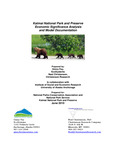
Katmai National Park and Preserve Economic Significance Analysis and Model Documentation
Neal Christense and Ginny Fay
-
All-Alaska Rate Electric Power Pricing Structure
Ginny Fay and Alejandra Villalobos Meléndez
Economists at the Institute of Social and Economic Research, University of Alaska Anchorage were asked to research the potential options and impacts of establishing an All-Alaska Rate as an alternative to the current Power Cost Equalization (PCE) program funding formula. We were asked to provide a history of the PCE program and information on electricity rates and patterns of consumption across regions of Alaska. This report provides the results of this analysis. Alaska is unique in many ways, including its consumption and pricing of electricity. There are large regional differences in consumption and prices that result from proximity to different types and quantities of resources. Differences in remoteness and population size also influence costs. Urban areas in the southern Railbelt benefit from larger economies of scale and access to natural gas and hydroelectric resources; the majority of hydroelectric facilities are located in Southcentral and Southeast Alaska. Most communities in rural Alaska depend on volatile and high price fossil fuels for the generation of electricity. The Alaska statewide weighted average residential rate for electricity (17.6 cents per kilowatt (kWh) in CY2011) is higher than the U.S. average of 11.8 cents per kWh (U.S. EIA, 2012). Alaska now trails behind Hawaii (34.5 cents), New York (18.4 cents) and Connecticut (18.1 cents) based on ranking of average residential price per kWh. Hidden in the Alaska statewide average is considerable variation with some communities paying less than the national average and some paying considerably more.
-
Alaska Energy Statistics 1960-2010 Final Report
Ginny Fay, Alejandra Villalobos Meléndez, and Amber Converse
Prior to 1985, the federal Alaska Power Administration published the Alaska Electric Power Statistics. Then, the Alaska Energy Authority (formerly the Alaska Power Authority) began gathering statistical data and publishing this annual report. In 1988, the Alaska Electric Power Statistics report became a combined effort between the Alaska Systems Coordinating Council and the Alaska Energy Authority. Beginning in 1993, the report became a joint effort between the Alaska Systems Coordinating Council and the Alaska Department of Community and Regional Affairs, Division of Energy. After the 1995 report, no further reports were published until 2003 when a report was prepared by the Institute of Social and Economic Research (ISER), University of Alaska Anchorage (UAA), with funding provided by the Alaska Energy Authority (AEA), the Regulatory Commission of Alaska (RCA), and the Denali Commission.The purpose of this report is to present electric power reference data for Alaska; it is not intended to provide detailed analysis of energy production, consumption or uses.
-
Alaska Fuel Price Projections 2012-2035
Ginny Fay, Alejandra Villalobos Meléndez, and Sohrab Pathan
This and previous Alaska fuel price projections were developed for the Alaska Energy Authority (AEA) for the purpose of estimating the potential benefits and costs of renewable energy projects. Project developers submit applications to AEA for grants awarded under the Alaska Renewable Energy Fund program process. The fuel price projections are not price forecasts but a statistical estimation of potential future utility avoided fuel costs based on the relationships between historic utility fuel prices and crude oil and refinery prices reported by the U.S. Department of Energy, Energy Information Administration (EIA). These statistically estimated relationships are used to project potential future fuel prices based on EIA’s published Annual Energy Outlook crude oil and natural gas price forecasts. In addition to developing these low, medium and high fuel price projections, estimates of the social cost of carbon (previously included as estimates of potential carbon taxes), and a price differential for home heating fuel are provided and are incorporated into the Renewable Energy Fund benefit-cost model for evaluating potential projects. Previously, a five cents premium for low sulfur fuels was added to the projections in anticipation of implementation of low sulfur fuel air quality requirements. However, the low sulfur fuel requirement was implemented in 2010; hence recent prices reflect the effects of the rule and a premium is no longer necessary. The fuel price projections are limited in their applicability to the modeling of project benefits and costs and should not be considered fuel price forecasts.
-
Power Cost Equalization Funding Formula Review
Ginny Fay, Alejandra Villalobos Meléndez, and Tobias Schwörer
The purpose of this study is to examine the current Power Cost Equalization (PCE) program formula’s impacts on incentives for implementation of energy efficiency and renewable energy measures. In addition, it examines if alternative formula structures might improve market signals that are more conducive to investment in energy efficiency and renewable energy in rural Alaska. As part of the analysis we also present information on the history of the PCE program and levels and patterns of electricity consumption across regions of Alaska. Alaska has large regional and intra-regional differences in energy consumption and prices that result from a number of factors including proximity to different types and quantities of resources, community population, remoteness, and transportation costs. Most communities in rural Alaska depend on volatile and high priced fossil fuels for the generation of electricity, space heating and transportation. The Alaska statewide weighted average residential rate for electricity (17.6 cents per kWh in CY2011) is substantially higher than the U.S. average of 11.8 cents per kWh (U.S. EIA, 2012). Yet in Alaska the average residential rate per kWh is currently lower than in Hawaii (34.5 cents), New York (18.4 cents) and Connecticut (18.1 cents). Hidden in the Alaska statewide average is considerable variation with some communities paying less than the national average and some—generally those least able to afford it—paying among the highest in the country. The Railbelt and Southeast regions have the lowest average residential electric rates (Appendix I map). North Slope residential customers also have lower average rates because of access to natural gas and North Slope Borough energy payments in addition to PCE disbursements. Most other regions have rates two to three times as high as Alaska urban rates. Some communities with hydroelectric power have notably low rates but customers are not paying the full, true cost of power because the cost of construction was heavily subsidized by state and federal governments. In Table 3 (p. 20) we present average annual residential electricity consumption and rates for different regions of Alaska.
-
Alaska Energy Statistics 1960-2011 Preliminary Report
Ginny Fay, Alejandra Villalobos Meléndez, and Corinna West
Prior to 1985, the federal Alaska Power Administration published the Alaska Electric Power Statistics. Then, the Alaska Energy Authority (formerly the Alaska Power Authority) began gathering statistical data and publishing this annual report. In 1988, the Alaska Electric Power Statistics report became a combined effort between the Alaska Systems Coordinating Council and the Alaska Energy Authority. Beginning in 1993, the report became a joint effort between the Alaska Systems Coordinating Council and the Alaska Department of Community and Regional Affairs, Division of Energy. After the 1995 report, no further reports were published until 2003 when a report was prepared by the Institute of Social and Economic Research (ISER), University of Alaska Anchorage (UAA), with funding provided by the Alaska Energy Authority (AEA), the Regulatory Commission of Alaska (RCA), and the Denali Commission. Beginning in 2008, Alaska Electric Energy Statistics updates have been prepared by ISER in partnership with AEA. The purpose of this report is to present electric power reference data for Alaska; it is not intended to provide detailed analysis of energy production, consumption or uses.
-
Federal Spending in Alaska: Running Out of Steam?
Oliver Scott Goldsmith
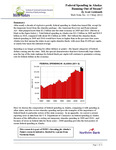
After nearly a decade of explosive growth, federal spending in Alaska has turned flat, except for the temporary boost from the stimulus package—the American Recovery and Reinvestment Act—that pumped more than $2.2 billion into the state economy in 2009 and 2010. (Shown in black in the figure below.) Total federal spending in Alaska was $11.2 billion in 2009 and $10.9 billion in 2010, compared with about $9.4 billion in 2008. But without the stimulus funds, federal spending in 2009 and 2010 would have been no higher than in the previous four years. Alaska was first among the states in per capita stimulus funds, with more than $3,000 per capita, or nearly four times the national average. Spending is no longer growing for either defense or grants—the largest categories of federal dollars coming into the state. Still, the special characteristics that have historically kept Alaska near the top of the state rankings for federal funds per capita will continue to guarantee a strong role for federal dollars in the economy. Here we discuss the composition of federal spending in Alaska, comparing it with spending in other states, and also review stimulus spending and provide examples of the importance of federal funds to particular sectors of the state economy. In an appendix, we correct a serious reporting error in data from the U.S. Department of Commerce on federal spending in Alaska. Because of the difficulties in sorting out temporary stimulus spending in 2009 and 2010—and because of errors in federal data for those years—2008 spending provides the best picture of recent federal spending in Alaska.
-
Managing Alaska’s Petroleum Nest Egg for Maximum Sustainable Yield
Oliver Scott Goldsmith
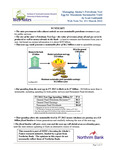
Web Note #7 (How Much Should Alaska Save? February 2011) suggested we should think of Alaska’s petroleum wealth as an asset from which we should spend only the earnings—thus preserving that wealth for future generations, while at the same time providing a sustainable annual flow of income for current Alaskans. Based on the value of state financial assets and a projection of future petroleum revenues, in early 2011 we estimated total petroleum wealth—the Petroleum Nest Egg—to be $126 billion. That total could generate an annual sustainable flow of income, or Maximum Sustainable Yield, of $5 billion. That year actual state spending from petroleum revenues, along with the Permanent Fund dividend, was $5.5 billion, or $.5 billion more than the sustainable amount. This put a Fiscal Burden on future generations of Alaskans because it reduced the size of the nest egg. The state could have avoided that burden either by increasing non-petroleum revenues $.5 billion, or by reducing spending that much. Doing one or the other would have added $.5 billion of saving to the nest egg and so maintained its value. This Web Note revisits the calculation of the Petroleum Nest Egg, the Maximum Sustainable Yield, and the Fiscal Burden, taking into account both changes in expectations of future revenues and the size of the state budget. The estimated size of the nest egg has increased since last year, to $155 billion, because of higher oil prices and more optimistic production assumptions, so the estimated sustainable yield is up to $6.2 billion a year. But that growth has been more than offset because spending of petroleum revenues has also increased. The FY 2012 state budget exceeds the Maximum Sustainable Yield by $.8 billion, passing a Fiscal Burden of that amount on to the next generation of Alaskans. Looking beyond FY 2012, continued spending growth would have dramatic effects on the Nest Egg and Sustainable Yield. For example, if spending growth of 6% a year were to go on year after year and the growth was funded by petroleum revenues, the currently estimated Nest Egg would shrink at an accelerating rate and the Fiscal Burden would grow at an increasing rate. The Maximum Sustainable Yield for the next generation of Alaskans would drop by half in 20 years. Looked at another way, sustaining spending growth of 6% a year would require a Nest Egg of $350 billion—more than twice the current estimate. To put that amount in perspective, $350 billion is more than half the current size of the Norwegian government’s pension fund.
-
Managing Extractive Resource Wealth for Sustainability: Lessons from Alaska Seen Through the Lens of Maximum Sustainable Yield
Oliver Scott Goldsmith
Alaska has enjoyed a generation of unprecedented economic growth and prosperity driven by crude oil production primarily from one giant field, Prudhoe Bay, on the North Slope. Through a number of financial savings accounts, including the Alaska Permanent Fund, the Statutory Budget Reserve, and the Constitutional Budget Reserve, the state has successfully converted a share of petroleum wealth into $55 billion in financial assets. It has been less successful in diversifying the economic base away from dominance by oil and gas production. Now oil production has fallen to less than 1/3 of its peak and this decline is projected to continue—reducing public revenues and private economic activity. This paper will explore whether the state of Alaska has the resources to be able to transition successfully to a Post-Prudhoe Bay economy, how that transition could take place, and what impediments might prevent a successful transition. This analysis will be of interest to other natural resource dependent economies that are trying to manage the cycles that resource extraction generate.
-
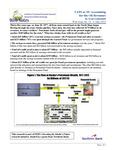
TAPS at 35: Accounting for the Oil Revenues
Oliver Scott Goldsmith
Thirty-five years ago, on June 20, 1977, oil from state-owned land on the North Slope began flowing through the trans-Alaska pipeline. Since then, the state has collected $170 billion in oil revenues, in today’s dollars.i Petroleum (both oil and gas) still in the ground might generate another $100 billion for the state.ii What has Alaska done with its oil wealth so far?
-
2012 Alaska's Construction Spending Forecast
Oliver Scott Goldsmith and Mary Killorin
The total value of construction spending “on the street” in Alaska in 2012 will be $7.7 billion, up 3% from 2011.1,2,3 Wage and salary employment in the construction industry will be stable at the same level as last year— 15,800. This is down from a peak of 18,300 in 2005. Excluding the oil and gas sector—which accounts for 41% of the total—construction spending will be $4.6 billion, up 4% from 2011 and about the same rate of increase as last year. Oil and gas spending will be $3.2 billion, 1% higher than in 2011. Private spending for construction will be up in 2012. Public spending for traditional government purposes will be down somewhat, but public funds also help finance some projects in the utility and health sectors, which are primarily private. So overall, an increase in state spending for construction will offset a decline in federal spending.
Printing is not supported at the primary Gallery Thumbnail page. Please first navigate to a specific Image before printing.