






-
What do we know about the effects of the Alaska Permanent Fund Dividend?
Mouhcine Guettabi
The Alaska Permanent Fund Dividend (PFD) has been distributed to Alaska residents for 37 years, providing each resident an equal share of a yearly government appropriation based on the earnings of the Alaska Permanent Fund. While support for the program is high, work assessing the PFD’s influence on the lives of Alaskans is limited. Recently, a number of researchers have analyzed the causal effect of the PFD on a variety of socio-economic outcomes including employment, consumption, income inequality, health, and crime. This paper summarizes this empirical literature and highlights future areas of research.
-

Economic Impacts of the Vetoes on the Alaska Economy
Mouhcine Guettabi and Nolan Klouda
On June 28, 2019 Governor Mike Dunleavy announced line-item vetoes totaling $409 million from the State of Alaska budget for Fiscal Year 2020. These vetoes include significant cuts to the University of Alaska, Medicaid, payments to local governments, public assistance programs, state personnel headcounts, and numerous other categories. The full consequences of these cuts on the state economy, fiscal health, population, and policy outcomes will take years to develop. In this paper, we provide the short term impacts of the cuts, how they interact with the current state of the economy, and a descriptive outlook of the some of the future effects. We find the cuts will result in more than 4,000 jobs lost in the short run and will therefore return the Alaska economy into recession. While the short term losses represent a considerable negative shock to the economy, the consequences of these cuts on long term development could be even more pronounced.
-
Economic Impacts of the Vetoes on the Alaska Economy
Mouhcine Guettabi and Nolan Klouda
On June 28, 2019 Governor Mike Dunleavy announced line-item vetoes totaling $409 million from the State of Alaska budget for Fiscal Year 2020. These vetoes include significant cuts to the University of Alaska, Medicaid, payments to local governments, public assistance programs, state personnel headcounts, and numerous other categories. The full consequences of these cuts on the state economy, fiscal health, population, and policy outcomes will take years to develop. In this paper, we provide the short term impacts of the cuts, how they interact with the current state of the economy, and a descriptive outlook of the some of the future effects. We find the cuts will result in more than 4,000 jobs lost in the short run and will therefore return the Alaska economy into recession. While the short term losses represent a considerable negative shock to the economy, the consequences of these cuts on long term development could be even more pronounced.
-
FASD Costs: Evidence from Hawaii Medicaid Data
Bridget Hanson, Rebecca Porter, and Mouhcine Guettabi
Fetal alcohol spectrum disorders (FASDs), a collection of permanent yet preventable developmental disabilities and birth defects resulting from prenatal alcohol exposure, are associated with substantial costs. We use information from Hawaii Medicaid data for individuals who have at least one FASD-related condition. The total spending for these individuals between 2011 and 2015 was $460,515,584. Of that total, more than $32 million is directly associated with FASD-related visits/codes. We find that the average FASD-related visit costs $121, which is more expensive than the average medicaid visit. We also find that the frequency of FASD-related visits increases with age. We find evidence that the number of initial conditions is positively associated with the number of visits and accumulated medical costs and that 20% of the patients are responsible for 85.85% of the total spending. This paper was supported by the United States Department of Health and Human Services, Centers for Disease Control and Prevention Cooperative Agreement 5NU01DD001143.
-
Hitchhikers on floats to Arctic freshwater: Private aviation and recreation loss from aquatic invasion
Tobias Schwoerer, Joseph Little, Jennifer Schmidt, and Kyle Borash
This study of aviation-related recreation loss shows that a survey primarily aimed at collecting information on invasive species’ pathways can also be used to estimate changes in pathway-related ecosystem services. We present a case study for Elodea spp. (elodea), Alaska’s first known aquatic invasive plant, by combining respondents’ stated pre-invasion actual flights with stated post-invasion contingent behavior, plane operating costs, and site quality data. We asked pilots about the extent of continued flights should destinations become invaded and inhibit flight safety. We estimate a recreation demand model where the lost trip value to the average floatplane pilot whose destination is an elodea-invaded lake is US$185 (95 % CI $157, $211). Estimates of ecosystem damages incurred by private actors responsible for transmitting invaders can nudge actors to change behavior and inform adaptive ecosystem management. The policy and modeling implications of quantifying such damages and integration into more complex models are discussed.
-
Alaska High School Graduation Rate Trends
Trang Tran and Alexandra Hill
This paper examines trends in Alaska public high school graduation rates from academic year 2010-11 to 2015-16 and explores differences across demographic groups. We focus specifically on students from public neighborhood high schools. These are publicly-funded schools run by district or Regional Educational Attendance Area school boards serving all residents within school attendance boundaries. These schools represent about 88% of Alaska’s high school students.
-
Universal Cash and Crime
Brett Watson, Matthew Reimer, and Mouhcine Guettabi
We estimate the effects of universal cash transfers on crime from Alaska’s Permanent Fund Dividend, an annual lump-sum payment to all Alaska residents. We find a 14% increase in substance-abuse incidents the day after the payment and a 10% increase over the following four weeks. This is partially offset by a 8% decrease in property crime, with no changes in violent crimes. On an annual basis, however, changes in criminal activity from the payment are small. Estimated costs comprise a very small portion of the total payment, suggesting that crime-related concerns of a universal cash transfer program may be unwarranted.
-
Universal Cash Transfers Reduce Childhood Obesity Rates
Brett Watson, Matthew Reimer, and Mouhcine Guettabi
We evaluate the impact of universal income on childhood obesity. While the goals of implementing universal income are many, its influence on childhood obesity is of particular interest given the growing obesity epidemic and its future threat to global public health. We use evidence from Alaska’s universal income program, the Permanent Fund Dividend (PFD), which has provided annual, unconditional, and universal income to Alaskan residents for over thirty-five years. We use both survey and administrative data to evaluate how the availability of unconditional resources at an early developmental stage, in terms of PFD payments to the child, affects a child’s body mass index (BMI). Using date-of-birth eligibility cut-offs as an identification strategy, we find that an additional one thousand dollars in PFD payments decreases the probability of an Alaskan child being obese by as much as 4.5 percentage points. Back-of-the-envelope calculations for Alaska suggest these reduction may avert 500 cases of obesity and achieve medical cost savings of $2-10 million per year. These findings highlight just one of the potential social benefits of universal income and the potential it has as a tool for addressing the obesity epidemic.
-
Economic Effects of Climate Change in Alaska
Matthew Berman and Jennifer Schmidt
We summarize the potential nature and scope of economic effects of climate change in Alaska that have already occurred and are likely to become manifest over the next 30-50 years. We classified potential effects discussed in the literature into categories according to climate driver, type of environmental service affected, certainty and timing of the effects, and potential magnitude of economic consequences. We then described the nature of important economic effects, and provided estimates of larger, more certain effects for which data were available. Largest economic effects were associated with costs to prevent damage, relocate, and replace infrastructure threatened by permafrost thaw, sea level rise, and coastal erosion. The costs to infrastructure were offset by a large projected reduction in space heating costs attributable to milder winters. Overall, we estimated that five, relatively certain, large effects that could be readily quantified would impose an annual net cost of $340-$700 million, or 0.6 to 1.3 percent of Alaska GDP. This significant, but relatively modest net economic effect for Alaska as a whole obscures large regional disparities, as rural communities face large projected costs while more southerly urban residents experience net gains.
-
Win or Lose: Residential Sorting After a School Choice Lottery
Andrew Bibler and Stephen Billings
We examine residential relocation and opting out of the public school system in response to school choice lottery outcomes. We show that rising kindergarten and sixth graders who lose a school choice lottery are 6 percentage points more likely to exit the district or change neighborhood schools (20-30% increase) and make up 0.14-0.35 standard deviations in average school test scores between lottery assignment and attendance the following year. Using hedonic-based estimates of land prices, we estimate that lottery losers pay a 9-11% housing price premium for access to a school with a one standard deviation higher mean test score.
-

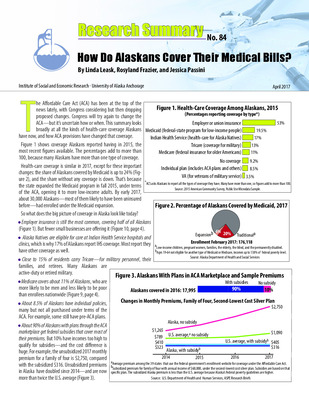
Trends in Alaska's Health-Care Spending
Rosyland Frazier, Mouhcine Guettabi, and Jessica Passini
All Americans spend a lot to get health care—but Alaskans spend the most per resident, face the highest insurance premiums, and have seen overall spending grow much faster. Here we highlight some trends in Alaska’s health-care spending since the 1990s, based on existing publicly available data that allow us to compare changes in Alaska and nationwide. A chart book with much more detail is available on ISER’s website. We hope this broad information on trends in health-care spending will help Alaskans better understand what happened, consider possible reasons why, and think about potential ways to change the upward spiral.
-
History and Options Regarding the Unfunded Liabilities of Alaska’s Public Employees’ and Teachers’ Retirement Systems
Cliff Groh
In early 2003, financial analysts working for the State of Alaska announced that the two largest public employee retirement systems in Alaska had become significantly underfunded.3 From fiscal year 2006 (July 1, 2005 through June 30, 2006) to date, the state has paid $6.951 billion— (an average of $534.7 million annually)—to pay down these obligations, which will be called “unfunded liabilities” in this paper.4 The State of Alaska has substantial unfunded liabilities remaining to pay off for these two systems, the Public Employees’ Retirement System (PERS) and the Teachers’ Retirement System (TRS). There is uncertainty about the size of these unfunded liabilities, and there are also different ways of calculating them. For example, the State of Alaska’s snapshot balance-sheet approach, subtracting the accrued liabilities from the assets, based on their actuarial value, produces an estimate of $6.609 billion for the combined unfunded liabilities of PERS and TRS.5 That figure is an estimate of the unfunded liabilities discounted to the present day. Estimates of the size of the unfunded liabilities particularly vary based on the use of different critical assumptions, such as the rate of future returns on investment. As an example, using an estimated rate of return of 2.142 percent instead of the State of Alaska’s assumption of 8 percent produces an estimate of $33.9 billion for the state’s unfunded liabilities. 6 The State of Alaska has committed to paying off the unfunded liabilities under a 25-year amortization schedule that started in 2014, so another highly relevant measurement of those liabilities appears to be the amount actuaries for the state currently project will be needed under that pay-off plan, which runs through fiscal year 2039. The state’s actuaries project that from fiscal year 2019 through fiscal year 2039 the state will pay a total of $10.815 billion in extra contributions—called “state assistance” or “additional state contributions” in this paper—to pay off the unfunded liabilities. 7 In contrast to the state’s snapshot estimate of $6.609 billion, this estimate of $10.815 billion in state assistance represents a flow of annual cash payments. That is, the $10.815 billion is an estimate of the total amount needed to eliminate the unfunded liabilities of PERS and TRS under the 25-year amortization schedule the state adopted in 2014. 4 Note that this state assistance is above and beyond the amount the state is projected to owe in its role as employer in the normal course of funding the two systems.8 Employers other than the state—primarily local governments and school districts—also participate in PERS and TRS, and the figure for state assistance covers not only unfunded liabilities attributed to the state but also a portion of the unfunded liabilities attributed to non-state employers. As explained more later, the state has assumed, by statute, the responsibility to pay for a share of the unfunded liability of these other employers. 9 This paper: • Describes the structure of the Alaska public employee retirement systems in the context of some unusual features of public employment on the Last Frontier • Reviews how the problem of unfunded liabilities came about • Examines how concerns over unfunded liabilities produced both changes and proposed changes in the retirement systems over the past dozen years, including proposals for changes in the allocation of burdens between the state and local governments in paying for retirement benefits • Describes current projections of future amounts needed to pay off the unfunded liabilities • Discusses how future estimates of the unfunded liabilities might change in response to economic and demographic factors • Discusses legal provisions protecting the rights of beneficiaries of the retirement systems • Lays out options for policymakers—other than the current policy of paying down the unfunded liabilities over time—including buyout, bailout, and bankruptcy
-
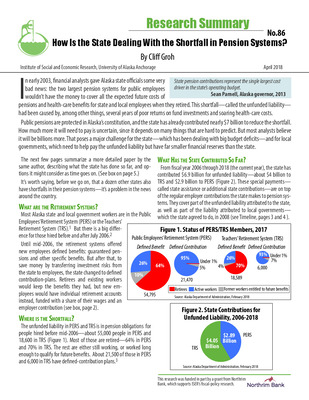
How Is the State Dealing With the Shortfall in Pension Systems?
Cliff Groh
I n early 2003, financial analysts gave Alaska state officials some very bad news: the two largest pension systems for public employees wouldn’t have the money to cover all the expected future costs of pensions and health-care benefits for state and local employees when they retired. This shortfall—called the unfunded liability— had been caused by, among other things, several years of poor returns on fund investments and soaring health-care costs. Public pensions are protected in Alaska’s constitution, and the state has already contributed nearly $7 billion to reduce the shortfall. How much more it will need to pay is uncertain, since it depends on many things that are hard to predict. But most analysts believe it will be billions more. That poses a major challenge for the state—which has been dealing with big budget deficits—and for local governments, which need to help pay the unfunded liability but have far smaller financial reserves than the state.
-
A short brief on the regional dimensions of the Alaska recession
Mouhcine Guettabi
We provide a short update on the Alaska recession by examining its regional dimensions. Specifically, we evaluate the performance of the Alaska boroughs/census areas in each of the last three years and determine which areas have been resilient and which ones continue losing jobs.
-
How do oil prices influence Alaska and other energy-dependent states?
Mouhcine Guettabi
We analyze monthly data from the Bureau of Labor and Statistics to evaluate how fluctuations in oil prices affect economic activity in Alaska and other energy-dependent states. For this most recent recession, we find that only 6 of the traditional oil states experienced a recession. Four of those have already recovered, leaving Alaska and North Dakota as the only two to continue losing jobs. Using monthly employment data between 1991 and 2018 we estimate that, on average, the long run effect of a 10% change in oil prices results in a 1.7% change in employment across the five most important oil states. When analyzed individually, we find that some of them experience symmetric responses to oil price increases and decreases while others are much more sensitive to price declines.
-
How Has the 80th Percentile Rule Affected Alaska's Health-Care Expenditures?
Mouhcine Guettabi
We use the Health Expenditures by State of Residence data (1991-2014) compiled by Centers for Medicare & Medicaid Services to examine the causal effect of the 80th percentile rule on Alaska's health care expenditures. We find evidence that Alaska's expenditures would have been lower in the absence of rule. The share of the overall increase in expenditures that we attribute to the 80th percentile rule is between 8.61% and 24.65%. It is important to note that using expenditures as a proxy for costs has limitations as it is the product of both quantity of services used and prices.
-
How Has the 80th Percentile Rule Affected Alaska's Health-Care Expenditures?
Mouhcine Guettabi
We use the Health Expenditures by State of Residence data (1991-2014) compiled by Centers for Medicare & Medicaid Services to examine the causal effect of the 80th percentile rule on Alaska's health care expenditures. We find evidence that Alaska's expenditures would have been lower in the absence of rule. The share of the overall increase in expenditures that we attribute to the 80th percentile rule is between 8.61% and 24.65%. It is important to note that using expenditures as a proxy for costs has limitations as it is the product of both quantity of services used and prices.
-
What do we know to date about the Alaska recession and the fiscal crunch?
Mouhcine Guettabi
We provide a broad overview of the state’s economic and fiscal conditions. We show how the economic contraction has spread away from natural resource and mining and state government to household spending dependent sectors. We also show that while the rate at which jobs are being lost has slowed, it is inaccurate to think about that as a sign of a recovery. That is because the engine of growth that is O&G employment as of June 2017 was only 75% of what it was in 2014. Additionally, the softness in spending activity may linger for an extended period of time. We also assess the regional effects of the recession and show the significant heterogeneity in experience. Unsurprisingly, areas with economic bases not associated with Oil and Gas and with relatively little dependence on state government spending are holding up best. After establishing an understanding of the economic conditions, we offer a back of the envelope calculation of the capital investment losses associated with the fiscal uncertainty. Then, we provide a comparison of Alaska’s taxes relative to the rest of the US, and a simulation of the effects of different withdrawal amounts on the permanent fund balance and the earnings reserve.
-
Perceptions of Universal Ballet Delivery Systems
Virgene Hanna and Jessica Passini
A total of 412 registered voters in the Bethel, Dillingham, and Kusilvak Census Areas completed surveys with ISER interviewers in March and April of 2018. The majority (74%) of respondents reported their race as Alaska Native and 13% were White. Near the beginning of the survey, interviewers asked respondents how they preferred to receive their ballot and 60% said they preferred to get it in person on Election Day, 21% would prefer to receive it by mail, and 17% would prefer to receive their ballot online. After respondents heard a description of three voting methods being considered: 1) keep voting the way it is now; 2) mail out and mail back; and 3) receive ballot in the mail and have different ways to return it their preferences changed somewhat. Of the three methods, keep voting the way it is now was the first choice by 49% of respondents, followed by 36% for option 3, and 14% for option 2. Respondents had little experience with voting methods other than in-person. When asked what made it difficult for them and other members of their community to vote, personal reasons, such as being sick or out of town, was the most frequent (37%) response. About two-thirds (64%) reported personal reasons made it difficult for people in their community to vote followed by 46% saying that the ballot being written in English made it difficult for people in their community. Over half (56%) of respondents reported they are satisfied with their mail service, only 17% of those who were satisfied said they would prefer to receive or return their ballot by mail.
-
Perceptions of Universal Ballot Delivery Systems
Virgene Hanna and Jessica Passini
A total of 412 registered voters in the Bethel, Dillingham, and Kusilvak Census Areas completed surveys with ISER interviewers in March and April of 2018. The majority (74%) of respondents reported their race as Alaska Native and 13% were White. Near the beginning of the survey, interviewers asked respondents how they preferred to receive their ballot and 60% said they preferred to get it in person on Election Day, 21% would prefer to receive it by mail, and 17% would prefer to receive their ballot online. After respondents heard a description of three voting methods being considered: 1) keep voting the way it is now; 2) mail out and mail back; and 3) receive ballot in the mail and have different ways to return it their preferences changed somewhat. Of the three methods, keep voting the way it is now was the first choice by 49% of respondents, followed by 36% for option 3, and 14% for option 2. Respondents had little experience with voting methods other than in-person. When asked what made it difficult for them and other members of their community to vote, personal reasons, such as being sick or out of town, was the most frequent (37%) response. About two-thirds (64%) reported personal reasons made it difficult for people in their community to vote followed by 46% saying that the ballot being written in English made it difficult for people in their community. Over half (56%) of respondents reported they are satisfied with their mail service, only 17% of those who were satisfied said they would prefer to receive or return their ballot by mail.
-
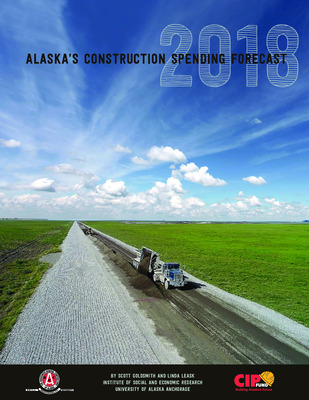
2018 Alaska's Construction Spending Forecast
Linda Leask and Oliver Scott Goldsmith
The total value of construction spending “on the street” in Alaska in 2018 will be $6.6 billion, up 4% from 2017.1, 2,3 The increase is due to a recovery in Petroleum sector spending which will grow 15% to $2.6 billion from its low of $2.2 billion last year. All other construction spending will be $4.0 billion, a decline of 2% from $4.1 billion last year. Private spending, excluding petroleum, will be about $1.5 billion, down 5% from $1.6 billion last year—while public spending will decline 1% to $2.5 billion. Wage and salary employment in construction will decline 3% to 14.5 thousand.4 After falling by half in the last two years, spending by the petroleum industry will start to recover because of the rise in the price of oil, and more support for the industry from the federal and state governments.
-
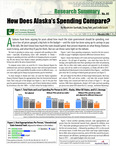
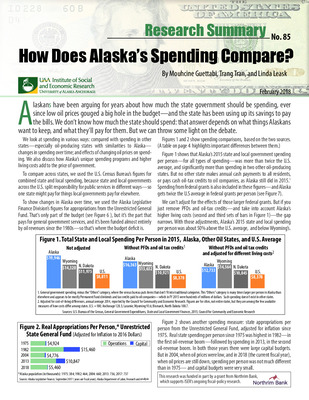
How Does Alaska's Spending Compare?
Linda Leask, Trang Tran, and Mouhcine Guettabi
A laskans have been arguing for years about how much the state government should be spending, ever since low oil prices gouged a big hole in the budget—and the state has been using up its savings to pay the bills. We don’t know how much the state should spend: that answer depends on what things Alaskans want to keep, and what they’ll pay for them. But we can throw some light on the debate.
-
Mechanisms matter for evaluating the economic impacts of marine reserves
Matthew Reimer
Large areas of marine and coastal environments have been protected to satisfy diverse policy goals, but there has been limited work understanding the economic impacts of such closures. While methods for establishing causal impacts are prevalent, less attention has been paid to explaining the mechanisms through which the causal relationship came to be. Understanding mechanisms is crucial for designing policies that foster the mechanisms that achieve the intended objectives of marine reserves and mitigate the mechanisms that do not. We estimate the treatment effect of a large marine reserve on the net earnings of a commercial fishery using difference-in-differences and synthetic-control designs, and decompose the treatment effect into its constituent mechanisms through structural equation modeling. We find minimal evidence that closing the marine reserve to fishing had a significant economic cost for the industry; however, several counteracting mechanisms are critical for explaining the effect and for generalizing to other settings.
-
Adapting to Environmental and Social Change: Subsistence in Three Aleutian Communities
Jennifer Schmidt and Matt Berman
-
Adapting to Environmental and Social Change: Subsistence in Three Aleutian Communities
Jennifer Schmidt and Matthew Berman
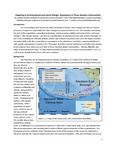
Our surroundings and society are both constantly evolving. Some changes are due to natural processes. People are responsible for other changes, because of what we do—for example, increasing the size of the population, expanding technology, and increasing mobility and connectivity. And some changes—like climate change—are due to a combination of natural processes and actions of people. In the Arctic, including the Aleutian Islands, marine and coastal ecosystems have seen the largest number of regime shifts with direct and indirect consequences for subsistence activities, commercial fisheries, and coastal communities (Council 2016). This paper describes current subsistence activities and changes local residents have observed over time in three Aleutian Island communities—Akutan, Nikolski, and Atka. As described more later, we did initial household surveys in 2016 and a second round in 2017, as well as more detailed interviews with some residents.
Printing is not supported at the primary Gallery Thumbnail page. Please first navigate to a specific Image before printing.