-

Wind-Diesel Systems in Alaska: A Preliminary Analysis
Ginny Fay, Katherine Keith, and Tobias Schwörer
Most remote rural communities in Alaska use diesel to generate electricity. But the recent rapid development of a worldwide commercial wind industry, along with the rise in diesel fuel prices, has increased interest in wind power in rural Alaska—both to reduce energy costs and to provide local, renewable, sustainable energy. Wind is abundant in Alaska, and a growing number of rural communities are building winddiesel systems, integrating wind into isolated diesel power plants. These systems have moved from the initial demonstration phase a decade ago toward a technology available for many communities. Even in places that have not yet added wind, some rural utilities are planning for the possibility. For example, Alaska Village Electric Cooperative (AVEC) has committed to making new diesel power plants “wind ready” by designing its electrical systems so that wind turbines can be incorporated in the future without major reconfiguration. But it is not clear under what rural Alaska conditions wind-diesel systems are more economical than conventional diesel plant operations. The Alaska Energy Authority asked the Institute of Social and Economic Research (ISER) and the Alaska Center for Energy and Power (ACEP) to assess the performance of existing rural wind-diesel systems. We analyzed data available for existing wind-diesel systems as of spring 2010. Keep in mind that our analysis is preliminary; most rural wind-diesel systems are very new, and more time is needed to evaluate them fairly. Only three wind systems (Kotzebue, Wales, and Saint Paul Island) have been operating for more than a few years. Initial funding for the Kotzebue and Wales projects came from the U.S. Department of Energy, which funds research but does not subsidize utility operations. These early projects, built in the late 1990s, faced problems but demonstrated there is hardware that can operate in arctic environments. The Saint Paul village corporation funded the system on the island; it provides power for an industrial complex and airport the corporation owns. It is a high-performing system, and the most successful of the early demonstration systems, as measured by its capacity factor. However, it should be noted that both the Kotzebue and Wales systems have provided valuable experiences and lessons learned while integrating wind on a community-scale grid. Beginning in 2004, the Denali Commission funded projects in five communities (Selawik, Hooper Bay, Kasigluk, Savoonga, and Toksook Bay). In 2008, the Alaska Legislature created the Renewable Energy Fund, a competitive program intended to invest in renewable energy. That fund, which is administered by the Alaska Energy Authority, paid for construction of six projects listed as completed in spring 2010.
-
Alaska Fuel Price Projections 2010-2030
Ginny Fay and Ben Saylor
We generated Low, Medium, and High case fuel price projections for the years 2010-2030 for the following fuels: Incremental natural gas in Southcentral Alaska delivered to a utility-scale customer Incremental diesel delivered to a PCE community utility tank Incremental diesel delivered to a home in a PCE community Incremental home heating oil purchased in Anchorage, Fairbanks, Juneau, Kenai, Ketchikan, Palmer, and Wasilla This memorandum provides documentation of the assumptions and methods that we used. A companion Excel workbook contains the detailed projections
-
Alaska Isolated Wind-Diesel Systems Performance and Economic Analysis
Ginny Fay, Tobias Schwoerer, and Katherine Keith
Most remote rural communities in Alaska use diesel to generate electricity, but the high price of diesel is causing an increasing number to add a local power source that’s also renewable—wind. Our analysis is preliminary; most existing systems are new. Adding wind to diesel systems makes economic sense to customers if wind energy costs less than the equivalent energy cost of diesel. Our review of project histories did reveal some potential ways of improving the economics and performance of rural wind-diesel systems. Those include geographically and technologically aggregating projects to take advantage of economies of scale; employing skilled project developers who use technological innovations to increase wind-energy generation; having clear power-purchase agreements; having skilled and motivated local operators; establishing remote monitoring to alert project managers about problems and record maintenance and performance data; and hiring people with expertise in Alaska’s harsh climate.
-
Response to Questions: Potential Effects on Alaska of Proposed Health-Care Reform Legislation
Mark A. Foster and Rosyland Frazier
Mark Foster of Mark A. Foster and Associates (MAFA) is a consultant to ISER, and Rosyland Frazier is an ISER research associate. Both the authors have broad experience studying health-care issues in Alaska, and they have recently been looking at the problems Alaska’s Medicare patients face in getting primary-care doctors to see them. They prepared this note to respond quickly to questions from and discussions with the Office of the Governor in Washington, D.C. and Alaska’s Congressional delegation. Those questions and discussions were about the possible implications for Alaska’s Medicare patients of provisions in health-care reform legislation the U.S. Congress is considering, as well as about the broader potential effects on Alaska of the proposed legislation. This is by no means a full analysis of the many complex issues associated with health-care reform. A working paper by the same authors—examining the Medicare-access problem and related health-policy issues in more detail—will be available soon. The findings and conclusions of this note are those of the authors. If you have questions, get in touch will Rosyland Frazier at: [email protected]
-

Improving Health Care Access for Older Alaskans: What Are the Options?
Rosyland Frazier and Mark A. Foster
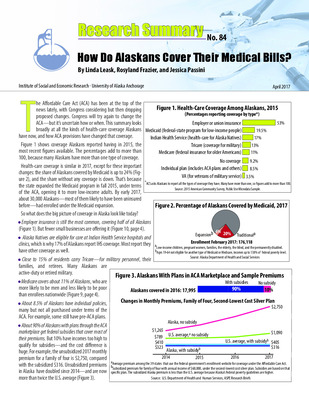
This report focuses on the problem older Alaskans who rely on Medicare face getting access to primary care, and discusses some of the options policymakers are considering to resolve the problem. But older Americans across the country also report difficulty getting the primary care they need. The discussion here sheds light on the problem and potential solutions nationwide. Most Americans 65 and older use Medicare as their primary health insurance. Medicare is federal health insurance for people 65 and older, people under 65 with certain disabilities, and people of any age with end-stage renal disease—but this report looks only at access issues for Medicare beneficiaries 65 and older. Doctors don’t have to participate in the Medicare program. But those who do participate have to accept, as full payment, what Medicare pays for specific services. Many primary-care doctors say Medicare doesn’t pay them enough to cover their costs—so growing numbers are declining to see new Medicare patients. Among primary-care doctors nationwide, 61% accept new Medicare patients.1 National surveys sponsored by the Medicare Payment Advisory Commission have found that 17% of Medicare patients in the U.S. had “a big problem” finding family doctors in 2007—up from 13% in 2005.2 In Alaska, a 2008 survey by the Institute of Social and Economic Research (ISER) found that just over half of Alaska’s primary-care doctors were willing to treat new Medicare patients.3 The situation was worse in Anchorage, where 40% of all older Alaskans live. Only 17% of primary-care doctors in Anchorage were willing to treat new Medicare patients as of 2008 (Figure 1).4
-
Structural Analysis of the Alaska Economy: What are the Drivers?
Oliver Scott Goldsmith
Because of public ownership of much of the natural resource base, state government has a unique role to play in Alaska fostering economic development. A clear understanding of the structure of the economy is a necessary prerequisite for formulating a successful development strategy. This paper describes and quantifies the 14 BASIC sectors (Economic Drivers) upon which all economic activity in the state depends. Without them, the Alaska economy would not exist. Each of these 14 BASIC sectors draws money into the state, which directly generates revenues for businesses, wages and jobs for Alaskans, and other income. As Alaska businesses and households spend this new money within the state, additional revenues, wages, and jobs are created in other businesses (NON-BASIC sectors) through a process known as the economic multiplier. The size and growth of the economy depends largely upon these BASIC sectors because, without the money they bring into the state, the NON-BASIC sectors would not exist.1 We begin this paper with an estimate of the contribution of each of the 14 BASIC sectors to total employment and resident income. We do this using a simple model to calculate how much new money each driver brings into the economy and then estimating how that new money works its way through the economy generating business revenue, wages, jobs, and other sources of income.2 The results of the analysis are summarized in Table I.1. in which total employment (resident and non resident) and personal income of Alaskan households averaged over the period 2004-2007 are parceled out among the 14 BASIC drivers—aggregated into 5 major categories. We find that the various activities of the federal government, both national defense and non-defense spending, account for the largest share of total economic activity. This economic activity is not only the personal income directly flowing to households as payrolls and transfer payments and federal government jobs. It also includes a measure of personal income and jobs generated throughout the economy as the federal dollars circulate through the NON-BASIC sectors in industries like retail trade, business and personal services, transportation, and construction. The total of $9.93 billion in personal income and 131 thousand jobs can be interpreted as the loss to the state if Alaska were to receive no federal dollars over the period 2004- 2007. Petroleum was the largest private economic driver, contributing $7.44 billion to Alaska personal income and 117.6 thousand jobs. The contribution of petroleum comes from production-related activities, current petroleum revenues, and spending from the accumulated savings from revenues collected in prior years and deposited in the Alaska permanent fund and the constitutional budget reserve. The other three driver categories—traditional natural resources, new resources, and personal assets--together accounted for personal income of $7.61 billion and employment of 121.9 thousand. Traditional natural resources are those private sectors that were most important to the economy at the time of statehood. New resources are activities that have developed more recently. The category of personal assets represents the purchasing power of households that is independent of current employment such as retirement income.
-
The Alaska Permanent Fund Dividend: A Case Study in Implementation of a Basic Income Guarantee
Oliver Scott Goldsmith
The Alaska Permanent Fund Dividend program has attracted considerable interest because it is a unique example of a BASIC INCOME GUARANTEE. In this paper, I describe the structure of the dividend program, its economic effects, some of its unintended consequences; and I close with a number of observations about how the dividend might be structured differently. My objective is to give the reader insights into the factors to consider in implementing a BASIC INCOME GUARANTEE in other places. However, before beginning it is important to present a short description of Alaska because the structure of any BASIC INCOME program and its impacts are contingent upon the particular institutional, economic, political, and social environment in which it is located. Alaska is the largest of the 50 United States measured by land area—but among the smallest measured by population. Its 700 thousand residents comprise only about twotenths of one percent of the total U.S. population. As a state within the United States, its border is open to the rest of the nation for the free movement of goods and services, people, capital, and information. Furthermore, it is subject to the laws, regulations, and policies established by the federal government. As I will discuss below, these connections create some challenges for the dividend program because the state cannot totally control its own economic and political environment.
-

2010 Alaska's Construction Spending Forecast
Oliver Scott Goldsmith and Mary Killorin
The total value of construction spending “on the street” in Alaska in 2010 will be $7.0 billion, down 3% from 2009.1,2,3 Wage and salary employment in the construction industry will continue the slow decline which began in 2006, but the level remains above the long-term average for the industry. Excluding the oil and gas sector—which accounts for 43% of the total—construction spending will be $4.0 billion— down 4% from 2009. Private-sector construction spending will be down only 1% from 2009, to $4.4 billion, in spite of the slowdown in the Alaska economy. Oil and gas sector spending will be flat. Spending will increase in the utilities and hospitals4 categories but will decline in mining, residential, other commercial, and the other rural basic sector categories. Public construction spending will be down 5%, to $2.6 billion, in spite of the infusion of cash from the American Recovery and Reinvestment Act (ARRA). Although some categories of federal spending will be higher, many will be lower and state spending will also be lower because of the lean FY 2010 capital budget. Uncertainty in this year’s forecast comes from several sources. As we start 2010 there is no clear indication if the national economy is starting to recover from the recession, and if it does, how strong that recovery will be. Although Alaska has been insulated from the worst effects of the recession—the crash in the housing market, high unemployment, and lack of credit—concerns about the national recovery will continue to influence investment decisions in the state, particularly in the commercial and residential markets. Local government capital spending is also vulnerable to reductions in tax revenues from activities, like tourism, driven by the national economy. The passage of the American Recovery and Reinvestment Act (ARRA) in early 2009 has provided an important boost to construction spending this year. A second stimulus may be undertaken later this year, but it is too soon to speculate on how that might impact construction spending, so we assume no further federal action. The Alaska economy contracted in 2009 for the first time in 22 years—but the reduction in employment was only about 1%. Forecasts for Alaska’s economy in 2010 vary from further moderate declines in employment to a resumption of growth. This difference of opinion underscores the sense of caution in the business community about the near-term prospects for the economy. As the year begins, petroleum and precious metal (gold and silver) prices are strong and rising, and base metal prices (zinc) have rebounded from the lows of last year. Petroleum and mining capital budgets are particularly sensitive to these prices, which are likely to continue to fluctuate throughout the year. We assume these prices remain strong throughout the year.
-
The Foraker Group Report on the Alaska Nonprofit Economy: 2010 Update
Oliver Scott Goldsmith and Tobias Schwörer
A report on the economic importance of Alaska’s nonprofit sector conducted by the Institute of Social and Economic Research University of Alaska Anchorage
-
Report on the Benzene Study of 2008-2009
Mary Ellen Gordian
The purpose of this study was to determine whether reducing the amount of benzene in gasoline, which is scheduled to take place in 2011, will effect a change in indoor air benzene levels in Anchorage, Alaska. This is an interim report that discusses the first phase of a two-phase study. The first phase measured benzene levels in homes and garages every month for over one year. Due to the lack of chemical markets, the gasoline refined in Alaska contains 5% or more of benzene. Over the past two decades, volatile organic compounds (VOCs) measured in Anchorage, Alaska, have had higher concentrations in both indoor and ambient air than most other cities in the United States. Previous studies in Anchorage have shown that attached garages are a significant source of benzene and other VOCs in the living space of homes. In 2007-2008 we conducted a randomized study of houses with attached garages in Anchorage, Alaska, to determine whether there were associated respiratory health risks. We asked the resident owners of these houses to measure the benzene, toluene, ethyl benzene, and xylenes (BTEX) in their homes for one week using a passive vapor monitor badge. The results of that study showed that 47% of the houses had indoor-air benzene levels that—if they were maintained throughout the year—would exceed the minimal risk levels for inhalation set by the Agency for Toxic Substances and Disease Registry (ATSDR). Sixteen percent of the houses exceeded the acute risk. The results also showed that the BTEX measured in the indoor air came from gasoline fumes. We conducted this second study to determine whether levels found on a single, weekly measurement adequately represented the actual annual exposure in that house. We also wanted to see what the ratio was between levels in the garage and levels in the house since most of the exposure was thought to be coming into the house from the garage. We were also interested in any seasonal variation in the exposure to indoor benzene concentrations. This study would give us that sense of seasonal variability to be able to approximate long-term exposure and to guide future study. We were getting baseline data that could demonstrate the effect of the reduction in benzene in gasoline on the indoor air quality in Anchorage. It is expected that the level of benzene in gasoline will be reduced starting as soon as next year.
-
Indigenous Employment, Training and Retention: Successes and Challenges at Red Dog Mine
Sharman Haley and David Fisher
-
The Political Economics of United States Marine Aquaculture
Gunnar Knapp
Government leasing and regulatory policies are critically important for the development of marine aquaculture to a scale far below its economic potential. Two extreme examples are the State of Alaska's ban on all finfish farming, and the absence of an enabling regulatory framework for aquaculture in offshore federal waters. This paper suggests five broad reasons for which U.S. policies have been unfavorable towards marine aquaculture: (1) Marine aquaculture is new and small; (2) Fish and marine waters are traditionally public resources; (3) Many Americans perceive potential negative effects of marine aquaculture without offsetting positive effects; (4) MGOs have systematically and effective opposed marine aquaculture; and (5) The governance system for leasing and regulation is structurally biased against U.S. marine aquaculture. The paper suggests four broad strategies for addressing these political challenges: (1) Fix real problems; (2) Demonstrate benefits; (3) Argue effectively; and (4) Reform Governance.
-
Youth in Crisis Characteristics of Homeless Youth Served by Covenant House Alaska
Stephanie Martin and Alejandra Villalobos Meléndez
This research is the result of a partnership between Covenant House Alaska and the Institute of Social and Economic Research at the University of Alaska, Anchorage, as part of a national effort, initiated by Covenant House Institute, to create partnerships between Covenant House service providers and academic institutions. This report documents trends in use of Crisis Center at Covenant House Alaska and the characteristics of its clients. Use of Crisis Center, measured by visits and length of stay, has been increasing since 2003. The number of youth coming to Covenant House Crisis Center from outside of Anchorage is increasing, as is the number Alaska Natives served by Covenant House. Data indicate that many after aging out of foster care, many youth end up at Covenant House. Similarly many who receive mental health care outside of the state, return to Alaska and end up at Crisis Center. Few have high school diplomas or GED and three out of four are unemployed.
-
Youth in Crisis: Characteristics of Homeless Youth Served by Covenant House Alaska
Stephanie Martin and Alejandra Villalobos Meléndez
This research is the result of a partnership between Covenant House Alaska and the Institute of Social and Economic Research at the University of Alaska, Anchorage, as part of a national effort, initiated by Covenant House Institute, to create partnerships between Covenant House service providers and academic institutions. This report documents trends in use of Crisis Center at Covenant House Alaska and the characteristics of its clients. Use of Crisis Center, measured by visits and length of stay, has been increasing since 2003. The number of youth coming to Covenant House Crisis Center from outside of Anchorage is increasing, as is the number Alaska Natives served by Covenant House. Data indicate that many after aging out of foster care, many youth end up at Covenant House. Similarly many who receive mental health care outside of the state, return to Alaska and end up at Crisis Center. Few have high school diplomas or GED and three out of four are unemployed.
-
Alignment of Alaska’s Educational Programs from Pre-School through Graduate Study: A First Look
G. Williamson McDiarmid and Alexandra Hill
Too many Alaska students leave formal education unprepared for their next steps in life. Too many drop out of high school; too few high-school graduates go on to post-secondary education; and too few of those who do enroll in post-secondary education graduate in a timely manner. Employers report that a substantial number of young people who enter the work world directly after graduating from high school (or after dropping out) lack the reading, writing, and math skills necessary for many of today’s jobs, even at entry level. Ideally, the various components of the education system would be structured so that as children or young people complete each step, they would be adequately prepared for the next. In practice, this is often not the case. Students arrive at kindergarten and again at college, vocational training, or work unprepared for the challenges they face and without the skills their teachers, professors, or employers expect. Alaska is not alone in these problems, and many states are focusing on alignment as a possible response. Policymakers and others are studying how students progress through the entire education system—from pre-school through college, graduate study, or career training. As defined above, alignment would coordinate the work of institutions providing different levels of education. Educators in K-12 and early childhood programs would agree on what children should know and be able to do when entering kindergarten (or first grade)—and on how those skills and abilities would be taught and assessed. Likewise, employers, institutions of higher education, and K-12 schools would work together to reach similar agreements on what young people need to know to enter the workforce or college. Alignment efforts bring together policymakers and practitioners from all levels of education to identify what needs to be done to achieve this coordination and to oversee the work. The first section of this report looks at alignment of early childhood programs and K-12 education. Why is it important to begin alignment at the level of early childhood education? Research has demonstrated the strong effect of quality early childhood education on later educational outcomes. Among the best-known research is the High/Scope Perry Preschool study, which followed 120 children from the time they attended that preschool in the 1960s, at ages 3 or 4, until they were age 40.1 Schweinhart, et al. (1993) looked at program participants through age 27 and estimated that the program had produced savings to taxpayers of over $7 for each dollar spent. Program participants were less likely to need special education services throughout their school careers, less likely to commit crimes, and less likely to receive welfare—and they alsoearned more and paid higher taxes than non-participants. Other studies have found that children who participate in quality early childhood education programs are less likely to be retained in grade, placed in special education, or drop out of high school (Schweinhart 1994). In Alaska, public early childhood education is limited to federally mandated special education and federally funded (with state supplemental funding) Head Start programs. These programs together enroll about 16% of 3-year-olds and 22% of 4-year-olds in the state. Many more students in urban areas are enrolled in some form of private pre-school. Head start programs exist in more than 75 Alaska communities and are run by 16 different grantees, which have varying degrees of coordination with their local K-12 districts and with each other. The second focus of this report is readiness of Alaska high-school graduates for post-secondary education or work. Alaska’s colleges and universities find that many of their entering students— even those with good grades in high school—aren’t ready for college-level work. Again, national research affirms that Alaska’s problems are not unique. Callan, Finney, Kirst, Usdan, and Venezia (2006) report “The more difficult challenge for students is becoming prepared academically for college coursework. Once students enter college, about half of them learn that they are not prepared for college-level courses. Forty percent of students at four-year institutions and 63 percent at two-year colleges take remedial education. Additionally, high-school students face an incredibly complex system of placement tests and college admissions requirements.” A national survey of 431 employers about workforce readiness found that “When asked to assess new workforce entrants, employers report that many of the new entrants lack skills essential to job success… Over 40 percent (42.4 percent) of employer respondents rate new entrants with a high school diploma as ‘deficient’ in their overall preparation for the entry-level jobs they typically fill. Almost the same percentage (45.6 percent) rate the overall preparation of high school graduate entrants as ‘adequate,’ but almost no one (less than ½ of 1 percent—0.2 percent) rates their overall preparation as ‘excellent.’ ” 2 Anecdotal information from Alaska employers indicates that many young people entering the workforce in Alaska aren’t prepared for work, either. This report brings together available data on the scope of these problems in Alaska and discusses what other states have tried and what we can tell so far about what has worked. We identify areas that need more research and where there may not even be data to conduct research. Finally, we suggest steps the state can undertake now, while conducting research, to fill in the gaps.
-
Economic Feasibility of North Slope Propane Production and Distribution to Select Alaska Communities
Tobias Schwörer and Ginny Fay
Could propane from Alaska’s North Slope reduce energy costs for electric utilities and residential space heating, water heating, and cooking demands? We explored the hypothesis that propane is a viable alternative for fourteen selected communities along the Yukon and Kuskokwim Rivers, coastal Alaska, and Fairbanks. Our analysis forecasts propane and fuel prices at the wholesale and retail levels by incorporating current transportation margins with recent analysis on Alaska fuel price projections. Annual savings to households associated with converting to propane from fuel oil can be up to $1,700 at $60 per barrel (bbl) of crude oil, and amount to $5,300 at $140 per barrel.1 Fairbanks residents would benefit from switching to propane for all applications at crude oil prices of $60/bbl. Interesting to note is that switching to propane for domestic water heating makes more sense at lower oil prices than conversions for home space heating. Three of the fourteen communities are projected to benefit from switching to propane for home heating at crude oil prices greater than $80 per barrel, and four communities at crude oil prices of more than $110/bbl. On the other hand, nine communities would benefit from conversion to propane for water heating as crude oil prices reach $50 and above. The realized household savings are also sensitive to assumptions surrounding the operating cost of the production facility and barge transportation delivery costs.
-
Components of Alaska Fuel Costs: An Analysis of the Market Factors and Characteristics that Influence Rural Fuel Prices
Nick Szymoniak, Ginny Fay, and Alejandra Villalobos Meléndez
Many Alaskans face extremely high, volatile fuel prices. Little is publicly known about the actual structure of Alaska’s rural fuel markets and what drives prices at the community level. The Alaska State Senate Finance Committee asked economists at the University of Alaska Anchorage, Institute of Social and Economic Research (ISER) to investigate rural Alaska fuel markets and identify policy options that could be considered for legislative action to reduce fuel prices. This study is both an update and an evolution of previous ISER Components of Fuel Costs studies.1 It does not include road-accessible communities.
-
Market Factors and Characteristics Influencing Rural Alaska Fuel Prices
Nick Szymoniak, Ginny Fay, Alejandra Villalobos-Melendez, Justine Charon, and Mark Smith
-
Economic Importance of Sportfishing in the Matanuska-Susitna Borough
Steve Colt and Tobias Schwörer
We have estimated the economic benefits of sport fishing activity occurring within the Matanuska-Susitna (Mat-Su) Borough, using data from year 2007. Our estimates are based on the recent study entitled, Economic Impacts and Contributions of Sportfishing in Alaska, 2007. 2 It contains estimates of angler spending patterns within three regions: Southcentral, Interior, and Southeast. We also used year 2007 data from the ADFG annual Statewide Harvest Survey (SWHS).3 These data allow us to allocate economic benefits to the Mat-Su Borough.
-
Nature-Based Tourism in Southeast Alaska
Darcy Dugam, Ginny Fay, Hannah Griego, and Steve Colt
In this report we calculate the economic importance of nature-based tourism in Southeast Alaska as measured by business revenue. Our estimates are based on field research conducted during 2005, 2006 and 2007. We define nature-based tourism as those tourism activities for which the natural environment is a significant input.1 Our key findings include the following: • Nature-based tourism generates about $277 million per year of direct business revenues in Sitka, Juneau, Chichagof Island, Prince of Wales Island, Petersburg and Wrangell. This number is most likely an underestimate of total revenues because not all naturebased tourism businesses and business sectors could be included in our estimates. Our numbers do not include tips – which in some businesses might add 25% to revenues – or taxes and fess paid directly to local governments. In addition, the especially rainy weather of 2006 probably caused abnormally low sales for some businesses. • Average revenue per visitor varies considerably among communities and activities; ranging from about $140 per visitor in Juneau to more than $2,600 per visitor on Prince of Wales Island. These differences reflect the range of activities offered -- from half-day excursions to multiple, overnight all-inclusive lodge stays. • Nature-based tourism expenditures create a significant economic ripple effect that keeps money circulating through the economy. This money supports jobs in marketing, support services, food and beverages, accommodations, fuel sales, government, and other sectors. • Communities are clearly striving to differentiate themselves and capitalize on local amenities such as the Stikine River, Anan Creek, the LeConte Glacier, Tracy Arm, Glacier Bay, Pack Creek and exceptional fishing and scenic opportunities. • A large and growing portion of Southeast Alaska’s visitors are cruise ship passengers. Both cruise passengers and independent travelers are similarly interested in nature-based tourism services. The majority of cruise ship shore excursions offer nature-based activities, from hikes and glacier viewing to flightseeing and forest canopy zip lines. • Communities hosting large numbers of cruise passengers are actively developing new and creative tourism products such as forest canopy zip lines and mountain biking while those with fewer visitors tend to be focused on sport fishing. This appears to be the case even if local amenities exist to support a broader range of business and visitor activities. Thus, there appear to be unrealized opportunities in some communities, but these may also reflect an inadequate visitor base upon which to risk additional investment. • There is a complex and competitive system for pre-booking cruise ship shore excursions. Businesses with exclusive cruise line contracts make price and tour information available only to cruise passengers and often agree to sell tours only through the cruise line.• The tourism businesses in cruise ports of call that appear to be most successful either have a cruise ship shore excursion contract or are catering to overnight (non-cruise) guests with high-quality and high-value services. Examples of these types of businesses include sport fishing lodges and multi-day yacht cruises. • It is difficult to compete with established businesses holding existing cruise line contracts. Despite this hurdle, a number of companies are offering creative new products including zip lines through the forest canopy, glass-bottomed boats, and an amphibious “duck” tour. • Some operators attribute the increased interest in adventure activities to a change in cruise ship clientele. In recent years, cruise companies have been catering to a younger crowd, targeting families. In any event, increasing numbers of passengers are interested in more active pursuits. • Competition for cruise passengers exists both within and between communities, as people are booking their shore excursions in advance and look at all the options. Sitka companies mentioned they were carefully tracking zip line activity in Juneau and Ketchikan, dogsled tours on the Mendenhall Glacier, and other activities to see which market niche they could capture. • There is some evidence that visitors are willing to pay premium prices for higher quality experiences in more pristine environments. However, it is not clear what specific attributes (seclusion, fishing experience, food, services, perceived exclusivity, and environmental amenities) are the key components of this higher market value. • It is possible to design a community-based tourism program that provides employment to local residents as is occurring in Hoonah. However, Elfin Cove appears to bring in more in gross revenues than Hoonah with about one-eighth as many visitors because Hoonah’s operation relies on volume while Elfin Cove businesses rely on higher-priced fishing lodge experiences. Day trips seem to be relatively higher cost, lower profit operations. • Independent travelers appear to try to avoid crowds and many are repeat visitors. Most tend to stay longer and have more open itineraries than those on cruise ships or organized tours. These characteristics make independent travelers more difficult to contact. • Independent travelers also appear to seek communities with fewer visitors and those that they perceive to be more “authentic,” such as Petersburg, Wrangell, and communities on Chichagof Islands. A lack of transportation capacity, whether on scheduled jets or on ferries, may be limiting the opportunities for these smaller communities. Less marketing may also be a factor limiting visits by independent travelers. • The primary marketing mechanisms for smaller, non-cruise related businesses are the internet and word of mouth. In addition, many customers return to the same fishing lodge, yacht tour, or charter business year after year. • Wildlife viewing is highly attractive to visitors due to spectacular scenery and abundant wildlife including whales and other marine mammals. Companies in several communities expressed a desire to move toward more wildlife viewing and sightseeing and away from sport fishing. These operators preferred wildlife viewing as it was less stressful due to less pressure to catch fish. Some operators were making this shift, while others thought they would not be able to match the revenue generated by sport fishing. • Weather has a significant impact on business for companies whose tours are not prebooked on cruise ships. Operators noted a marked difference between the sunny, dry summer of 2004 and the remarkably wet summer of 2006. Visitors walking off a ship in the rain were much less likely to go on marine tours or hikes in soggy conditions, and seasonal revenues were down. Businesses with cruise contracts did not experience this setback as passengers are not reimbursed for pre-sold tours when weather conditions are poor. The one exception was flightseeing, where companies had to cancel tours due to unsafe weather conditions. • Promoting wildlife watching is an important marketing strategy for Southeast Alaska communities. Visitors bureaus currently produce pamphlets with charismatic large animals, such as whales and bears. Bureau staff cited studies showing the desire to see wildlife was attracting a large portion of out-of-state visitors. • A significant policy question emerging from this research is how the public lands might be managed to increase the economic returns from tourism to residents of Southeast Alaska communities, especially the smaller communities that can only accommodate smaller numbers of visitors at one time. Bear viewing is one example of a high-value activity that depends on controlled access to specific infrastructure.
-
Study of the Components of Delivered Fuel Costs in Alaska: January 2009 Update
Ginny Fay, Ben Saylor, Nick Szymoniak, Meghan Wilson, and Steve Colt
This is an update of our previous report titled “Components of Delivered Fuel Prices in Alaska.”1 We provide more recent data on actual fuel prices in ten rural communities that we first examined in fall 2007. Rural communities across Alaska face extremely high fuel prices. People in these remote, cold places need large quantities of fuel for heat, electricity, and transportation. The estimated household cost for energy use in remote rural Alaska has increased significantly since 2000—increasing from approximately 16% of total household income to 47% in 2008 for the lowest income households. It is a higher portion of income for all income levels in remote rural Alaska as compared to Anchorage.2 In addition to the high price of fuel in rural Alaska, villages and communities have high unemployment rates, limited local economic bases, and local governments that are struggling to provide basic services to residents and businesses.3 A 2008 report done by the Alaska Division of Community Advocacy stated that the price of gasoline in 100 Alaska communities ranged from $2.75 (Fairbanks) to $9.00 (Arctic Village) per gallon with a mean of $5.80.4 In many areas of Alaska, transporting bulk fuel by air, barge, truck or a combination of these methods increases the price of fuel, most of which must be purchased prior to “freeze up” in cold winter months in order to allow time for delivery to remote villages. High remote rural fuel prices appear to be the result of a number of factors. These include high transportation costs to remote locations, limited and costly storage, small market size, and the financing costs associated with holding large inventories. The main purpose of this research is to identify the components of the cost of delivered fuel across rural Alaska. By understanding these cost components, it may be possible to identify opportunities to address them and reduce the overall cost of fuel.
Printing is not supported at the primary Gallery Thumbnail page. Please first navigate to a specific Image before printing.