-
How Would$1,200 Per Person State Payments Compare With Increased Household Costs for Energy Use?
Steve Colt and Ben Saylor
In the face of sharply rising energy costs, Alaska’s governor, Sarah Palin, has proposed to pay every Alaskan $1,200 to help cover those increased costs. The Alaska Legislature will be considering the governor’s proposal in the special session that began July 9. How would the proposed payments—about $3,300 for the average-size Alaska household—compare with recent increases in energy costs? We looked at that question and present our estimates here. But these truly are estimates, because there’s not much current information about the types and amounts of energy Alaska households use.
-

Alaska Fuel Price Projections 2008 - 2030
Steve Colt, Ben Saylor, and Nick Szymoniak
We generated Low, Medium, and High case fuel price projections for the years 2008-2030 for the following fuels: • Incremental natural gas in Southcentral Alaska delivered to a utility-scale customer • Incremental diesel delivered to a PCE community utility tank • Incremental diesel delivered to a home in a PCE community • Incremental home heating oil purchased in Anchorage, Fairbanks, Juneau, Kenai, Ketchikan, Palmer, and Wasilla This memorandum provides documentation of the assumptions and methods that we used. Two companion Excel workbooks contain the detailed projections
-
Benefit-Cost Assessment of the Port Mackenzie Rail Extension
Steve Colt and Nick Szymoniak
Costs We assume that the Port MacKenzie rail extension would cost $275 million to construct.1 This is a conservative estimate based on a range of between $200 million and $300 million for different route options. The time horizon runs 50 years from 2012 to 2061. O&M costs are assumed to be $1.5 million per year, with a net present value of $26.1 million. The net present value of all costs using a 5% real discount rate2 and a base year of 2010 is $301.1 million. Benefits The rail extension would provide two distinct types of benefits: 1) It reduces the cost of rail transportation; and 2) It is likely to stimulate significant new mines and other major development. These benefits come from a diverse mix of potential projects – thus a strength of the rail extension is that its economic viability does not depend on any one project. Reduced transportation costs Relative to Seward, using the extension would save 140.7 miles per one-way trip.3 Assuming an average cost savings of 6 cents per ton-mile and a 5.0% real discount rate, we estimate that using the extension would save $572 million in avoided rail costs, avoided port costs, and avoided railroad and road upgrades. These savings are shown in the table and figure on the following page. In addition to the above, we estimate that about 22,000 train crossings of Pittman Road and other roads would be avoided by the extension, saving motorists up to 64,000 vehicle-hours of travel time delay between now and 2061.
-
Economic Impacts of the South Denali Implementation Plan
Steve Colt, Nick Szymoniak, and Ginny Fay
This study estimates the economic effects of carrying out the South Denali Implementation Plan. The plan provides for construction of new visitor facilities in the South Denali Region. ISER economists used the IMPLAN input-output modeling system to project the jobs, income, and sales due to 1) initial construction activity; 2) ongoing operation and maintenance expenses; and 3) additional visitation and visitor spending attributable to the new facilities. The model results include the effects at the Mat-Su Borough and statewide Alaska levels. Local area impacts are also estimated. Suggested Citation: Colt, Steve, Fay, Ginny, Szymoniak, Nick. 2008. Economic Impact of the South Denali Implementation Plan. Prepared for the National Park Service, Denali National Park and Preserve and the Matanuska-Susitna Borough Planning and Land Use Department. Anchorage: University of Alaska Anchorage Institute of Social and Economic Research.
-
Alaska Native Graduates of UAA: What Can They Tell Us?
Diane Erickson and Diane Hirshberg
Alaska Natives make up 9% of students at the University of Alaska Anchorage, and the number attending classes on the Anchorage campus is up more than 40% since 2000—from 950 to nearly 1,400. But despite that fast growth, few Alaska Native students go on to graduate. Less than 5% of the students earning bachelor’s degrees at UAA in 2007 were Alaska Native. And as Figure 1 shows, only about one in 10 of the Native students who were freshmen in 2000 had earned bachelor’s degrees six years later, in 2006. Alaska Native students begin leaving at high rates in their second year at UAA. Among those who started in 2005, less than 60% of the Native freshmen but 70% of all freshmen went on to the next year. Still, that was an improvement over 2000, when only about half the Alaska Native freshmen continued on to their second year (Figure 1). The low graduation rates among Native students—not only at UAA but throughout the University of Alaska—are worrisome. Alaska Natives are under-represented in teaching, health care, business, and many other professions—and that won’t change until more Alaska Native students get the educational credentials they need. But what about those Alaska Native students who do succeed in earning bachelor’s and master’s degrees and doctorates? What keeps them going, when so many others don’t make it to graduation?
-
How Vulnerable Is Alaska’s Economy to Reduced Federal Spending?
Oliver Scott Goldsmith
About a third of all jobs in Alaska can be traced to federal spending here—and over the past decade the rapid increase in federal spending drove much of the economic growth. Federal spending in Alaska more than doubled between 1995 and 2005, and in 2006 it was $9.25 billion. But now federal spending here has stopped growing, and many Alaskans are worried that the economy is vulnerable to spending cuts as the federal budget tightens. This analysis estimates that Alaska could be vulnerable to federal spending cuts in the range of $450 million to $1.25 billion—which could cost the economy anywhere from about 7,000 to 20,000 jobs in the future. We estimate potential vulnerability as a range, because it’s impossible to predict with any precision how federal spending will actually change. The best we can do is estimate the likely magnitude of reductions, given federal budget problems. Any cuts will likely be made gradually, over time, and recent strength in the petroleum and mining sectors will help cushion the effects.
-
Replacement Cost for Public Infrastructure in Alaska: An Update
Oliver Scott Goldsmith
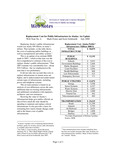
Replacing Alaska’s public infrastructure would cost nearly $59 billion, in today’s dollars. That includes, as the table shows, the costs of replacing public buildings as well as transportation and utility systems.1 This is an update of an estimate ISER made in 2007—which at that time was the first comprehensive estimate of the cost to replace Alaska’s public infrastructure.2 That 2007 estimate was considerably less—about $39.5 billion—but we emphasized at the time that it was preliminary. It did not take into account that costs to replace infrastructure in remote areas are higher, and it undercounted and undervalued certain types of infrastructure, including power and telephone systems. This revised estimate is based on an analysis of cost differences across the state, additional data on existing infrastructure, and additional consultation with engineers, architects, and cost estimators.
-
What Drives The Alaska Economy?
Oliver Scott Goldsmith
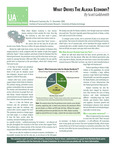
What drives Alaska’s economy is new money: money coming in from outside the state. How big the economy is, and how much it grows, depends on how much new money comes in. New money comes from “basic” sectors— the sectors that are the basis for all jobs and income across Alaska. They are, in effect, the gears driving the economy. Alaska has eight main basic sectors, but the number of Alaskans they employ directly is small, compared with the number of jobs they support indirectly. Figure 1 shows numbers and shares of jobs for Alaskans that the federal government, the petroleum sector, and the other basic sectors generated on average between 2004 and 2006. The numbers for any specific period aren’t as important as the percentages, which don’t change much from year to year.
-
How Vulnerable Is Alaska's Economy to Reduced Federal Spending?
Scott Goldsmith
About a third of all jobs in Alaska can be traced to federal spending here—and over the past decade the rapid increase in federal spending drove much of the economic growth. Federal spending in Alaska more than doubled between 1995 and 2005, and in 2006 it was $9.25 billion. But now federal spending here has stopped growing, and many Alaskans are worried that the economy is vulnerable to spending cuts as the federal budget tightens. This analysis estimates that Alaska could be vulnerable to federal spending cuts in the range of $450 million to $1.25 billion—which could cost the economy anywhere from about 7,000 to 20,000 jobs in the future. We estimate potential vulnerability as a range, because it’s impossible to predict with any precision how federal spending will actually change. The best we can do is estimate the likely magnitude of reductions, given federal budget problems.
-
Understanding Alaska's Remote Rural Economy
Scott Goldsmith
In the big, remote stretches of northern and western Alaska, many households keep themselves going with a mix of cash, subsistence, sharing, and other non-cash trading. That’s a world away from the state’s urban economy, and under standard measures like income, the remote rural economy lags far behind. Over the years there have been many efforts to improve the remote rural economy—but there’s a lot we don’t know about it. Standard economic measures don’t capture all the activity in an economy where subsistence, sharing, and non-cash trading play important parts. Some kinds of data don’t even exist. But to develop effective strategies, Alaskans need to understand the economic realities of the remote region. This paper is an overview of the remote economy, based on published data. It’s at best an approximation, because the data are so limited. Still, it’s a first step—and it highlights the many gaps in information. Stretching from the North Slope to the Alaska Peninsula, the remote region covers 395,000 square miles and is large enough to hold Japan, Germany, and Great Britain. Alaska Natives, the region’s aboriginal people, still make up most of the population—although thousands have moved to urban areas in recent times. The 60,500 residents live in five regional centers and about 150 small communities.
-
Viability of Business Enterprises for Rural Alaska: Community Factors and Entrepreneurial Strategies
Sharman Haley, Virginia Fay, Cami Woolam, Jane Angvik, and Linda Leask
-
Southeast Rural Outreach Programs and Education Business Survey
Virgene Hanna and Ann Marbourg
The Rural Outreach Programs and Education (ROPE) is designed to strengthen community and small business competitiveness. It is a multi-pronged business development effort to support economic stability and capacity-building in Southeast Alaska. The program will bring together different entities across the state in a collaborative effort, so the program recipients will have increased levels of technical assistance, training, and communication. One component in this process was to conduct a phone survey of businesses in Southeast Alaska. The survey was designed to determine the specific training and assistance needs of participating communities in Southeast Alaska. By focusing on 13 specific communities and gathering extensive information on each one, ROPE will offer targeted training and workshops, one-on-one confidential counseling, need-specific consultants and seminars, and business training. In May and June of 2008, 128 structured interviews were completed in the 13 communities. The majority of these interviews—88—were with businesses in the private sector, and the remaining 40 were with non-profit, tribal, or municipal organizations. Businesses were asked detailed questions about employees, customers, business expenses, and start-up costs and experiences. The questionnaire was designed to gather information about where employees were from, where customers were from, and the percentage of sales that were to local versus non-local customers. Both businesses and organizations were asked about training they felt would be beneficial and to offer advice to organizations trying to help businesses in Southeast.
-
Kids Count Alaska 2006/2007
Virgene Hanna, Irma Schreiner, Patricia DeRoche, and Claudia Lampman
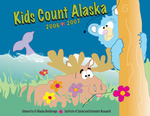
About This Year’s Book Every year the Kids Count Alaska data book reports on how the children of Alaska are doing. But we also like to tell readers a bit more about life in Alaska, to help them understand the place Alaska’s children call home. This year, we’re celebrating the wildlife that is so much a part of life in Alaska. Alaskans watch, hunt, photograph, and coexist with hundreds of large and small species of animals and birds. That coexistence is not always easy for either the wildlife or the people, but it is always interesting. An increasing number of tourists are also being drawn to Alaska for the opportunity to see wildlife that is either scarce or non-existent in other areas of the United States and the world. The whimsical wildlife illustrations on the cover and at the start of each indicator section are the work of Sebastian Amaya Garber, a talented young artist who grew up in Alaska but is now working toward a degree in industrial design at Western Washington University in Bellingham, Washington. The flip side of each illustration describes something about the specific animals and birds we’re profiling, which are: The sea otter, whose rich fur brought the Russians to Alaska • in the century before the United States bought Alaska The brown bear, one of the most respected and feared land • animals in North America The raven, which plays a big role in Alaska Native culture and • is one of the smartest, toughest birds anywhere The puffin, whose large, yellow-orange bill and orange feet • make it a stand-out in Alaska’s coastal waters The moose, which can weigh up to 1,500 pounds and is • often seen wandering neighborhoods and crossing streets in Alaska’s largest urban areas The humpback whale, whose dramatic breaches make it a • favorite of Alaskans and visitors along the southern coast of Alaska in the summertime Whahat is Kids Count Alaska? Kids Count Alaska is part of a nationwide program, sponsored by the Annie E. Casey Foundation, to collect and publicize information about children’s health, safety, and economic status. We pull together information from many sources and present it all in one place. We hope this book gives Alaskans a broad picture of how the state’s children are doing and provides parents, policymakers, and others interested in the welfare of children with information they need to improve life for children and families. Our goals are: Broadly distributing information about the status of Alaska’s • children Creating an informed public, motivated to help children• Comparing the status of children in Alaska with children • nationwide, and presenting additional Alaska indicators (including regional breakdowns) when possible Who Are Alaska’s Children? More than 206,000 children ages 18 or younger live in Alaska—just under a third of Alaska’s 2006 population of about 671,000. That’s an increase of about 15% in the number of children since 1990. During the past 15 years the age structure of Alaska children has also changed, with younger children making up a declining share and teenagers a growing share. In 1990, children ages 4 or younger made up 31% of all children; by 2006 that share had dropped to 26%. Among those 15 to 18, the 1990 share was about 16%, but it had risen to 22% by 2006. Boys outnumber girls in Alaska by close to 6%. There are more boys than girls in every age group. Even among infants, boys outnumbered girls by 8% in 2006. Alaska’s children have also grown more racially diverse in the past two decades, as illustrated by the figure showing Alaska’s school children by race. In 1988, 68% of school children were White and 32% were from minorities—primarily Alaska Natives.
-
Turnover Among Alaska Teachers: Is It Changing?
Alexandra Hill and Diane Hirshberg
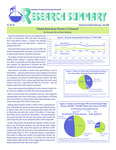
Turnover among Alaska’s teachers was roughly the same in 2007 as it had been in 1999, with about 14% leaving their school districts (Figure 1). Turnover also remained twice as high in rural as in urban districts—about 22%, compared with 10%. That lack of broad change comes after years of efforts by Alaska’s state government, universities, and school districts to reduce teacher turnover, especially in rural areas. The Institute of Social and Economic Research has been tracking Alaska’s progress in reducing teacher turnover since 2004, in partnership with the Alaska Teacher Placement program, the Department of Education and Early Development, and university teacher training programs.
-
It Was Bad or It Was Good: Alaska Natives in Past Boarding Schools
Diane Hirshberg
In 2004 and 2005 my colleagues and I gathered information on the boarding school and boarding home experiences of 60 Alaska Native adults who attended boarding schools or participated in the urban boarding home program from the late 1940s through the early 1980s. From the early 1900s to the 1970s Alaska Natives were taken from rural communities that lacked either primary or secondary schools and sent to boarding schools run by the federal Bureau of Indian Affairs (BIA), by private churches or, later, by Alaska's state government. Some were also sent to boarding homes to attend school in urban places. Their experiences reveal a glimpse of both the positive and negative effects of past boarding schools. Many spoke with ambivalence about their boarding school experience, finding both good and bad elements. This article presents some of the findings of this study.
-
The University of Alaska: How Is It Doing?
Theodore Kassier and Alexandra Hill
Recent reports on higher education in the U.S. say it’s in trouble— that it’s too expensive, doesn’t offer enough need-based aid, isn’t educating people for today’s jobs, doesn’t demand enough of instructors or students, and isn’t sufficiently accountable to policymakers and taxpayers.1 Is the University of Alaska (UA)—the state’s only public university —offering a good, affordable education for Alaskans? This paper looks at that question. It first presents the available data on various measures and then summarizes successes and continuing challenges for UA. It ends with a discussion of how UA and the state are addressing higher-education issues and what other steps they might consider.
-
The University of Alaska: How Is It Doing?
Theodore Kassier and Alexandra Hill
Recent reports on higher education in the U.S. say it’s in trouble— that it’s too expensive, doesn’t offer enough need-based aid, isn’t educating people for today’s jobs, doesn’t demand enough of instructors or students, and isn’t sufficiently accountable to policymakers and taxpayers.1 Is the University of Alaska (UA)—the state’s only public university —offering a good, affordable education for Alaskans? This paper looks at that question. It first presents the available data on various measures and then summarizes successes and continuing challenges for UA. It ends with a discussion of how UA and the state are addressing higher-education issues and what other steps they might consider. UA has made substantial progress on a number of goals in the past decade. For example, it’s attracting a growing share of Alaska’s college-bound freshmen, and it’s educating many more students for jobs in high-demand areas like health care and technology. The school’s overall retention and graduation rates are improving. But UA also faces many of the same issues as other public universities— like sharp increases in tuition and significant numbers of students who come out of high school unable to read, write, or do math at college-level.
-
The Value of Evidence-Based Computer Simulation of Oral Health Outcomes for Management Analysis of the Alaska Dental Health Aide Program
Daniel P. Kiley, Sharman Haley, Ben Saylor, and Brian L. Saylor
Objectives: To create an evidence‐based research tool to inform and guide policy and program managers as they develop and deploy new service delivery models for oral disease prevention and intervention. Methods: A village‐level discrete event simulation was developed to project outcomes associated with different service delivery patterns. Evidence‐ based outcomes were associated with dental health aide activities, and projected indicators (DMFT, F+ST, T‐health, SiC, CPI, ECC) were proxy for oral health outcomes. Model runs representing the planned program implementation, a more intensive staffing scenario, and a more robust prevention scenario, generated 20‐year projections of clinical indicators; graphs and tallies were analyzed for trends and differences. Results: Outcomes associated with alternative patterns of service delivery indicate there is potential for substantial improvement in clinical outcomes with modest program changes. Not all segments of the population derive equal benefit when program variables are altered. Children benefit more from increased prevention, while adults benefit more from intensive staffing. Conclusions: Evidence‐ based simulation is a useful tool to analyze the impact of changing program variables on program outcome measures. This simulation informs dental managers of the clinical outcomes associated with policy and service delivery variables. Simulation tools can assist public health managers in analyzing and understanding the relationship between their policy decisions and long‐term clinical outcomes.
-
2008 Alaska's Construction Spending Forecast
Mary Killorin and Scott Goldsmith
Total construction spending “on the street” in Alaska in 2008 will be $7.01 billion, down 2% from last year. Excluding the oil and gas sector—which accounts for 41% of the total—construction spending will be down for the second year in a row, falling 6% to $4.12 billion. Last year it declined 3%. Lower construction spending, combined with higher material and labor costs, will result in a modest reduction in the level of construction employment in 2008. Although this will be the second year of decline in construction employment, it remains well above the long-term trend. Construction costs continue to rise faster than the general rate of inflation—and that trend is expected to continue, further reducing the purchasing power of each construction dollar. Private-sector construction spending is projected to be $4.64 billion in 2008, an increase of 2% over 2007. Strong growth is expected in oil and gas, mining, utilities, and the other basic sectors.
-
Fuel Costs, Migration, and Community Viability
Stephanie Martin, Mary Killorin, and Steve Colt
ISER researchers compiled and reviewed existing studies and data sources relating to the economic and social viability of remote rural Alaska communities. We particularly looked for possible linkages between high fuel costs and migration. Our review indicates the following: (1) migration from smaller places toward larger places is an ongoing phenomenon that is more noticeable when birth rates drop; (2) there is no systematic empirical evidence that fuel prices, by themselves, have been a definitive cause of migration; (3) the pursuit of economic and educational opportunities appears to be a predominant cause of migration; (4) however, currently available survey data are not sufficient to definitively determine other reasons for migration, which could include concerns about public safety and/or alcohol abuse; 5) most of the survey data pre-date the latest rapid increase (2006-2008) in fuel prices. We suggest several ways that better data could be collected on community viability and the reasons for migration.
-

Alaska Election Security Report, Phase 2, Executive Summary
Stephanie Martin, LuAnn Picard, Mark Ayers, David B. Hoffman, and Kenrick Mock
A laska’s election system is among the most secure in the country, and it has a number of safeguards other states are now adopting. But the technology Alaska uses to record and count votes could be improved— and the state’s huge size, limited road system, and scattered communities also create special challenges for insuring the integrity of the vote. In this second phase of an ongoing study of Alaska’s election security, we recommend ways of strengthening the system—not only the technology but also the election procedures. The lieutenant governor and the Division of Elections asked the University of Alaska Anchorage to do this evaluation, which began in September 2007.
Printing is not supported at the primary Gallery Thumbnail page. Please first navigate to a specific Image before printing.